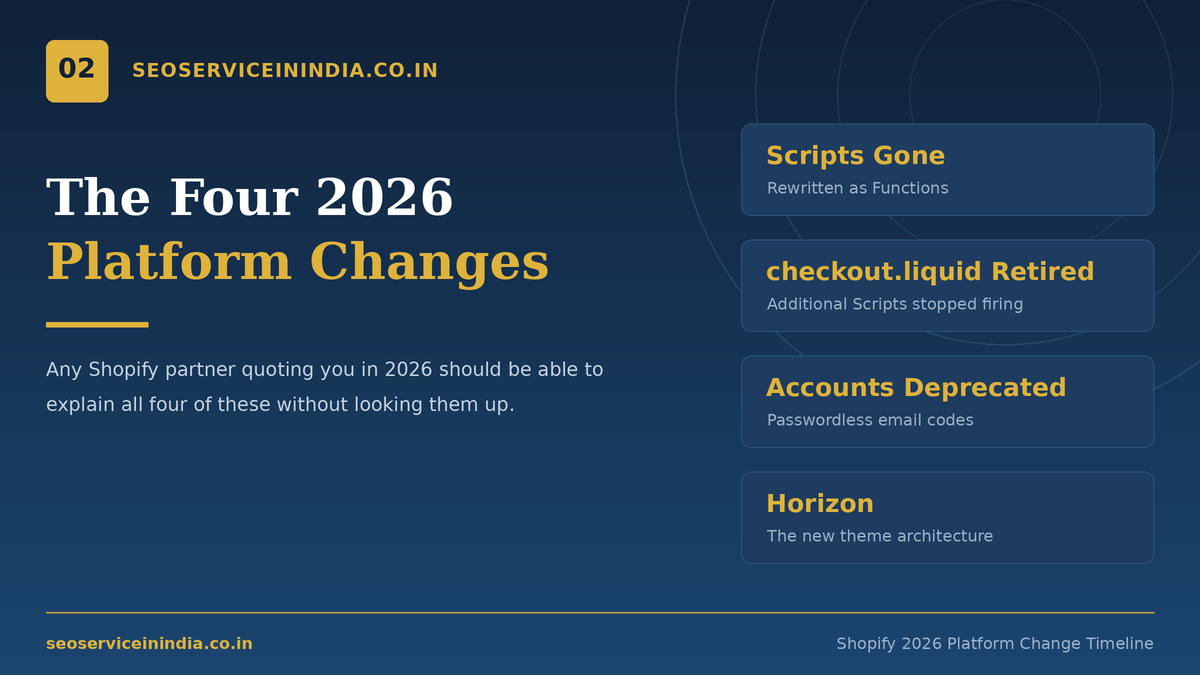
Shopify Scripts are gone. Scripts stopped running at the end of June 2026 and the replacement is Shopify Functions. If your store ran custom discount, shipping or payment-method logic through Scripts, that logic had to be rewritten — not reconfigured.
Shopify · Design & Development
Shopify Ecommerce Website Designing Services Company in India
Most Shopify stores are not lost at the design stage. They are lost eighteen months later, when a theme that was never built to be extended collides with a platform that has moved on — a checkout page that can no longer run the pixel it depends on, a discount engine that stopped working, a login flow that Shopify stopped supporting, and a page speed score that has been sliding since the eleventh app was installed.
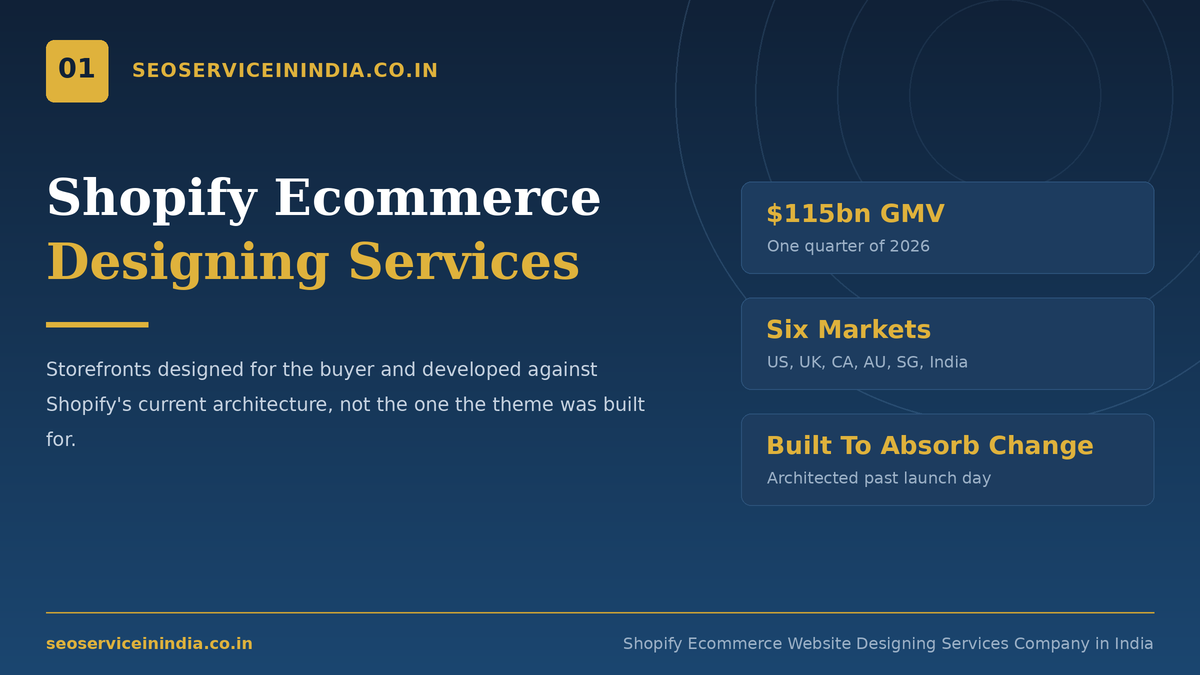
SEOServiceinIndia is a Shopify ecommerce website designing services company in India building storefronts for merchants in the USA, UK, Canada, Australia, Singapore and India. We design for the buyer, develop against Shopify's current architecture rather than the one that was current when the theme was purchased, and hand over a store the client's own team can actually operate.
Platform Reality
01
02
03
04
Why Shopify, and why the build quality matters more than it used to
Shopify has stopped being the "small store" platform. Merchants on the platform moved more than $115 billion of gross merchandise volume in a single quarter of 2026, and Shopify now accounts for a double-digit share of all US ecommerce — which means the competitive set for any given product page is no longer a handful of local shops, it is every well-funded brand on the same infrastructure.
That levels the technical playing field and moves the advantage somewhere else entirely: to merchandising, to page experience, to the quality of the product data, and to whether the store is architected to absorb change. Two merchants on the same plan, the same theme family and the same payment gateway can be a year apart in performance purely because one of them was built by someone who thought past launch day.
The four platform changes Shopify pushed through in 2026
Any Shopify designing and development partner quoting you in 2026 should be able to explain these without looking them up:
checkout.liquid is fully retired. From 26 August 2026 the legacy Thank You and Order Status pages went away for non-Plus stores. Anything that lived in the Additional Scripts box — analytics snippets, affiliate tags, conversion pixels, upsell app injections — stopped firing on those pages. Plenty of merchants are currently under-reporting revenue in their ad platforms and do not know it. The replacement is Checkout Extensibility, using apps, UI extensions and Web Pixels.
Legacy customer accounts are deprecated. Since February 2026 the old email-and-password, Liquid-templated account area is no longer available to new stores and no longer receives updates. The new system uses passwordless email codes, which changes the actual customer-facing login experience — not just the code behind it. Any customised "My Account" section built on the old templates needs rebuilding.
Horizon is the new theme architecture. Horizon is Shopify's block-based theme system, with nested blocks and AI-assisted section generation that let a merchandiser restructure a page from the editor instead of raising a developer ticket. It is not a deadline. But it is the direction the platform is investing in, so for any new build or full redesign it is the sensible default.
We treat these four items as a standing audit, not a sales pitch. If your store is already clean on all four, we will tell you that and scope only the work that actually moves revenue.
Build Path
01
02
03
Theme, custom or headless — choosing the right Shopify build path
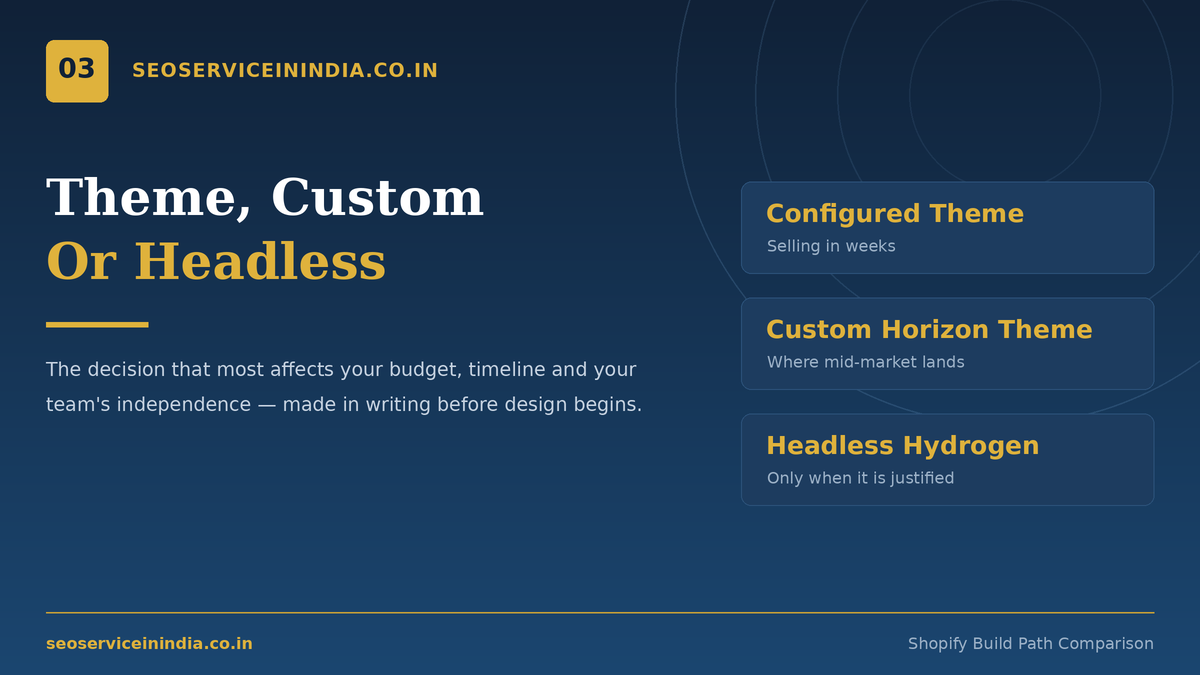
This is the single decision that most affects your budget, your timeline and your team's independence afterwards. We make it with you before design begins, in writing.
Configured theme build
A commercial or Shopify-authored theme, configured properly, with the brand applied through the theme editor, metafields and metaobjects rather than hard-coded edits. Fastest to launch, cheapest to maintain, easiest for your team to run, and it keeps you eligible for theme updates. Right for merchants with a straightforward catalogue who need to be selling in weeks, not quarters.
Custom Shopify theme build on Horizon
Your design, built as a real Horizon theme with custom sections and blocks, purpose-built for how your products are actually chosen — configurators, size and fit logic, bundle builders, subscription selectors, B2B price lists, complex variant structures. You own the look, and your merchandising team still gets editor-level control. This is where most mid-market brands land.
Headless with Hydrogen and Oxygen
A React storefront on Shopify's Hydrogen framework, deployed to Oxygen, with Shopify still handling cart, checkout, payments and orders. Right when you need content and commerce fused, extreme page-experience control, multi-brand or multi-region front ends, or unusual UX that Liquid genuinely constrains. It is also the most demanding option: headless storefronts carry a real upgrade obligation, and framework releases must be kept current rather than pinned and forgotten. We will talk you out of headless if your requirement does not justify it, because an abandoned headless build is the most expensive outcome in ecommerce.
Service Stack
01
02
03
04
05
06
What our Shopify website designing services include
Discovery, catalogue modelling and information architecture
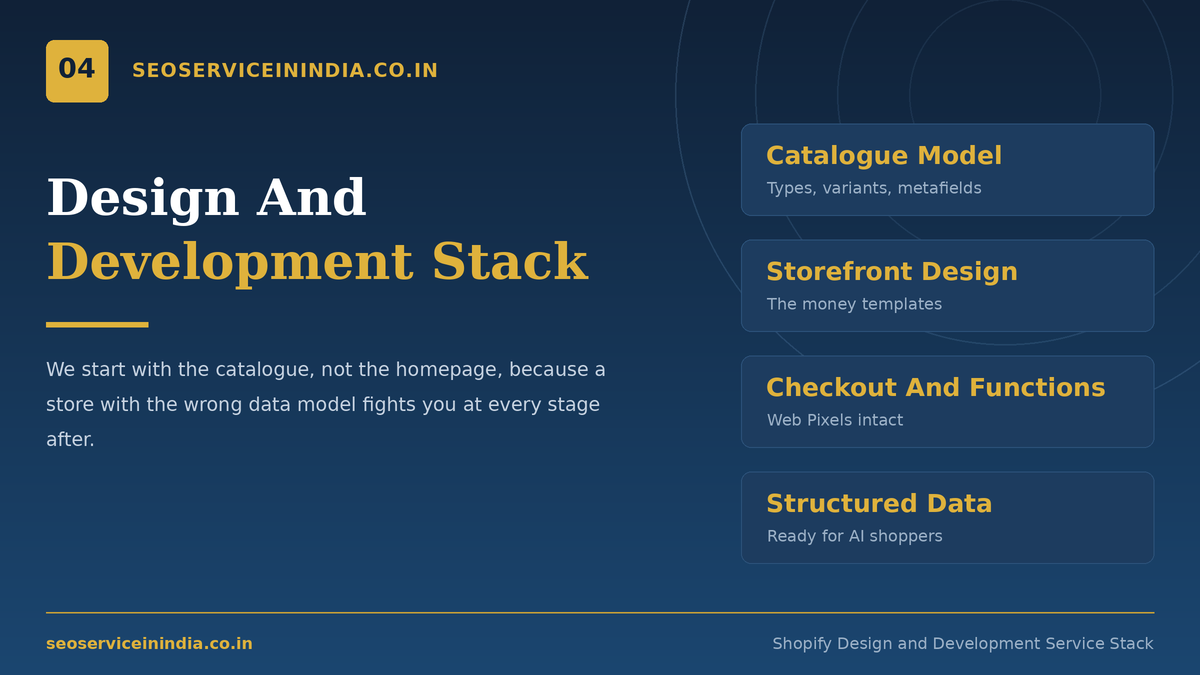
We start with the catalogue, not the homepage. Product types, option sets, variant counts, collection logic, filtering requirements, taxonomy and metafield structure. A store whose data model is wrong will fight you at every stage afterwards — in navigation, in filtering, in search, in feeds, in reporting. Getting this right first is unglamorous and it is the highest-leverage work on the project.
Conversion-led storefront design
Wireframes then high-fidelity design for the pages that carry the money: home, collection, product, cart, account and the content templates. Decisions we argue for in design review include variant selection patterns, gallery behaviour on mobile, the position and honesty of shipping and duty messaging, review placement, bundle and cross-sell logic, and how much of the product page is above the fold on a mid-range Android device rather than a designer's monitor.
Liquid and Horizon development
Semantic, accessible, well-commented front-end code. Sections and blocks that your team can rearrange without breaking layout. Metaobjects for structured content instead of hard-coded HTML. No abandoned page builders, no orphaned CSS, no snippets nobody can identify in twelve months.
Apps, integrations and the boring plumbing
App selection is a performance decision as much as a functional one. We audit every app for script weight and overlap, prefer native or app-embed approaches, and remove leftovers properly rather than just disabling them. Integrations typically cover ERP or inventory, accounting, shipping and 3PL, subscriptions, reviews, email and SMS, search and merchandising, and CRM or customer data platform.
Checkout, Functions and post-purchase
Checkout Extensibility work where your plan allows it: UI extensions for delivery instructions, gift messaging, age or licence checks and B2B fields; Shopify Functions for discount, shipping and payment logic; Web Pixels so your conversion tracking is intact on the current order status page instead of quietly broken.
Search, structured data and AI-surface readiness
Clean crawlable URL structure, collection pages that deserve to rank, canonical handling for filtered views, complete Product and Offer structured data with price, availability, GTIN and review markup, and product data tidy enough to hold up when an AI shopping agent — not a human — is comparing your item against three alternatives.
Migration & Replatforming
Shopify migration and replatforming
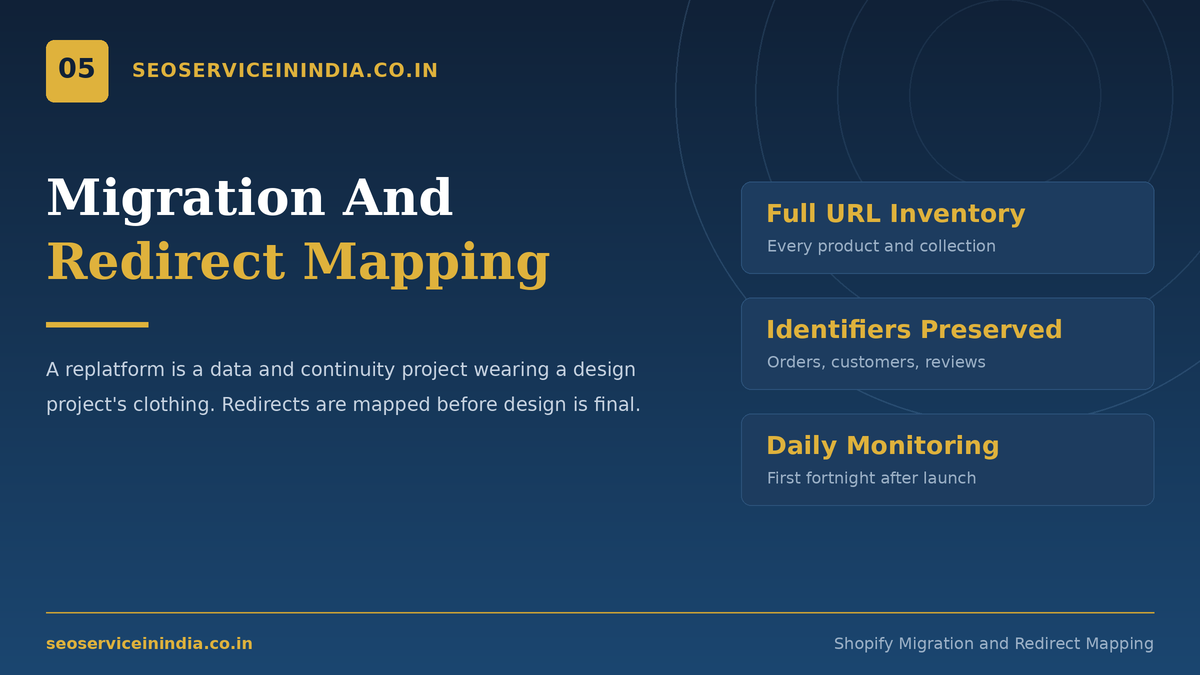
Moving from WooCommerce, Magento, BigCommerce, Wix, OpenCart or a bespoke stack is a data and continuity project wearing a design project's clothing. Our migration scope covers:
- Full URL inventory and a mapped 301 redirect plan for every product, collection, CMS page and blog post, including the patterns your old platform generated automatically
- Products, variants, images, customers, order history, discount codes and reviews migrated with identifiers preserved wherever the source allows
- Recreating the parts of the old store that were doing genuine SEO work, instead of quietly dropping them in the redesign
- Staging on a password-protected store, full QA, and a launch checklist covering DNS, payments in live mode, tax and duty settings, email deliverability and analytics
- Rank and revenue monitored daily for the first fortnight after launch, with a documented rollback position
The most common way a Shopify migration destroys traffic is not a technical failure. It is a redesign that silently removed three hundred indexable pages because nobody mapped them first.
Packages
Starter
Growth
Enterprise / Shopify Plus
Shopify design and development packages
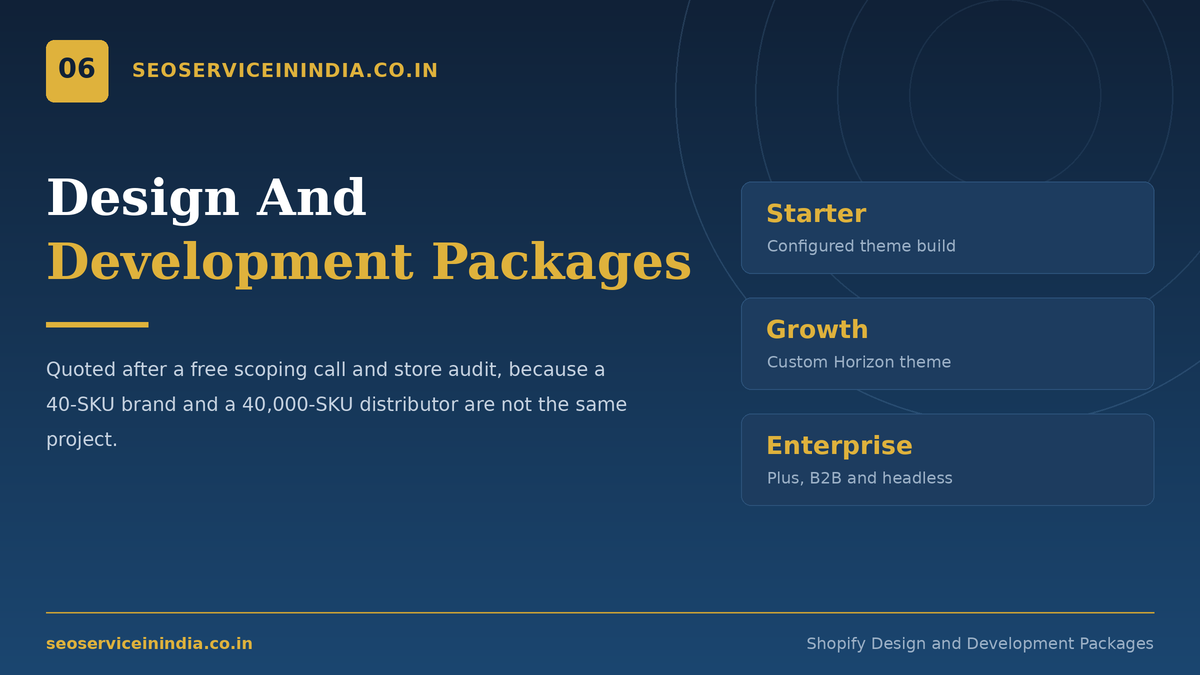
We quote after a free scoping call and store audit, never from a price list, because a 40-SKU brand and a 40,000-SKU distributor are not the same project. Every tier includes design files you own, code documentation, a training handover and a defect-fix window after launch.
Starter — a configured theme build for merchants launching or relaunching quickly. Brand applied, core templates set up, up to a defined catalogue size, essential apps installed, payments and shipping configured, analytics and conversion tracking verified, basic on-page SEO and structured data, launch QA.
Growth — a custom Horizon theme built to your design. Custom sections and blocks, metaobject-driven content, advanced collection filtering and merchandising, Checkout Extensibility work within plan limits, Core Web Vitals engineering, full structured data, integration work, migration if you are replatforming.
Enterprise / Shopify Plus — multi-store or multi-market builds, B2B and wholesale on Shopify's native B2B features, Shopify Functions development, checkout UI extensions, headless Hydrogen storefronts on Oxygen, ERP and PIM integration, custom app development where a public app cannot do the job, and a managed release cadence so platform deprecations are handled before they become emergencies.

Global Delivery
Built in India, delivered for six markets
Being an India-based Shopify development company is a delivery advantage, not a discount pitch. Our build hours overlap your evening, so work lands overnight and you review it in the morning. It also means we have to be deliberate about market difference rather than assuming it away.
USA — sales tax nexus handling, ZIP-level shipping logic, Shop Pay and express wallet placement, and returns expectations that are far higher than most first-time merchants budget for.
UK — VAT-inclusive display, post-Brexit EU shipping and duty messaging, Klarna and Clearpay placement, and accessibility expectations that are increasingly a procurement question, not a nice-to-have.
Canada — bilingual English and French storefronts via Shopify Markets, province-level tax, and cross-border duty clarity for US-based fulfilment.
Australia — GST configuration, Afterpay and Zip prominence, realistic metro-versus-regional delivery promises, and a mobile-first bias that is more pronounced than in North America.
Singapore — GST, multi-currency for regional buyers, PayNow and regional wallets, and design restraint that reads as premium rather than promotional.
India — Razorpay and UPI, COD workflow and its verification layer, pin-code serviceability checks, GST-compliant invoicing, and performance engineering for genuinely variable mobile networks.
Build Process
01
02
03
04
05
06
How the build runs
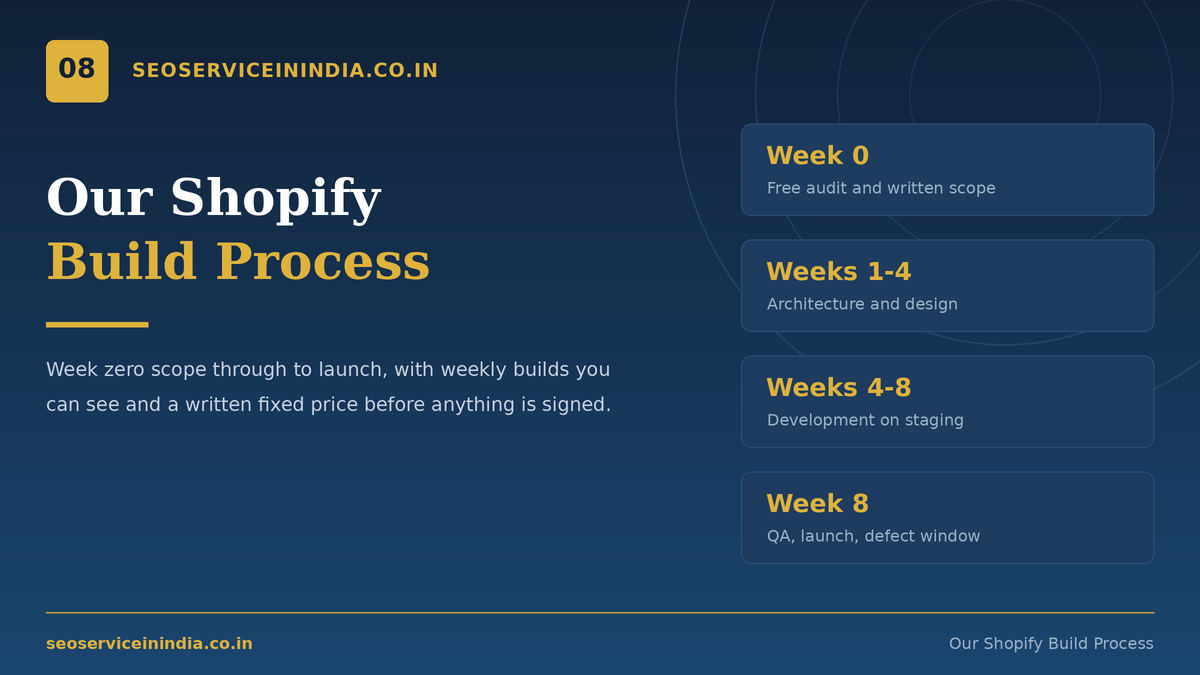
Week 0 — scope. Free audit of your existing store or requirement. You get a written scope, build-path recommendation with reasons, timeline and fixed price before anything is signed.
Weeks 1–2 — architecture. Catalogue and data model, sitemap, template inventory, integration list, redirect plan if migrating.
Weeks 2–4 — design. Wireframes, then visual design for all money templates, reviewed in two structured rounds rather than an open-ended comment thread.
Weeks 4–8 — development. Theme or headless build on a staging store, integrations, checkout work, structured data, speed engineering. You see weekly builds.
Week 8 — QA and launch. Cross-device and cross-browser testing, accessibility pass, test transactions in live mode, redirect verification, tracking verification, then go live on an agreed window.
Post-launch. Defect window, analytics review at 30 days, and an optional care plan covering platform deprecations, theme updates, CRO iterations and performance monitoring.
Timelines scale with catalogue size and integration count — a Starter build can ship inside three weeks, an Enterprise migration can run a quarter.
Why merchants choose us
We are a working ecommerce team, not a template reseller. The same people who build these stores also run SEO and paid media on them afterwards, which changes how we build: we know what a badly structured collection page costs in organic traffic, and what a broken order-status pixel costs in ad attribution, because we are the ones who have to report it.
We publish our reasoning. Every recommendation on this page — theme over headless, Horizon over a legacy architecture, native over app — comes with a stated reason and a stated trade-off. We will document when we think you are overspending.
You own everything. Design files, code repository, admin access, documentation. No proprietary page builder that holds your storefront hostage, no lock-in retainer disguised as a maintenance requirement.
Who this isn't for
If you want a store live in four days for the lowest possible number, a good theme and Shopify's own setup flow will serve you better than we will. If you need custom checkout behaviour on a non-Plus plan, we will tell you what is genuinely impossible rather than sell you around it. If you are looking for guaranteed revenue figures before a single line of code exists, no honest build partner can give you that. And if your real problem is product-market fit, a redesign will not fix it — we would rather say so on the call than three months into a project.
It depends on catalogue size, template count, integrations and whether you are migrating. A configured theme build sits at the low end, a custom Horizon build in the middle, and headless or Shopify Plus work at the top. We quote a fixed price after a free scoping call so you are comparing a real number against a real scope.
A well-chosen paid theme is the right answer more often than agencies admit. Go custom when your products need a selection experience a theme cannot express, when your merchandising team needs section-level control a theme does not give, or when your brand is the differentiator in a crowded category.
Horizon is Shopify's current block-based theme architecture, with nested blocks and AI-assisted section generation. There is no forced deadline. If your existing theme converts well, there is no urgency — but for a new build or a full redesign it is the sensible default.
Very likely. Legacy Thank You and Order Status pages were retired for non-Plus stores in August 2026, so anything pasted into the Additional Scripts box no longer fires. It is fixable by rebuilding that tracking on Checkout Extensibility with Web Pixels, and it should be treated as urgent because your ad platforms are currently optimising on incomplete data.
Yes, when redirects are mapped before the design is finalised rather than after. We inventory every existing URL, map 301s product by product, preserve identifiers where the source platform allows it, and monitor rankings daily for the first two weeks post-launch.
Yes. Plus work includes checkout UI extensions, Shopify Functions, multi-store and multi-market setups, and native B2B catalogues with company accounts and price lists.
That is the design goal. Content lives in metaobjects and editor-controlled sections, so page layout, banners, collection merchandising and content blocks are yours to change. Code changes still come to us.
Speed is engineered during the build, not bolted on. App script auditing, image and video strategy, font loading, third-party deferral, lazy loading below the fold, and Core Web Vitals measured on real mid-range mobile hardware rather than a desktop lab score.
No. Most of our Shopify work is for merchants in the USA, UK, Canada, Australia and Singapore, delivered from India with overnight turnaround and scheduled review calls in your timezone.
Free Shopify Build Scope
Start with a free Shopify build scope
Send us your current store URL or your requirement. You will get a written build-path recommendation, a platform-health check against Shopify's 2026 architecture changes, a realistic timeline and a fixed quote — before you commit to anything.