Strategy and information architecture. Who the site is for, what they need to do on it, what the primary conversion is, and how the URLs and menus are organised so both people and crawlers can find everything.
Website Design & Development
Website Designing & Development Packages
A website is not a design project with a launch date. It is the one asset that has to keep working every day after the designer logs off — loading fast on a four-year-old Android phone, holding its layout while a lead form loads, being readable to a screen reader, and being legible to Google and to the AI answer engines that now sit above the search results. Our website designing and development packages are built around that longer job. You get a fixed scope, a named team, a defined technology stack, a performance target written into the contract, and the complete source code in your hands at the end of it. Whether you are a single-location service business in Texas, a wholesale brand in Singapore or an agency in London reselling development under your own name, the package structure below is where the conversation starts.
Complete Scope
01
02
03
04
05
06
What a website design and development package should actually cover
Most quotes you receive will describe a number of pages and a delivery date. That tells you almost nothing about what you are buying. A complete website development package has six layers, and a missing layer always shows up later as an unplanned invoice.
Design. Wireframes first, then a visual design system — type scale, colour tokens, button and form states, spacing rules — so page thirty looks like page one and future pages can be added without a redesign.
Development. The build itself, on a stack chosen for your content volume, integrations and in-house skills, with a staging environment, version control and a clean, documented codebase.
Performance and accessibility. A page-weight and script budget enforced during the build, not audited after launch, plus keyboard operability, colour contrast and semantic markup.
Search and content readiness. Crawlable structure, indexable content, schema markup, internal linking, metadata fields the client can actually edit, and optimised content in place before launch.
Handover and aftercare. Training, documentation, credentials, source code ownership and a maintenance plan that covers updates, backups and security patching.
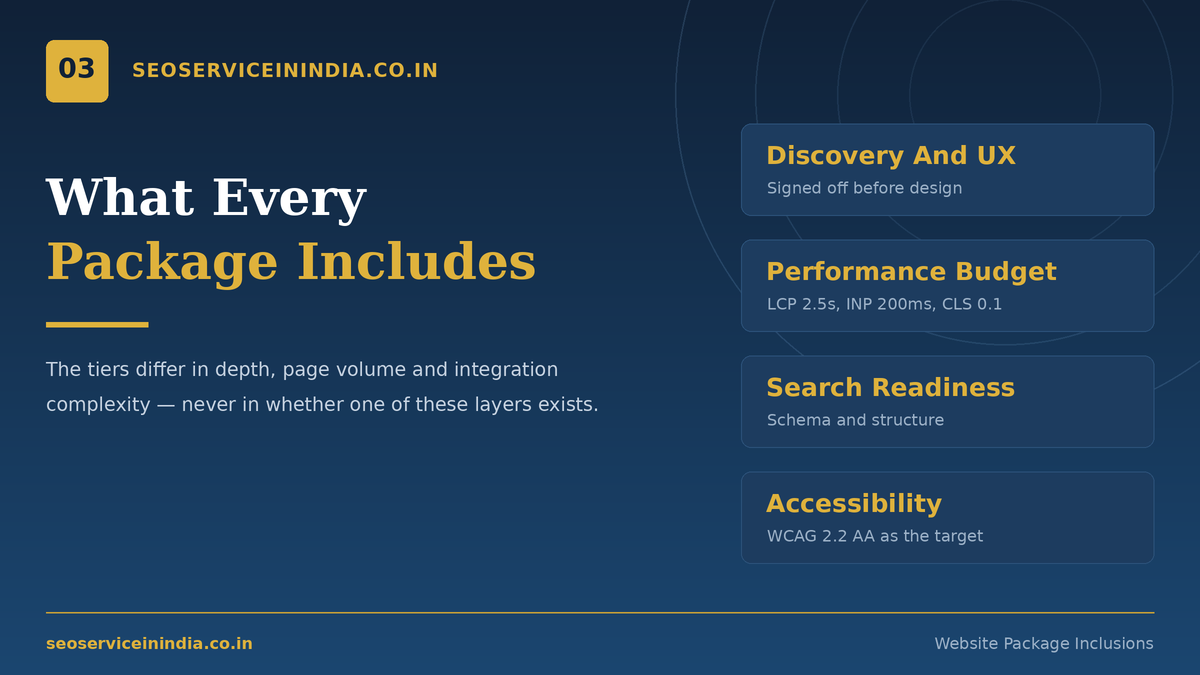
Every package we sell contains all six. The tiers differ in depth, page volume and integration complexity — never in whether a layer exists.
Why most website packages disappoint within eighteen months
We audit rebuilt-too-soon websites every month, and the failure patterns repeat.
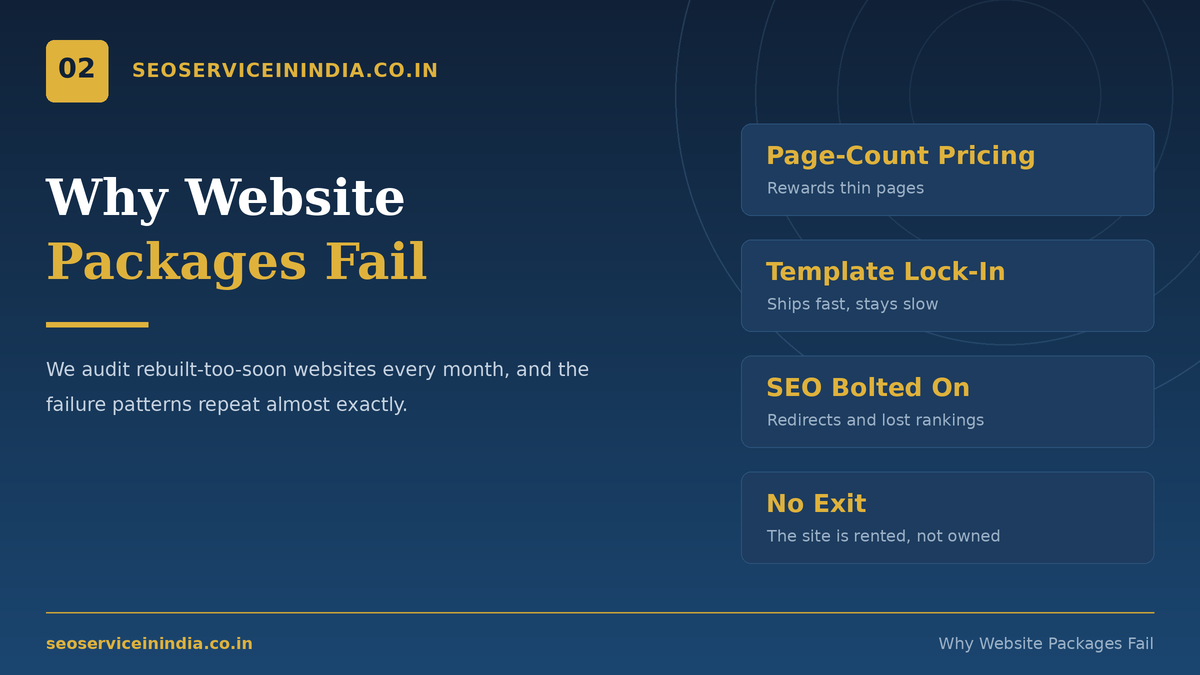
Pricing by page count. A five-page "package" priced per page rewards thin pages and punishes the structural work that decides whether the site can rank at all. The real cost drivers are design originality, integrations and content operations, not how many pages exist.
Template lock-in. A heavy multipurpose theme with four page builders stacked on it ships fast and then cannot be made fast. That is why performance stays stuck across the web: only around 48% of mobile origins passed all three Core Web Vitals in 2025, with LCP the weakest metric at 62%. The business cost is measurable — roughly every 100ms of load time costs about 1% in conversions. CO ConsultingDigital Applied Team
SEO bolted on afterwards. Retrofitting a crawlable structure onto a site built as a slideshow means redirect maps, rewritten templates and lost rankings. Building it correctly the first time costs a fraction of fixing it.
No exit. Proprietary builders, undocumented code and hosting held in the developer's account mean your website is rented, not owned. We hand over everything, in writing, at the end of every project.
Package Tiers
Our website designing and development packages
Three tiers, each priced after a free scope call — never from a template price list, because two sites with the same page count can differ tenfold in build effort.
Starter — for new and small businesses establishing a credible presence
Up to 8 pages. Custom-designed home page with a reusable inner-page template, mobile-first responsive build on WordPress or a comparable CMS, contact and enquiry forms with spam protection, Google Business Profile and Analytics/Search Console setup, on-page SEO for one primary keyword set per page, SSL, basic schema, speed tuning against Core Web Vitals thresholds, and one month of post-launch support. Suited to local service businesses, consultants, clinics and early-stage startups.
Growth — for businesses where the website is the main sales channel
Up to 30 pages plus blog and landing-page templates, full design system, ecommerce or booking functionality, CRM and payment gateway integration, multi-language or multi-location structure where needed, content strategy for a keyword cluster rather than a page list, advanced schema, conversion tracking and event measurement, accessibility remediation to WCAG 2.2 AA, and three months of support with monthly performance reporting. This is the tier most of our USA, UK and Australian clients choose.
Enterprise — for large catalogues, portals and custom applications
Unlimited scope defined by workshop, custom or headless architecture (Laravel, Next.js, Magento, Shopify Plus), ERP/PIM/third-party API integrations, role-based dashboards and customer portals, staging and QA pipelines, load testing, security hardening and penetration-test remediation, international SEO architecture with hreflang, accessibility audit and legal compliance documentation, SLA-backed maintenance and a dedicated project manager. Built for manufacturers, marketplaces, SaaS products, healthcare groups and multi-country brands.
White-label engagement is available on all three tiers for agencies who need a delivery team under NDA.
What every package includes
Discovery and UX. Stakeholder call, competitor teardown, keyword and intent mapping, sitemap and wireframes signed off before a single pixel of visual design is produced.
Responsive design and a reusable design system. Designed at mobile, tablet and desktop breakpoints, with components documented so your team can build new pages later without breaking the look.
The right stack, chosen honestly. We recommend the platform that matches your content volume, integration needs and internal skills — and we will tell you when a well-configured CMS gets you ninety percent of the way at a fraction of the price of custom code.
A performance budget. Google's 2026 thresholds are LCP under 2.5 seconds, INP under 200 milliseconds and CLS at or below 0.1, measured at the 75th percentile of real users. We treat those as build constraints: image formats and dimensions, font loading, script splitting, caching and CDN configured before handover, then verified on field data rather than a lab score. The commercial case is well documented — a 0.1-second load-time improvement lifted retail conversions by 8.4% in a Deloitte and Google study. SpotDevShno
Search and AI-answer readiness. Clean URL patterns, one H1 per page, logical heading hierarchy, editable metadata, internal linking, XML sitemap, robots directives, Organization/LocalBusiness/Service/FAQ/Product schema as applicable, and content structured so answer engines can quote it.
Accessibility and compliance. Keyboard navigation, contrast ratios, focus states, form labels, alt text and semantic landmarks. WCAG 2.2 AA is the current recommendation and the target we build to, which matters commercially as well as ethically: the European Accessibility Act has applied accessibility requirements to private-sector e-commerce, banking, transport and digital services in the EU since June 2025. SpotDevAbmatic AI
Security, backups and handover. SSL, hardened admin access, automated backups, update policy, plus documentation, credentials and full source code ownership transferred to you.
Platforms & Builds
Platforms and technologies we build on
There is no single best platform — only the best fit for your catalogue, team and roadmap.
WordPress and WooCommerce for content-led and lead-generation sites that marketing teams need to edit daily. Shopify and Shopify Plus for merchants who want hosted reliability and a fast path to multi-currency selling. Magento and Adobe Commerce for large catalogues with complex pricing, B2B tiers and ERP integration. Webflow, Wix and Squarespace where a visual editor and low maintenance overhead matter more than deep customisation. Custom PHP and Laravel for business logic, portals and applications no plugin covers. React and Next.js, including headless front ends where interface speed and app-like behaviour decide the user experience.
Platform choice has real performance consequences, and we use field data rather than preference when advising. Our per-platform package pages go into cost, timelines and limitations in detail, including our dedicated Magento ecommerce designing and development packages for merchants already committed to that stack.
Types of websites we design and develop
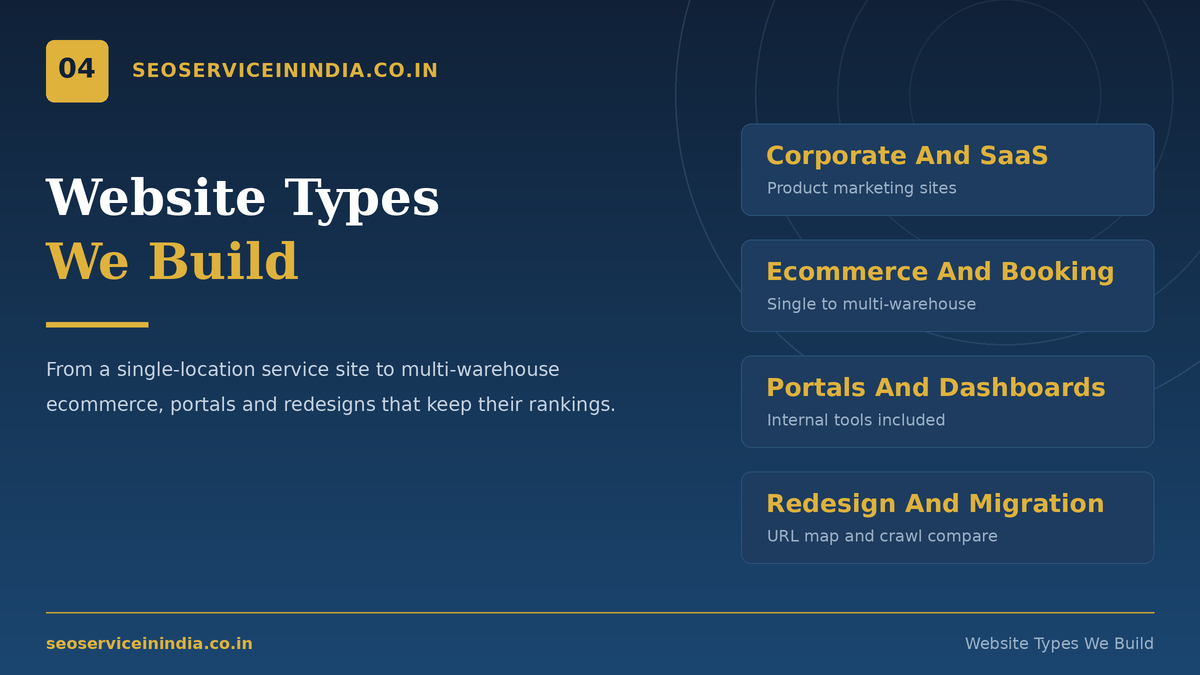
Corporate and business websites. Ecommerce stores, from single-catalogue to multi-warehouse. Lead-generation and landing-page systems for paid campaigns. SaaS and product marketing sites. Appointment and booking platforms for clinics, salons and service providers. Multi-location and franchise sites with location-page architecture. Customer portals, dashboards and internal tools. Portfolio, education and non-profit sites. Website redesign and migration projects where the objective is to modernise without losing existing rankings — handled with a full URL map, redirect plan and pre-launch crawl comparison.
Our Process01 02 03 04 05 06 07
How we work: the seven-step process
1. Free scope call and audit. We review your existing site, competitors and objectives, and tell you which tier fits — including when the honest answer is a smaller project than you asked for.
2. Proposal with a fixed scope. Deliverables, pages, integrations, timeline, milestone payments and exclusions in writing. No hourly surprises.
3. Discovery and architecture. Keyword and intent mapping, sitemap, wireframes, content plan. Signed off before design begins.
4. Design. Home page and key templates first, two revision rounds at each stage, then the full design system.
5. Development. Built on staging with weekly demo links, version control and a QA checklist covering cross-browser, device, form, speed and accessibility testing.
6. Content, SEO and pre-launch QA. Optimised copy, metadata, schema, redirects, analytics and conversion tracking installed and verified. Nothing launches on a placeholder.
7. Launch, training and aftercare. Deployment in a low-traffic window, a recorded walkthrough for your team, documentation, code handover and a support or maintenance plan.
Markets we serve
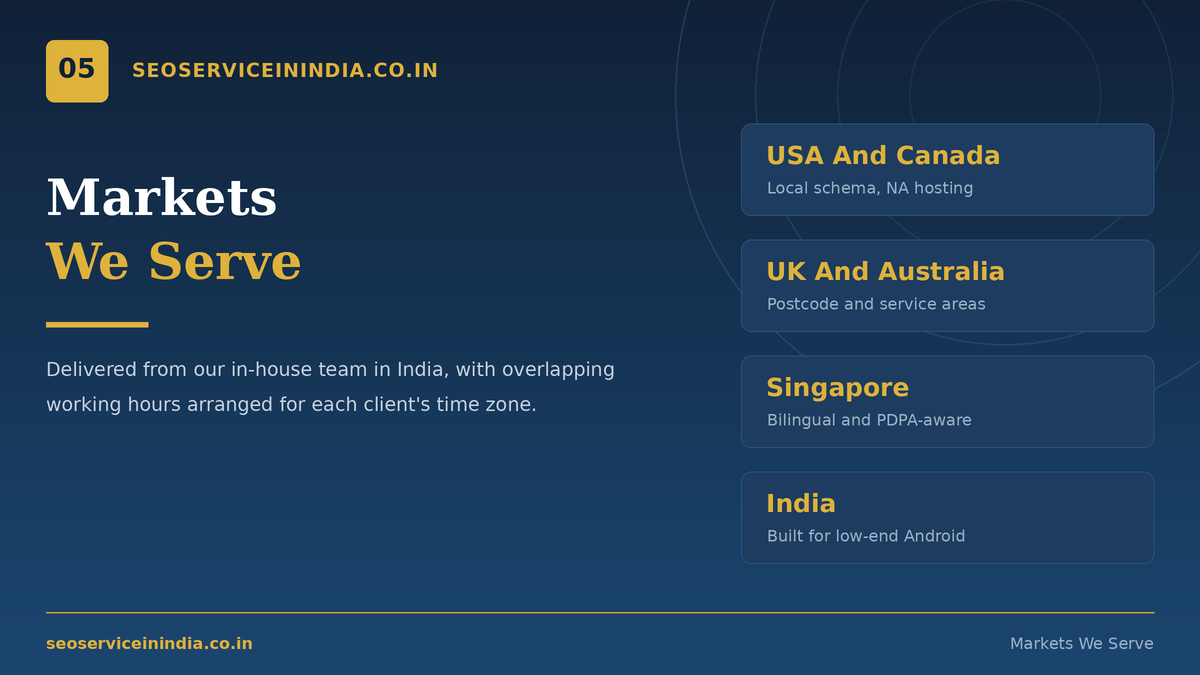
United States and Canada. Conversion-focused builds for service businesses and D2C brands, with local schema, multi-location structure and North American hosting for latency.
United Kingdom. Postcode-level local architecture, GDPR-compliant forms and consent handling, and accessibility standards expected by public-sector and enterprise buyers.
Australia. Service-area page structures for trade, health and home-service businesses, with region-aware hosting and AUD payment configuration.
Singapore. Bilingual and multi-market structures, PDPA-aware data handling, and premium design standards for a small, high-value and competitive market.
India. Fast builds for mid-market manufacturers, education providers, healthcare groups and D2C brands, engineered for lower-end Android devices and variable network conditions — where a heavy theme quietly costs you most of your traffic.
Every project is delivered from our in-house team in India, which is what makes an enterprise-grade process affordable at mid-market prices, with overlapping working hours arranged for each client's time zone.
Why Choose Us
Why businesses choose SEOServiceinIndia
Experience. We have designed, developed and optimised sites across ecommerce, healthcare, legal, education, logistics, manufacturing, real estate and SaaS — and we have inherited enough broken builds to know exactly which shortcuts cause them.
Expertise. Designers, front-end and back-end developers, SEO strategists, content writers and QA testers work on the same project from day one, which is why our sites do not need an SEO rescue three months after launch.
Authoritativeness. We are a full-service search and performance marketing team first and a build shop second. A site we deliver is designed to be marketed: the architecture, content and measurement are already in place for organic and paid campaigns.
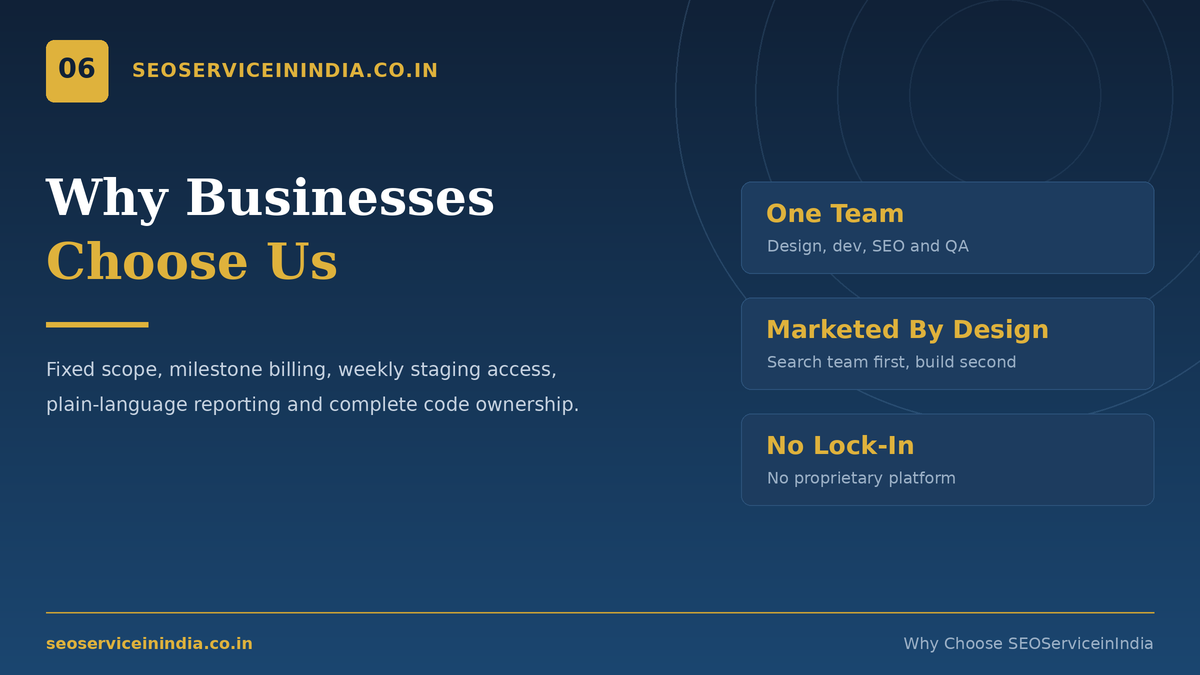
Trust. Fixed scope, milestone billing, weekly staging access, plain-language reporting and complete code ownership. We will also tell you what we are not: we do not sell guaranteed rankings, we do not lock clients into proprietary platforms, and we do not quote a price before we understand the scope.
Who these packages are not for
If you need a one-page site online by tomorrow for under a hundred dollars, a DIY builder is genuinely the better answer and we will say so. If you want the cheapest possible quote and intend to judge the work on that alone, we are not the right fit. And if you are hoping a rebuild alone will fix a traffic decline caused by content or authority problems, start with an audit instead — a new design will not recover rankings by itself.
Pricing Guidance
What your package will realistically cost
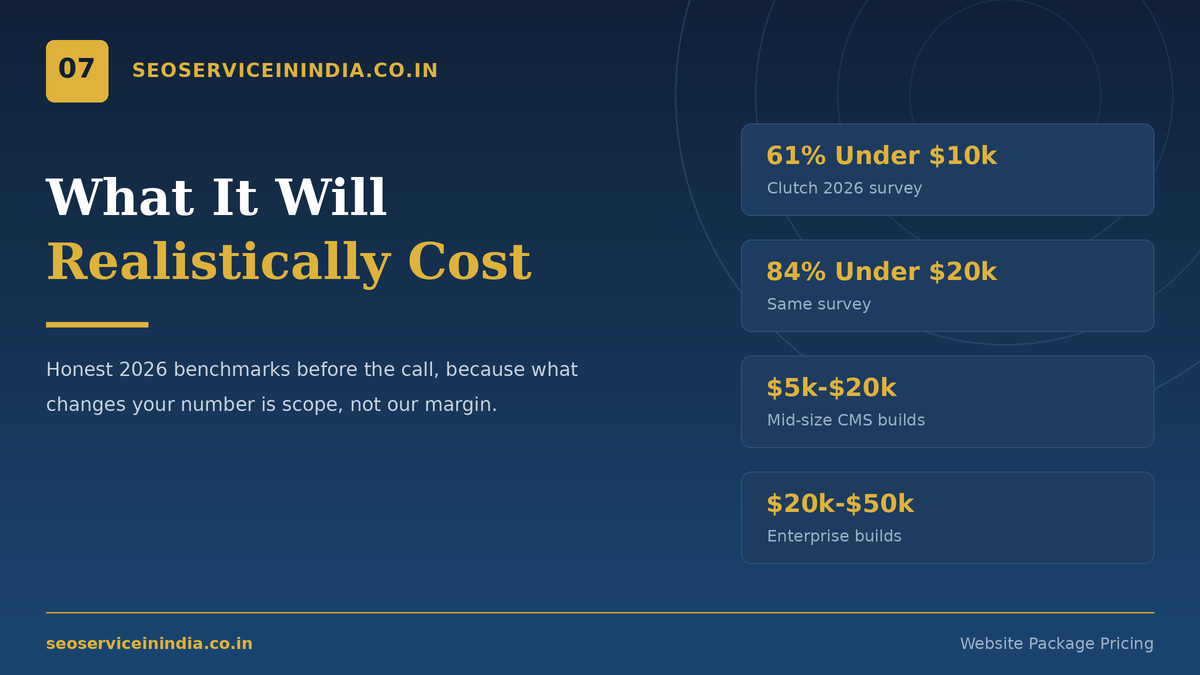
We quote after scoping, but you deserve honest benchmarks before that call. Clutch's 2026 survey found 61% of small business buyers spent under $10,000 on their most recent website project, and 84% spent under $20,000. A 2026 GoodFirms survey of more than 300 providers across 31 countries puts basic websites and MVPs at $1,000–$3,000, mid-sized CMS-based sites at $5,000–$20,000 and enterprise builds at $20,000–$50,000, while full custom ecommerce and headless builds routinely run far higher depending on catalogue complexity and ERP integration. Website Development Cost 2026: Complete Pricing Data +2
Our pricing sits deliberately below Western agency rates for comparable scope, because our delivery team is in India while our process, QA and reporting standards are built for US, UK, Canadian, Australian and Singaporean clients. What changes your number is scope, not our margin: number of unique templates, design originality, integrations, content volume, migration complexity and language count. Ongoing maintenance is quoted separately and openly, never buried in the build price.
Most small business builds land between a low four-figure and low five-figure budget depending on templates, integrations and content volume, with ecommerce and custom applications higher. We give you a fixed price after a free scope call rather than a list price that has to be revised later.
Design decides how the site looks, reads and guides a visitor — wireframes, layout, typography, colour and interaction. Development turns that into working code: templates, CMS, database, forms, integrations and performance. Our packages include both, plus the SEO and content work that sits between them.
A Starter site typically takes three to five weeks, a Growth build six to ten weeks, and an Enterprise project twelve weeks or more. Content readiness and feedback turnaround are the two things that most often move a timeline, so we agree a review schedule up front.
Yes. Code, design files, hosting credentials and documentation are handed over on completion of every package. Nothing stays in our accounts and nothing is built on a platform you cannot take elsewhere.
We configure both and recommend hosting matched to your traffic and region, but domain and hosting are billed by the provider in your name, so you keep control of the two assets you should never rent from an agency.
Every build ships mobile-first, tested on real devices, with crawlable structure, editable metadata, schema markup, internal linking and Core Web Vitals verified against Google's current thresholds before launch.
Yes, and it is a large part of our work. A redesign includes a full URL inventory, redirect map, pre- and post-launch crawl comparison and ranking monitoring so traffic carries across instead of falling off.
Two structured revision rounds at wireframe stage and two at visual design stage on every tier, with additional rounds quoted transparently. Fixing direction early is cheaper than rebuilding late.
Yes. We deliver under NDA with your branding on all documentation, your client relationship untouched, and a single point of contact on our side.
Free Scope Call
Start with a free scope call
Send us your current website or a short brief and we will come back with a structural review, the tier that fits, a fixed price and a realistic timeline — at no cost and with no obligation. If a smaller project or a different platform is the right answer, that is what we will recommend.
Get your free website scope call today — tell us what the site needs to do, and we will tell you exactly what it takes to build it.