Home/Podigee Podcast Submission Services for Global Brands
Podigee Podcast Submission Services for Global Brands
Podcast Hosting & Distribution
Podigee Podcast Submission Services
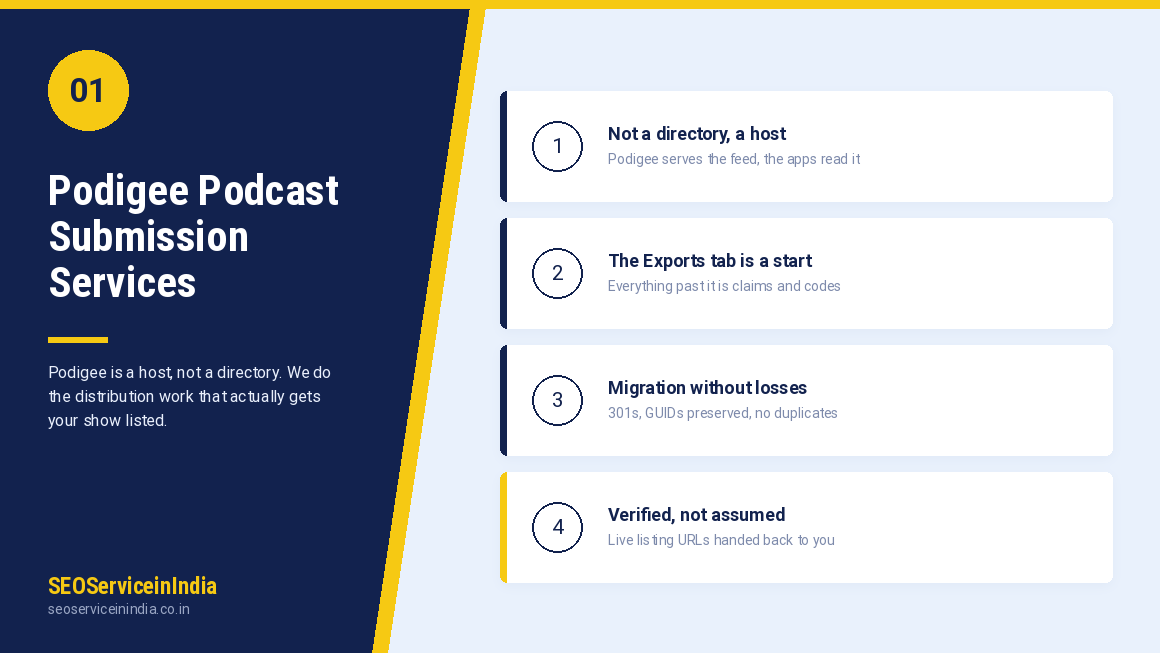
If you have landed here after searching for a way to "submit your podcast to Podigee," we want to save you the confusion straight away: Podigee is not a directory you get listed in. It is a German podcast hosting and distribution platform, and the thing you actually need is different — and larger — than a single submission form.
Podigee is where your show lives. Apple Podcasts, Spotify, Amazon Music, Deezer, TuneIn, YouTube and roughly a dozen more apps are where your audience finds it. Getting from one to the other properly is the work. At SEOServiceinIndia, we do that work for brands, agencies, publishers and in-house communications teams across the USA, UK, Canada, Australia, Singapore and India.
What Podigee actually is, and why the confusion exists
Podigee GmbH is based in Berlin and has been running since 2013, founded by Benjamin Zimmer and Mateusz Sójka. It is widely described as the leading podcast hosting and analytics platform in the GSA region — Germany, Switzerland and Austria — and its client list leans corporate: Deutsche Telekom, Deloitte, PwC and DHL sit alongside independent creators.
The confusion comes from the "Top 50 podcast submission sites" listicles that get copied from blog to blog every year. Those lists mix hosts, directories, apps, indexes and dead platforms into one undifferentiated column. Podigee ends up on them, so people search for a submission form that does not exist.
Here is the accurate picture. Podigee generates and serves your RSS feed. Directories and apps read that feed. Podigee also gives you an Exports tab that pushes your show into some of the biggest directories with a click. Beyond that handful, submission is manual, and several of the platforms that matter most require a claim, a verification code or a review queue that no dashboard button can shortcut.
The Exports tab covers a few doors. We cover the rest
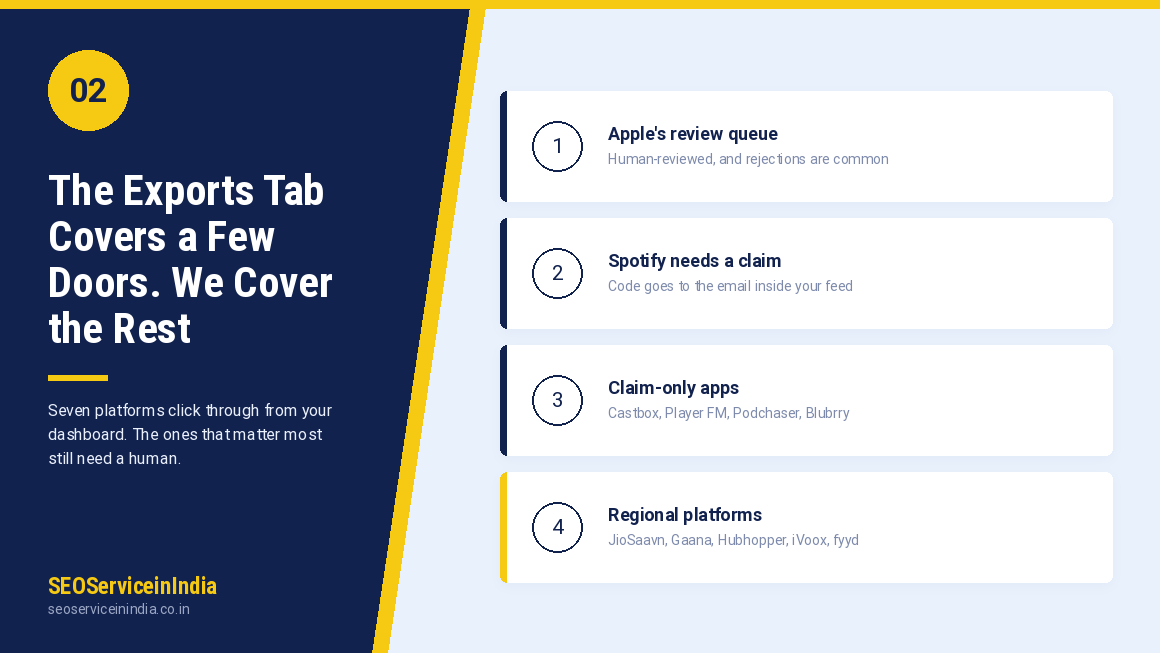
Inside your Podigee podcast settings, the Exports section lets you submit directly to a set of major platforms — Apple Podcasts (by entering your Apple Podcasts Connect Podcast ID), Spotify, Amazon Music and Audible (by accepting the licence agreement), Deezer, TuneIn and YouTube. That is genuinely convenient, and we will never charge you to click a button you could have clicked yourself.
What that tab does not do is everything else. Podigee's own help documentation is honest about it: for any other platform, you take the feed URL from Edit Podcast → Feeds and submit it yourself.
That "yourself" list is not short, and it is where most shows quietly stop existing:
Apple Podcasts still runs a human review queue, and rejections for artwork, metadata or feed faults are common and frustrating to diagnose.
Spotify requires a separate claim at Spotify for Creators, with a verification code sent to the email address published inside your feed.
Castbox, Player FM, Podcast Addict, Pocket Casts, Podchaser and Blubrry each need their own submission or ownership claim.
Podcast Index and the Podcasting 2.0 ecosystem need feed-level tags, not a form.
JioSaavn, Gaana and Hubhopper matter if you have an India or South Asian diaspora audience, and each has its own portal and its own verification quirks.
iVoox and fyyd matter if you are chasing Spanish-speaking or German-speaking listeners.
Compliance & Migration
The compliance case: why teams pick Podigee in the first place
Most podcast hosts were designed for hobbyists and had privacy compliance bolted on later. Podigee was built the other way round. Hosting sits in Europe, data processing agreements are standard paperwork rather than an enterprise upsell, and the embedded player runs without cookies or listener tracking.
If your legal or data protection team has a veto over marketing tools, that difference is the entire reason the platform is on your shortlist. A corporate communications lead launching an internal podcast will be asked where the audio files sit, who processes listener data and whether the vendor will sign a proper DPA. Podigee answers those questions cleanly.
We treat this as a fit assessment, not a sales pitch. In our free feed audit, we tell you plainly whether the compliance advantage is worth a migration for your specific show. If you are a US-only consumer podcast with no EU listeners and no procurement review, a cheaper host will serve you just as well, and we will say so before you spend anything.
Migration without losing the audience you already have
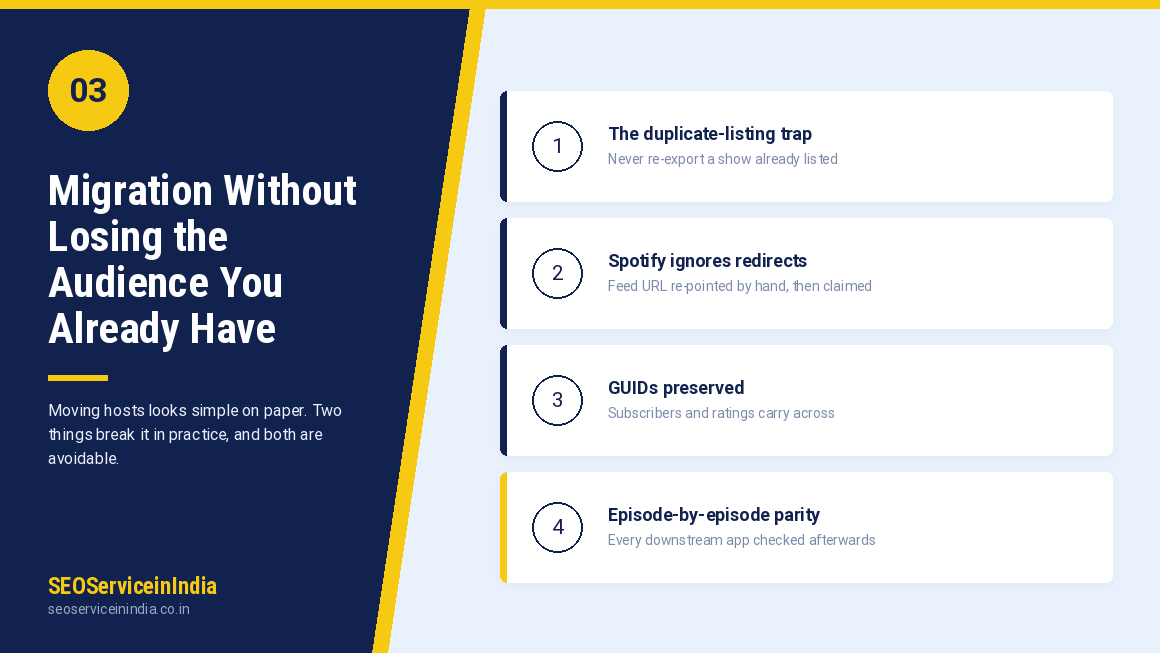
Moving to Podigee is straightforward on paper and full of traps in practice. The platform provides a "Request podcast import" form that pulls your feed, episodes, audio files, metadata and platform connections across. Your old host then gets set to redirect its feed to the new Podigee address, and the redirect-aware directories follow you automatically, keeping ratings and subscribers intact.
Two things break this, and both are avoidable.
The duplicate-listing trap
Podigee's documentation warns about it directly: if your show has been imported from another host and is already listed on a platform, you must not submit it again through the Exports tab. Do that and the show appears twice, splitting your downloads, your reviews and your search presence across two records that both look half-abandoned. Cleaning up a duplicate after the fact is far slower than preventing it. Our migration checklist audits every existing listing before a single export is triggered.
Spotify does not follow feed redirects
Unlike most directories, Spotify does not honour a redirect. The feed URL has to be changed manually inside Spotify for Creators, and if the show was submitted through Podigee you also need to claim it first, using a verification code sent to the address in your podcast settings. Miss this step and Spotify keeps serving your old feed until it goes stale — which, for many brands, means losing the single largest slice of their listenership without any error message anywhere.
We handle the sequence: redirect, verify, re-point Spotify, confirm episode-by-episode parity, then check every downstream app.
Video & Measurement
Video distribution, and why it has different plumbing
In April 2026 Podigee launched video podcast distribution across every pricing tier, making it the first host to push video to YouTube, Apple Podcasts and Spotify from a single upload. You drop in a video file the way you would an audio file, Podigee extracts the audio track, and your RSS feed stays audio-first so existing subscribers notice nothing.
The detail that matters operationally: these three platforms do not work the same way. Apple's video support runs on HTTP Live Streaming, Spotify video runs over an API connection rather than your RSS feed, and YouTube needs its channel connected once and then behaves like a video platform, not a podcast app. Three pipelines, three sets of specifications, three ways for an episode to publish everywhere except the one place your campaign was built around.
We configure the connections, set the aspect ratios and thumbnail conventions per platform, check that chapters and transcripts carry across, and build a publish-day verification routine so nobody finds out a week later that Spotify silently skipped an episode.
Measuring a podcast when the player has no cookies
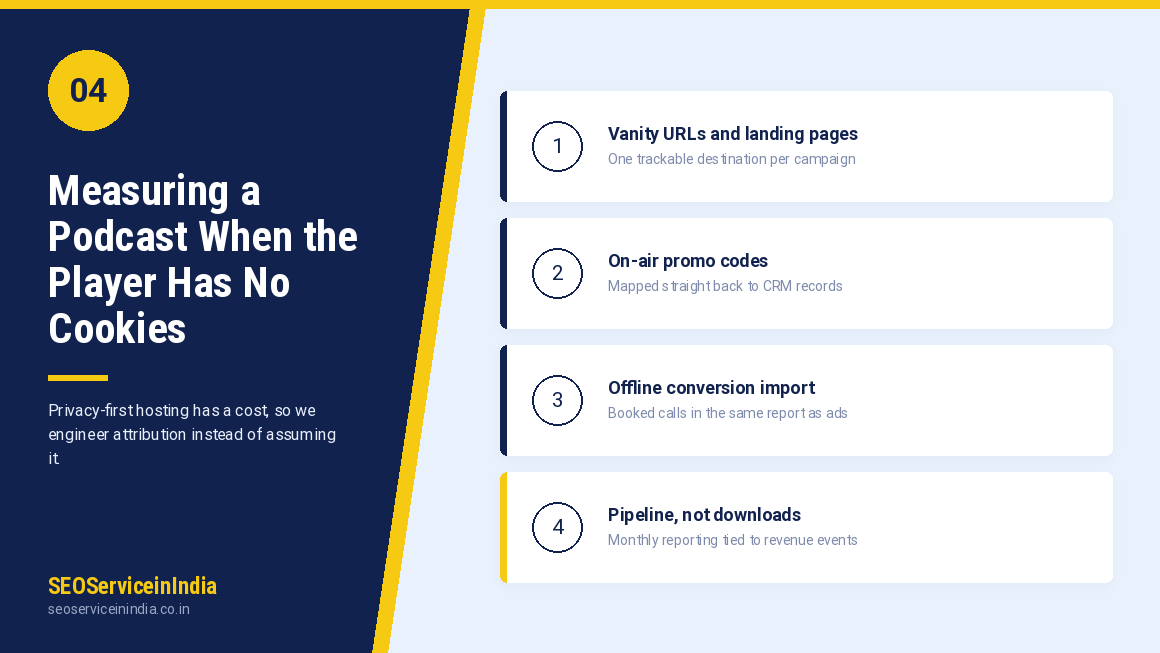
Privacy-first hosting has a cost, and honest agencies name it. Podigee gives you IAB-certified download and listener analytics, geographic data, episode performance and scheduled reports — but the cookieless player means no listener-level tracking, and reviewers regularly note that Spotify's own platform data does not surface inside the Podigee dashboard.
So attribution has to be engineered rather than assumed. What we build instead:
Campaign-specific vanity URLs and dedicated landing pages per episode or series
Unique promo codes and offer codes read on-air, mapped back to CRM records
Post-roll calls to action pointing at trackable destinations rather than a homepage
Offline conversion import, so a demo request or booked call that started with an episode is visible in the same report as everything else
A monthly report that talks about pipeline influence, not just download counts
For B2B and corporate shows, this is usually a better measurement story than pixel tracking ever produced — because it ties to revenue events, not impressions.
Discovery & Fit
The discovery layer nobody sells you
Directory placement gets you findable inside podcast apps. It does nothing for Google, and increasingly nothing for AI answer engines, which is where a growing share of "best podcast about X" queries now land.
This is the half of the work that separates a listed show from a discovered one:
Transcripts published as crawlable text on your own site, not just embedded in the player
Canonical episode pages — one indexable URL per episode with real content, not an infinite-scroll archive
PodcastEpisode and PodcastSeries schema so search engines understand what the page is
rel="alternate" feed auto-discovery so readers, indexes and crawlers find the feed from your website
Show and episode metadata written for search intent, because episode titles are a search surface in Apple, Spotify and Pocket Casts, not just a label
Chapter marks and structured show notes, which Podigee exports to Spotify automatically once configured
Podigee's AI tools can draft transcripts, show notes, titles and social copy, which speeds the raw production up considerably. What it does not do is decide which keywords a series should own, or structure a site so those pages rank. That part is ours.
Who this service fits
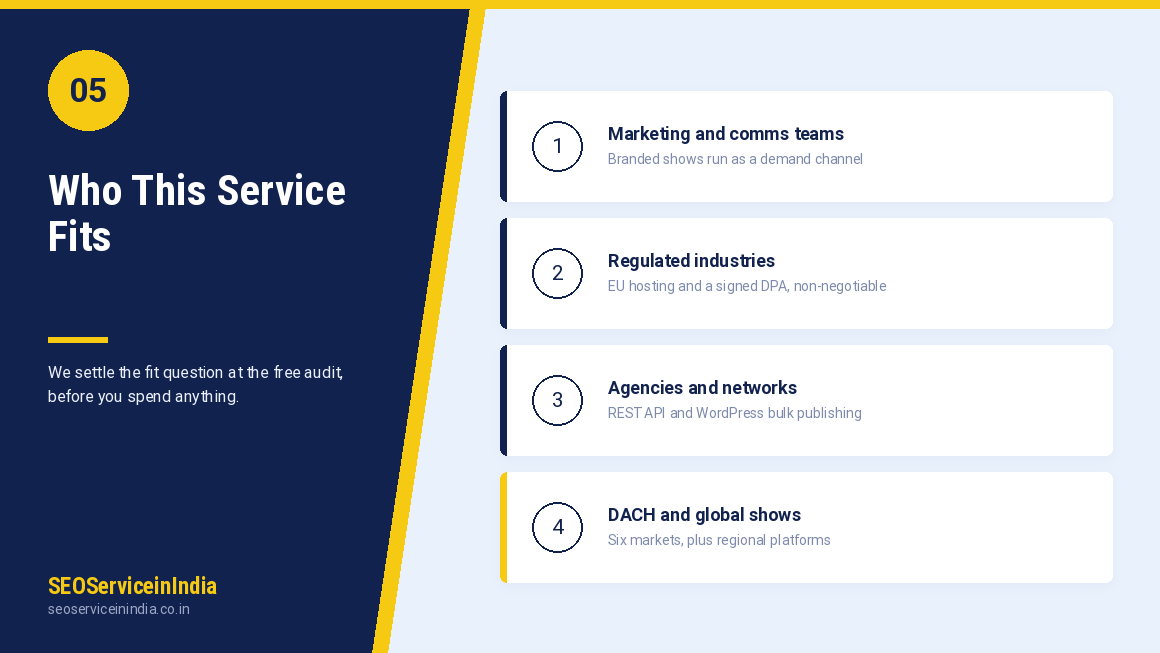
Marketing and communications teams running a branded podcast as a demand or employer-brand channel, who need distribution to be reliable and reportable without adding a full-time job
Marketing and communications teams running a branded podcast as a demand or employer-brand channel, who need distribution to be reliable and reportable without adding a full-time job.
Enterprises and regulated industries — finance, healthcare, legal, public sector — where EU hosting and a signed DPA are non-negotiable and the podcast still has to reach a public audience properly
Enterprises and regulated industries — finance, healthcare, legal, public sector — where EU hosting and a signed DPA are non-negotiable and the podcast still has to reach a public audience properly.
Agencies and networks managing multiple shows, where Podigee's REST API and WordPress publishing integration make bulk operations viable and someone needs to configure them
Agencies and networks managing multiple shows, where Podigee's REST API and WordPress publishing integration make bulk operations viable and someone needs to configure them.
Brands entering the DACH market
Brands entering the DACH market. Podigee's home advantage is real: it is the market leader across Germany, Austria and Switzerland. Worth knowing honestly, though — German audio consumption is still radio-dominated, with podcasts accounting for a small share of daily listening, so we plan DACH expectations against that reality rather than a hype number.
Global shows with distributed audiences
Global shows with distributed audiences. We run submissions and listing verification for clients across the USA, UK, Canada, Australia, Singapore and India, including the regional platforms that Western-default checklists ignore entirely.
Fit Check & Process
Who this isn't for
We would rather turn work away than take money for something that will not help.
This service is a poor fit if your feed is entirely private or paywalled, since directories will not index it and there is nothing to submit. It is a poor fit if you have one unfinished episode — several indexes will not treat a show as a podcast until there are three episodes with real runtime. It is a poor fit if you are looking for a guaranteed chart position or a "featured" slot, because those are editorial or algorithmic decisions no vendor controls, and anyone promising otherwise is selling you a story. And it is a poor fit if what you actually need is production — recording, editing, mixing — which is a different craft from distribution and SEO.
What we do, step by step
1
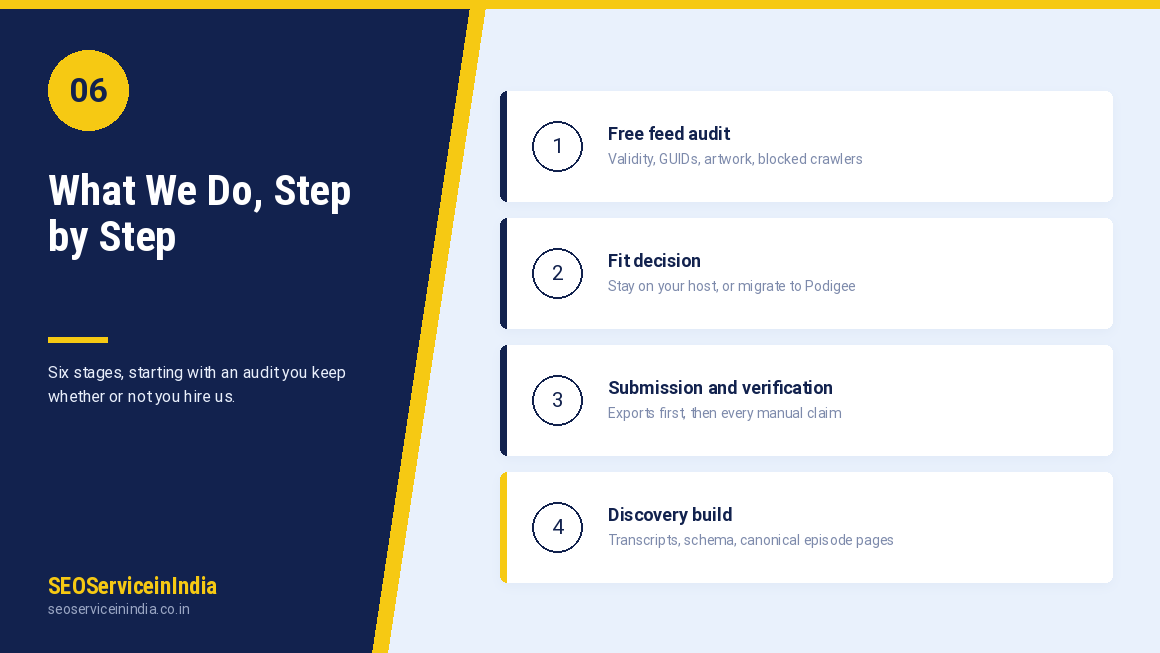
Free feed audit. Before any quote, we pull your feed and check it against every requirement that matters: validity, GUID stability, enclosure URLs, artwork dimensions and format, owner email visibility, encoding and bitrate, itunes:block tags left over from a previous setup, and whether firewalls or CDN bot rules are blocking directory crawlers. You get the findings whether or not you hire us.
2
Fit decision. Stay on your current host, or migrate to Podigee. We recommend based on your audience, compliance requirements and budget, not on which answer is more billable.
3
Setup or migration. Podigee account configuration, import, 301 redirects with GUIDs preserved, Spotify feed re-point, duplicate-listing prevention.
4
Submission and verification. Exports tab platforms first, then the manual set — claims, verification codes, review queues — followed by a listing-by-listing verification pass with live URLs delivered to you.
5
Discovery build. Transcripts, canonical episode pages, schema markup, metadata optimisation, internal linking from your existing site.
6
Reporting. Monthly, in plain language, tied to the outcomes you care about.
Packages & Expertise
Packages
We work in three tiers — Starter, Growth and Enterprise — covering single-show setup and submission, ongoing episode SEO and multi-show or multi-market programmes respectively.
We do not publish fixed prices, and here is the honest reason: the work varies enormously depending on whether you are launching clean, migrating a 300-episode archive, or repairing a show that has been silently broken across four directories for two years. Pricing is quoted after the free audit, when we know what we are actually doing.
One more thing we say on every page like this: the Podigee account has a free tier, and listing on almost every directory costs nothing. You are not paying us for access. You are paying for the feed engineering, the migration sequencing, the manual claims, the verification and the search work around it.
Why work with SEOServiceinIndia
We have been doing technical SEO and content work for over a decade, and podcast distribution sits naturally inside that — it is feed hygiene, structured data, metadata and search intent, applied to audio.
Our team has run submission and repair projects across live directories and dead ones, hosts that distribute automatically and hosts that leave you to it, and platforms in six markets with different verification rules. When platforms change — and in this space they change constantly — we find out from the platforms' own documentation and release notes, not from a listicle written in 2019.
We also tell clients when a platform is not worth their time, when a migration is not worth the disruption, and when a listing is free. That is a slower way to sell. It is a much better way to keep clients.
FAQ
Frequently Asked Questions
Not in the way you mean. Podigee is a hosting platform, not a directory, so there is no listing to be added to. You either host your podcast with Podigee or you do not. What you can do is use Podigee's Exports tab to submit your show to major directories, and submit manually everywhere else.
Partly. The Exports tab covers a set of major platforms including Apple Podcasts, Spotify, Amazon Music, Deezer, TuneIn and YouTube. Beyond those you take the feed URL and submit it yourself, and several platforms additionally require an ownership claim or pass through a review queue.
Not if the migration is done properly. Podigee imports your feed and episodes, and a redirect on your old host tells directories where you have moved, preserving subscriptions and ratings. The exception is Spotify, which does not follow redirects and needs its feed URL updated by hand.
Almost always because the show was submitted again after a migration when it was already listed. Podigee's own documentation warns against this. Duplicate records split your downloads and reviews, and removing one usually requires contacting the platform directly.
It is one of the strongest options if compliance matters to you. European hosting, standard data processing agreements and a cookieless player make it straightforward for legal teams to approve, which is why large corporates use it. If none of that applies to your show, other hosts may suit you better.
Yes. Since April 2026 Podigee distributes video episodes to YouTube, Apple Podcasts and Spotify from a single upload, across all plan tiers, while keeping your RSS feed audio-first. The three platforms use different technical pipelines, so setup and publish-day verification matter.
It varies by platform. Spotify typically lists within about an hour of a successful submission, with new episodes appearing within minutes afterwards. Apple Podcasts runs a human review and can take several days. Smaller indexes range from a few hours to a couple of weeks.
No, and we would be cautious about anyone who does. Charts respond to real listener behaviour and, on some platforms, editorial judgement. What we guarantee is that your feed is clean, your show is correctly listed and claimed everywhere it should be, and your episodes are discoverable in search.
Free Feed Audit
Start with the audit
Send us your RSS feed URL. We will run the full audit — feed health, existing listings, missing platforms, duplicate records, discovery gaps — and come back with a written summary of what is wrong, what is worth fixing and what you can safely ignore.
No obligation, no fee, and no recommendation to migrate unless the migration genuinely earns its cost.