Discovery and platform fit. Catalogue size, variant complexity, B2B pricing rules, number of markets and currencies, existing ERP or accounting system, and the team who will run the store after launch. These five answers decide the platform. They are not a formality.
Ecommerce Design & Development
Ecommerce Website Designing and Development Packages
You are not buying a website. You are buying the thing that takes the order, calculates the tax, holds the stock number, survives a Black Friday spike and still loads in under two and a half seconds on a mid-range Android phone in a market you have never visited. Everything else — the hero banner, the animation, the font pairing — is decoration on top of that.
SEOServiceinIndia builds ecommerce websites for merchants in the USA, UK, Canada, Australia, Singapore and India, on the platform that actually fits the catalogue instead of the platform the last agency happened to resell. Our ecommerce website designing and development packages cover the full path: platform selection, UX and design, front-end and back-end build, payment and logistics integration, performance engineering, search architecture and post-launch support.
Build Scope
What an ecommerce website build actually includes
Most quotes you receive are not comparable, because "ecommerce website" means something different to every vendor. Before you compare prices, compare scope. A complete online store development package should contain all of the following, and if a quote is missing three of them it is not cheaper — it is smaller.
Information architecture. Category tree, faceted navigation rules, URL structure, breadcrumb logic and the crawl and indexation plan. This is the single most expensive thing to change after launch, and the single most common thing to get wrong before it.
UX and visual design. Home, category, product detail, cart, checkout, account, search results, empty states, and the mobile version of each — designed as screens, not as a desktop mockup that someone squeezes later.
Front-end development. Semantic markup, accessible components, responsive behaviour on real devices, and a performance budget agreed in writing before the first line of code.
Back-end and integrations. Payment gateways, shipping and tax logic, inventory sync, order management, email and SMS flows, CRM or ERP hooks, and the product data feed.
Search and analytics foundations. Structured data, metadata patterns, sitemaps, redirect map for a replatform, GA4 with ecommerce events, and server-side tagging where consent rules demand it.
Launch and handover. QA across devices and browsers, load testing, staging-to-live process, admin training, documentation and a defined support window.
Why Stores Underperform
Why most ecommerce websites underperform
We audit stores every week before we quote on them. The same three failures account for the overwhelming majority of underperforming online stores.
It was designed, then made functional. The visual design was signed off before anyone mapped the checkout, so variants, filters, stock states and shipping edge cases were retro-fitted into a layout that never anticipated them. The store looks like the mockup and behaves like a compromise.
It was built on the wrong platform. A 40,000-SKU B2B catalogue with customer-specific price lists on a lightweight hosted builder. Or a 60-product apparel brand on an enterprise stack that needs a developer to change a banner. Both are expensive mistakes, and both are usually the result of nobody asking the discovery questions.
Nobody owned performance. Twelve apps, four tracking scripts, a drag-and-drop page builder, uncompressed hero images, and a theme nobody profiled. Across the wider web, only around 43% of sites pass all three Core Web Vitals on mobile, and the move from FID to INP made that bar meaningfully harder to clear — interactive, app-heavy storefronts feel that pressure most. fudge
Platform Fit
Choose the platform before you choose the design
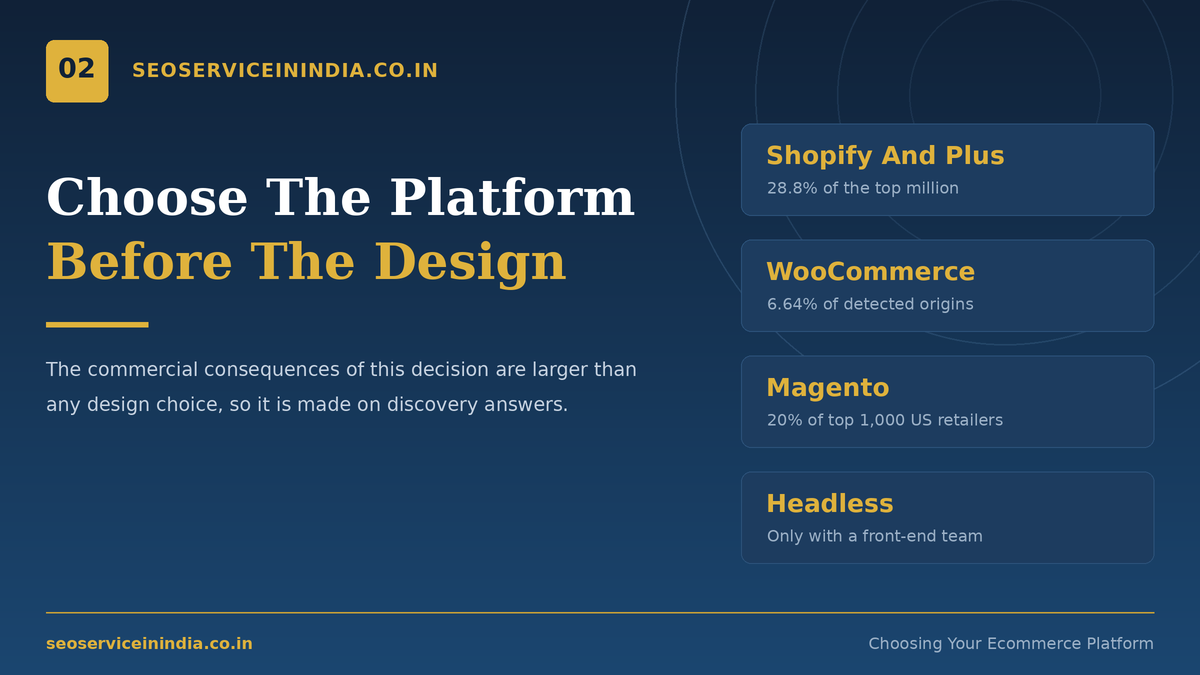
We are platform-agnostic by policy, because the commercial consequences of this decision are larger than any design choice. Here is how we actually advise, and the market reality behind it.
Shopify and Shopify Plus. The default recommendation for most D2C brands under a few thousand SKUs, and for merchants who want to run the store without a developer on retainer. Shopify leads among higher-traffic stores, holding roughly 28.8% of the top one million ecommerce websites, and it was the only large platform growing at scale year-on-year in the most recent origin data. Trade-off: platform fees, and app sprawl that quietly destroys interactivity scores if nobody polices it. MobiloudGravityKit
WooCommerce on WordPress. The right answer when content and commerce share the same audience — content-led brands, publishers with a shop, service businesses selling a handful of products. WooCommerce still leads the measurable web at around 6.64% of all detected origins. Trade-off: you own hosting, security and updates, so it needs a maintenance plan, not just a build. GravityKit
Magento and Adobe Commerce. Complex catalogues, B2B price lists, multi-store setups, deep ERP integration. Store counts have fallen to roughly 111,495 active stores in Q1 2026, down about 10% year-on-year, yet Magento and Adobe Commerce still power about 20% of the top 1,000 US retailers. Read that correctly: it is shrinking at the small end and holding at the enterprise end. If you are not at the enterprise end, you probably should not be here. MGT Commerce
BigCommerce and other hosted platforms. Useful for specific catalogue and multi-channel requirements, particularly where native B2B features save custom development.
Headless and composable. Storefront in Next.js, Hydrogen or similar, commerce engine behind an API. Genuinely right for high-traffic brands with an in-house front-end team, a content-heavy experience or several front-ends off one catalogue. Genuinely wrong for a merchant of forty products who wanted a faster site — a properly built native theme achieves that at a fraction of the cost and complexity.
We will tell you when the cheaper platform is the correct one. That conversation costs us margin and saves you a replatform in two years.
Agent-Ready Commerce
Built for two buyers: shoppers and shopping agents
This is the part of ecommerce website development that changed most recently, and the part most agencies are not yet building for.
Your product pages now have a second reader. AI assistants and shopping agents discover, compare and increasingly transact on a shopper's behalf. Checkout-focused and journey-wide standards emerged in quick succession — the Agentic Commerce Protocol from OpenAI and Stripe, and the Universal Commerce Protocol backed by Google and Shopify — with ACP already processing live transactions and extending across more than a million Shopify merchants. Google introduced UCP at NRF 2026 with Shopify, Etsy, Wayfair and Target, and the card networks followed, with Mastercard completing live agentic transactions in Asia-Pacific markets and Visa launching its Trusted Agent Protocol. FinPaz
The practical implication is unglamorous. Agents do not read your brand story; they evaluate structured data, feeds and APIs, so a complete and accurate real-time product feed does more for agent visibility than another long category essay. Where delivery windows, shipping costs or returns terms are vague or inconsistent, an agent can simply drop the offer before a human ever sees it. OpascopenShift
So in every build we ship, the following are treated as engineering requirements rather than SEO extras: complete Product and Offer structured data including price, currency, availability and shipping details; a clean, continuously accurate product feed; stable canonical product URLs; machine-readable returns, delivery and warranty terms; and stock and price that are true at the moment of purchase, not true as of last night's sync. That work also happens to be exactly what classic organic search and paid shopping feeds want, so nothing here is speculative spend.
Performance & Conversion
Performance engineering, with a number attached
We set a performance budget during design sign-off and hold the build to it: LCP within 2.5 seconds, INP at or below 200 milliseconds and CLS at 0.1 or less, measured at the 75th percentile of real user visits — the thresholds Google actually publishes. visionary-marketing
The reason is commercial, not academic. Ecommerce pages carry the heaviest payloads on the web — high-resolution galleries, variant swatches, reviews, recommendation carousels, trust badges and a stack of marketing tags — and each one is a chance to miss a threshold; first-party analysis puts the cost of every additional second of LCP delay at roughly an 11.4% drop in ecommerce conversion rate. In platform-level testing, drag-and-drop page builders ran 22% to 37% slower than the same layout written as native theme code, which is why our packages build components rather than assemble them in a visual editor. visionary-marketingfudge
What that looks like in delivery: AVIF and WebP with correct sizing and dimensions reserved, critical CSS inlined and the rest deferred, third-party scripts audited and loaded off the main thread, app and plugin count justified one by one, fonts subset and self-hosted, caching and CDN configured for your buyer geography, and field data reviewed in Search Console and CrUX after launch rather than a lab score screenshotted on the day of handover.
Search and conversion designed in, not bolted on
An ecommerce site that needs an SEO rescue six months after launch was built wrong. We involve the search and CRO view at wireframe stage.
On the search side: a category architecture that matches how people actually search rather than how your warehouse is organised; faceted navigation with deliberate rules about what is indexable, what is canonicalised and what is blocked; product pages with unique copy, real specification tables, user-generated review markup and internal links to siblings and accessories; a complete redirect map when we replatform, so hard-won rankings survive the move.
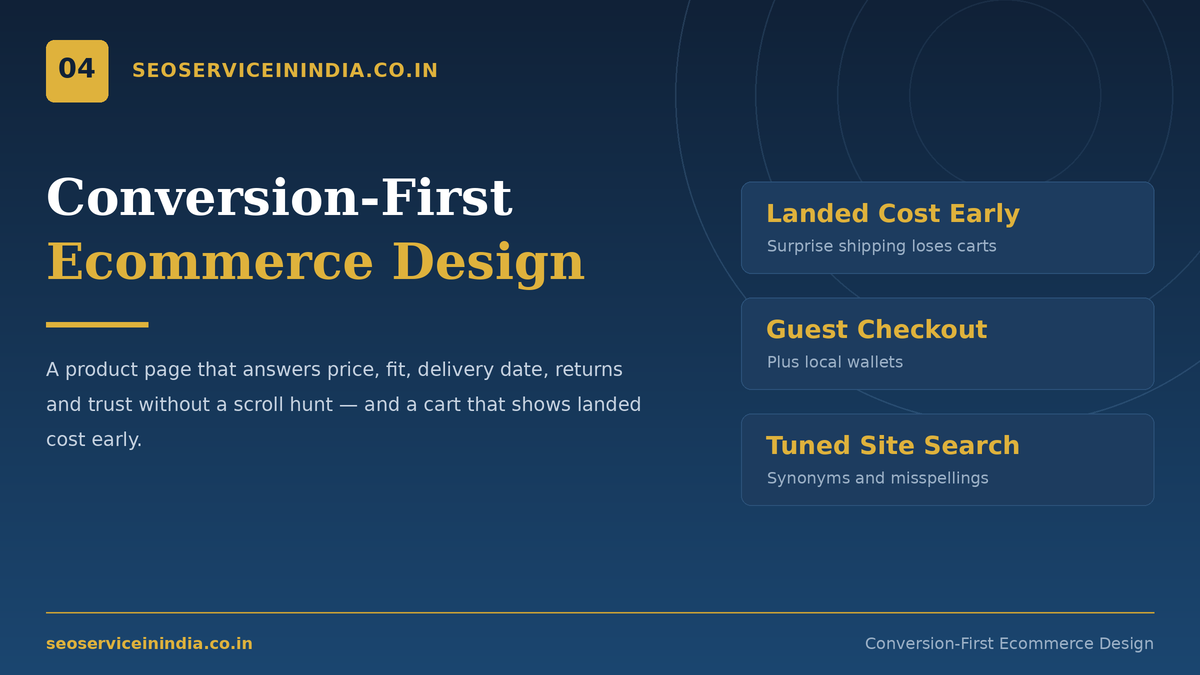
On the conversion side: a product page that answers price, fit, delivery date, returns and trust without a scroll hunt; a cart that shows landed cost early, because surprise shipping remains the most reliable way to lose a checkout; guest checkout, address autocomplete and the local wallets your market expects; search-within-site tuned with synonyms and misspellings, since internal search users convert several times better than browsers; and post-purchase flows that turn a first order into a second.
Packages
Starter Store
Growth Store
Enterprise / Headless
Our ecommerce website designing and development packages
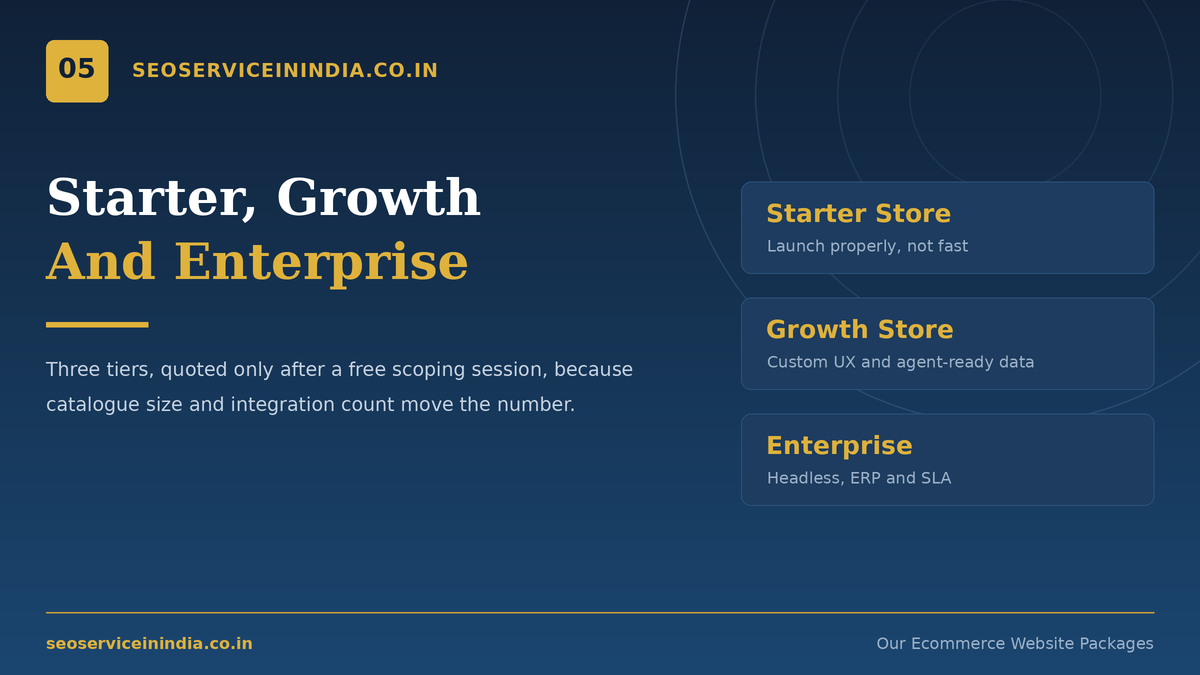
Three tiers. Pricing is quoted only after a free scoping session, because catalogue size, integration count and content readiness move the number more than any list price could honestly reflect.
Starter Store — for new and small merchants launching properly rather than launching fast. Platform recommendation, up to a defined page set, customised premium theme with brand-level design work, up to around 100 SKUs loaded, one payment gateway, standard shipping and tax configuration, essential structured data, GA4 ecommerce tracking, performance pass against the agreed budget, admin training and 30 days of post-launch support.
Growth Store — the tier most established brands need. Fully custom UX and design across every template, custom theme development, bulk catalogue import with variant and attribute modelling, multiple payment and logistics integrations, subscription or bundle logic where required, complete category and faceted navigation architecture, agent-ready product data and feed setup, CRO instrumentation with event tracking and heatmaps, multi-currency or multi-language where in scope, replatform and redirect handling, and 90 days of support.
Enterprise / Headless Store — for high-traffic, high-complexity merchants. Composable or headless front-end, API-first commerce layer, ERP and PIM integration, B2B pricing tiers and account hierarchies, multi-store and multi-region rollout, load testing to a defined concurrency target, staged release process with CI/CD, security review, SLA-backed support and a quarterly roadmap.
Every tier includes the same non-negotiables: the agreed performance budget, structured data, accessibility fundamentals, documented handover and full ownership of your code and accounts. You are never locked to us to make a change.
Global Builds
01 02 03 04 05 06 07
Markets we build for
United States and Canada. The most crowded and most sophisticated buying audiences. Mobile-first performance, local wallets, sales tax and provincial tax logic, and agent-readiness matter most here first.
United Kingdom. VAT handling, tight delivery-promise expectations and returns clarity, plus accessibility standards that serious retailers now treat as a requirement rather than a nice-to-have.
Australia. Long shipping distances make delivery transparency and courier integration the defining trust factor on the product page.
Singapore. Small, premium, multilingual market where polish and payment-method coverage decide credibility, and where regional expansion from a single storefront is usually the real brief.
India. Price-sensitive, extremely mobile-heavy, COD and UPI-driven. Performance on mid-range Android devices and patchy networks is not an optimisation here — it is the business case.
How we run the build
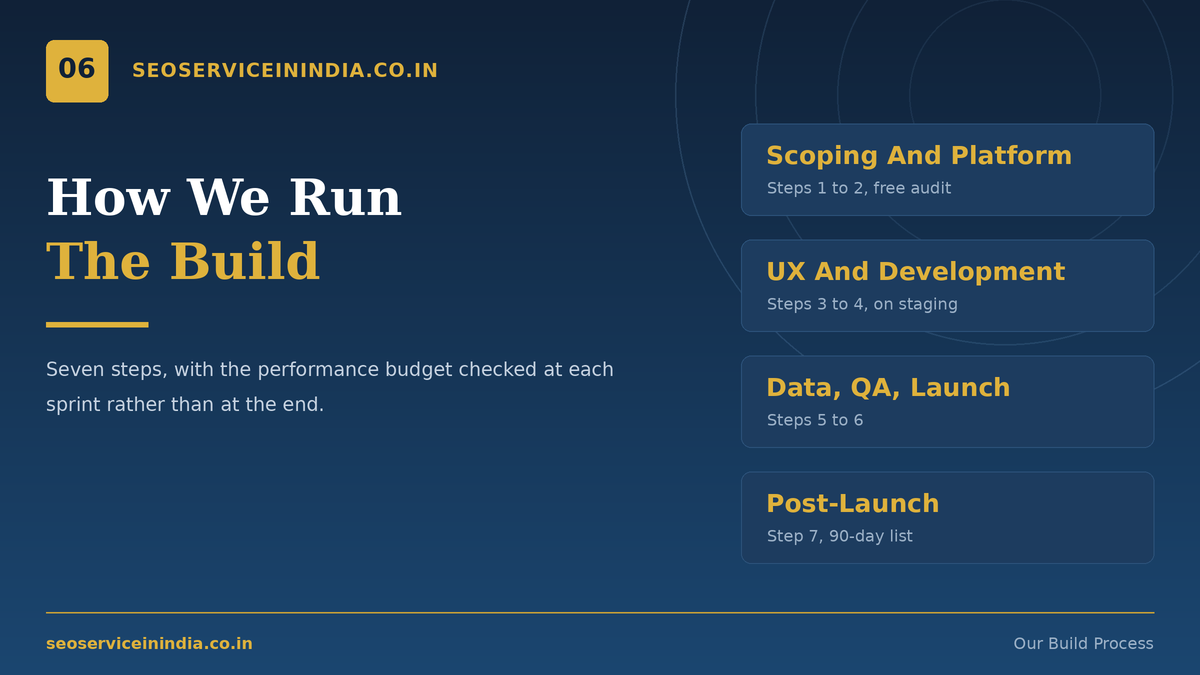
1. Scoping call and audit. Catalogue, integrations, markets, team, existing site. Free, and it ends with a written recommendation even if you do not proceed.
2. Platform and architecture decision. Written rationale, cost-of-ownership comparison, and the category and URL structure.
3. UX and design. Wireframes, then full designs across every template and breakpoint, reviewed with the search and CRO view in the room.
4. Development. Sprint-based, on staging, with the performance budget checked at each sprint rather than at the end.
5. Data, integrations and QA. Catalogue load, payment and shipping testing with real test orders, cross-device and cross-browser QA, load testing at the Enterprise tier.
6. Launch. Redirects deployed, feeds submitted, analytics verified, monitoring live.
7. Post-launch. Field Core Web Vitals reviewed, indexation checked, conversion funnel read, and a prioritised 90-day improvement list handed to you.
Why Choose Us
Why merchants choose SEOServiceinIndia
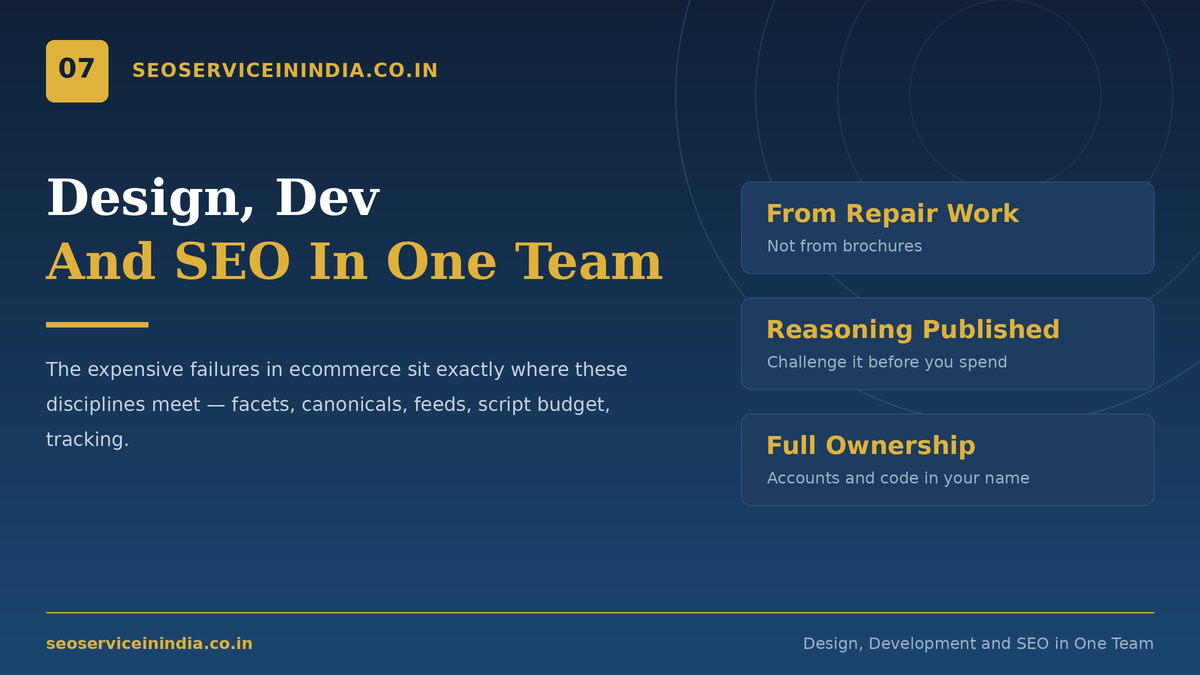
Experience. We have built and rebuilt stores on Shopify, WooCommerce, Magento, BigCommerce and headless stacks, and we have inherited enough broken replatforms to know precisely where they break. Our recommendations come from repair work, not brochures.
Expertise. The same team handles design, development, technical SEO and analytics. That matters because the expensive failures in ecommerce sit exactly where those disciplines meet — faceted navigation, canonicalisation, feed accuracy, script budget, checkout tracking.
Authority. We publish our platform reasoning, our performance thresholds and our architecture decisions rather than hiding them behind a proposal. You can challenge our recommendation before you spend anything.
Trust. Fixed scope, written deliverables, your accounts in your name, your code handed over in full, and a straight answer when a smaller build is the right build. When a platform, theme or tool is free or cheap, we say so — you are paying us for the engineering and judgement around it, not for access to something you could have had for nothing.
Who these packages are not for
We would rather say this now than in month three.
If you want the cheapest possible template deployment with no discovery, we are not the right vendor and a template marketplace will serve you better. If you want a headless rebuild purely because it sounds modern, we will decline and propose a native build instead. If your catalogue data does not exist yet — no descriptions, no clean images, no specifications — the build will stall, so we will scope content production first or ask you to handle it before we start. And if you are looking for a guaranteed ranking or revenue figure attached to a website build, no honest development partner can give you one.
Genuinely, it depends on catalogue complexity, integration count and how much of your product content already exists. Those three factors move the number more than the platform does. Book the free scoping call and you will get a written range, not a guess.
Answer five questions first: how many SKUs, how complex the variants and pricing rules, how many markets and currencies, what back-office system it must talk to, and who will run the store daily. Those answers select the platform. We give you that recommendation in writing before any build contract.
A Starter Store typically runs a few weeks. A Growth Store with custom design and multiple integrations runs longer, and an Enterprise or headless build is measured in months. Content readiness is the most common cause of delay, not development.
Not if the migration is planned. Rankings are lost when URL structures change without a complete redirect map, when category architecture is redesigned without a crawl plan, or when structured data is dropped. We treat all three as launch blockers.
Yes. Complete product structured data, accurate feeds, stable product URLs and machine-readable delivery and returns terms are built into every tier. That is the same work that supports organic search and shopping campaigns, so it is not additional spend.
Often, yes — and it is frequently the better decision. A design refresh plus a performance and architecture pass can deliver most of the commercial upside at a fraction of a rebuild cost. The audit tells us which route applies.
Every package includes a defined post-launch support window, and optional ongoing maintenance and growth retainers are available. WooCommerce and Magento builds in particular need an active maintenance plan, and we will say so plainly.
You do. Hosting, domain, platform and analytics accounts are created in your name, and the full codebase and documentation are handed to you at launch.
Free Build Scope
Start with a free build scope
Send us your current store URL, or your catalogue and requirements if you are starting fresh. You will get back a platform recommendation, an architecture outline, a performance assessment and a package fit with a realistic range — before any commitment.