
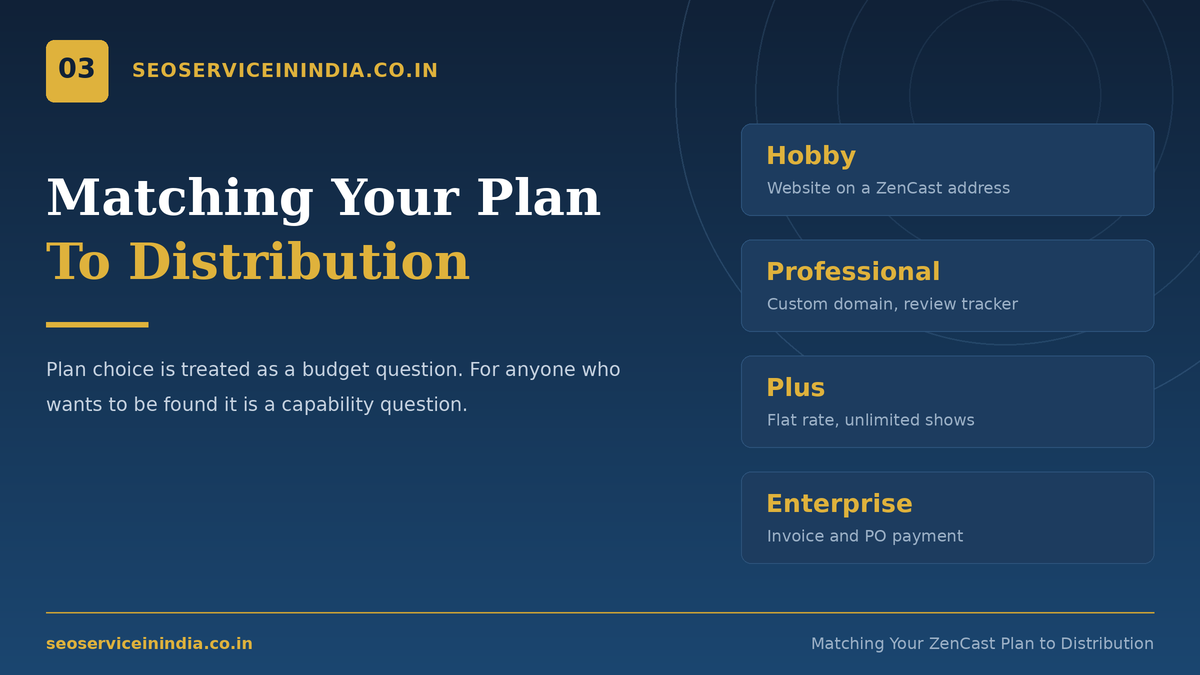
Hobby ($14/mo, $12 billed yearly) carries unlimited episodes and downloads, Apple and Spotify publishing, the player, the included website, standard analytics and transcriptions. It is a genuinely complete starter tier. Its limit for our purposes is that the included website sits on a ZenCast address, so every page of search equity your episodes earn accrues to a domain you do not own.
ZenCast Podcast Submission
ZenCast Podcast Submission Services
Your show is hosted, your feed is clean, and your episodes are uploading on schedule. So why can listeners only find you in two places?
ZenCast is a genuinely good podcast host. It gives you unlimited uploads and downloads, it keeps your RSS feed compliant so a malformed tag never costs you subscribers, and it throws in a self-updating website and an embeddable player at no extra cost. What it does not do — and has never claimed to do in its own documentation — is walk your feed through every directory, app, index and answer engine where a 2026 audience actually looks for shows. Its one-click submission takes you to Apple Podcasts and Spotify. Everything beyond that is a human job.
That human job is what we do. SEOServiceinIndia runs managed ZenCast podcast submission services for podcasters, agencies, studios and in-house content teams across the USA, UK, Canada, Australia, Singapore and India: feed and metadata audit first, then the full directory set, then the ownership claims, the review monitoring programme and the on-site episode SEO that decides whether your show surfaces in search results and AI answers at all.
Platform Reality
First, the record correction: ZenCast is a host, not a directory
Most "top 50 podcast submission sites" listicles put ZenCast in the same column as Apple Podcasts and Podcast Index. That is a category error, and it matters, because it changes what you should be buying.
A directory is a place listeners search. You submit your feed, it gets indexed, and people find you there. A host is where your audio files live and where your RSS feed is generated. ZenCast is the second kind. You do not "submit your podcast to ZenCast" — you publish your podcast from ZenCast, outwards, to the directories. There is no ZenCast listing to rank in and no ZenCast chart to climb, and any vendor promising you one is selling something that does not exist.
While we are correcting things: ZenCast and Zencastr are two different companies. ZenCast (zencast.fm) is the Melbourne-built hosting and publishing platform this page is about. Zencastr is a browser-based remote recording studio launched in 2014 by a separate team. If you were sent here looking for multitrack recording links for guests, that is the other one — and we will tell you so on the call rather than sell you a distribution package you do not need.
Twelve logos, one button
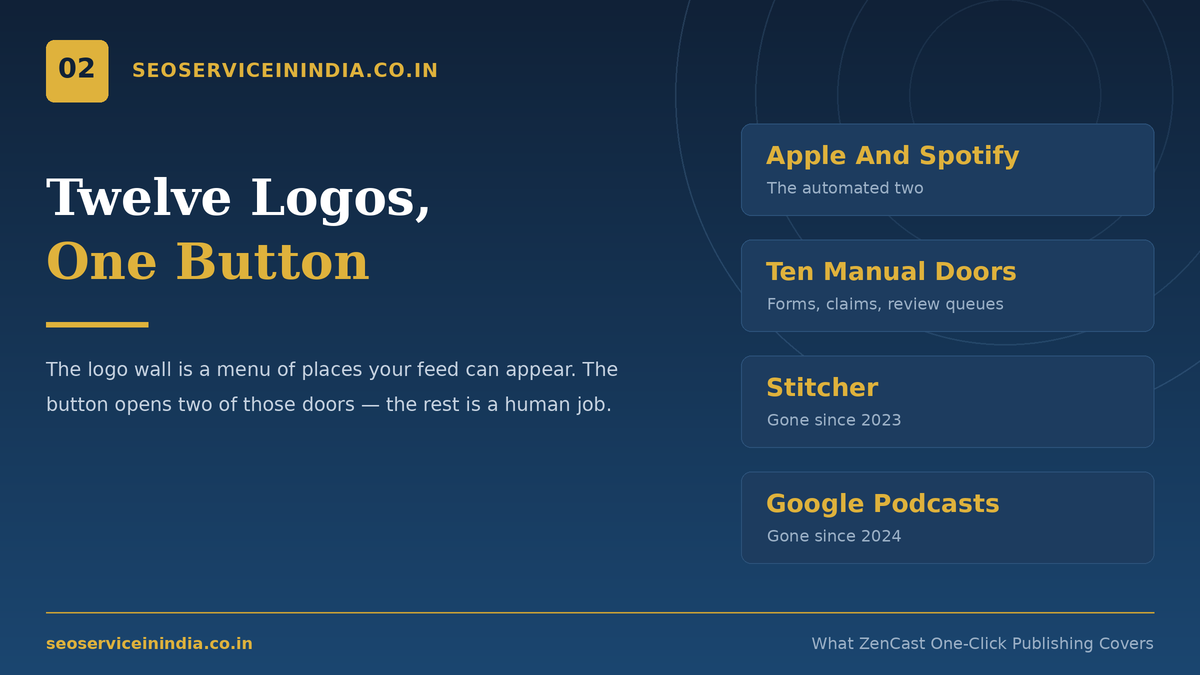
Open ZenCast's homepage and you will see a distribution wall: Apple Podcasts, Spotify, YouTube, Amazon Music, iHeartRadio, Pocket Casts, Overcast, TuneIn, Castro, JioSaavn, Gaana and Stitcher. Open ZenCast's own pricing FAQ and you will read something narrower and more honest: the platform generates your RSS feed and gives you a one-click submission process for Apple Podcasts, iTunes and Spotify.
Both statements are true. The logo wall is a menu of places your feed is capable of appearing. The button opens two of those doors. The remaining ten need a form, an account, an email verification, a review queue or a claim — and two of them, Stitcher and Google Podcasts, have not existed since 2023 and 2024 respectively, which tells you how long that section of the marketing site has gone untouched.
This is the honest centre of our service, and we say it on the page rather than in the small print: the one-click submission is already included in the ZenCast plan you pay for. You are not paying us for that. You are paying us for the ten doors it does not open, the claims nobody automates, and the search visibility work that no host performs for anybody.
Plan Sizing
Hobby
Professional
Plus
Enterprise
Which ZenCast plan your distribution plan actually needs
Plan choice on ZenCast is usually treated as a budget question. For anyone who cares about being found, it is a capability question — and picking wrong costs more than the upgrade would have.
Professional ($39/mo, $35 yearly) is where the distribution-relevant features live: the custom domain name, website customisation, the episode scheduler, advanced analytics, private podcasts and the review tracker. If your objective is search visibility, brand-owned pages or regional review monitoring, this is the floor, not the upgrade.
Plus ($99/mo, $89 yearly) is for networks, and it fixes a billing detail that catches people out. On Hobby and Professional, your invoice is billed per podcast — start a second show and you pay again. Plus is a flat rate for unlimited podcasts with ten contributors. We do this arithmetic at audit stage: if you are running three shows on Professional, you are usually already paying more than Plus would cost you.
Enterprise adds invoice or PO payment, advanced reporting and custom contracts — relevant if procurement, not a credit card, signs off your tooling.
There is a 14-day trial with no card required, a 10% discount on annual payment, no setup fee and no bandwidth fee, and ZenCast's own free concierge migration service if you are importing an existing show. We do not charge for a migration ZenCast performs for free. We charge for what happens after it.
Service Inclusions
What our ZenCast podcast submission service includes
Feed and metadata audit before anything is submitted
Every failed submission we have ever cleaned up traces back to the feed, not the form. Before we touch a directory we validate the feed against every ingestion requirement that matters: square artwork at 3000×3000 (1400×1400 absolute minimum), a title that is not a keyword sentence, an author field that is a real entity, a category set that maps to each platform's taxonomy rather than a guess, stable episode GUIDs, working enclosure URLs, correct explicit flags, a declared language, and an owner email that is actually visible inside the feed. That last one is the single most common silent killer, because several platforms send their verification code to the address published in the RSS — not to the address you typed into the submission form.
We also check that crawlers can reach you at all. A WAF rule, a CDN bot filter or a leftover itunes:block tag will keep you invisible while every dashboard you own reports success.
Apple Podcasts and Spotify, done properly rather than clicked
ZenCast's button submits. It does not diagnose. We handle Apple Podcasts Connect verification and the review queue, interpret rejections and resubmit against the actual cause, then verify the listing renders correctly — artwork, categories, episode order, show notes formatting. On Spotify we confirm the claim, the market availability and the episode metadata, and we make sure a later host change does not orphan the listing, because Spotify does not follow feed redirects the way other platforms do.
The manual directory set that nothing automates
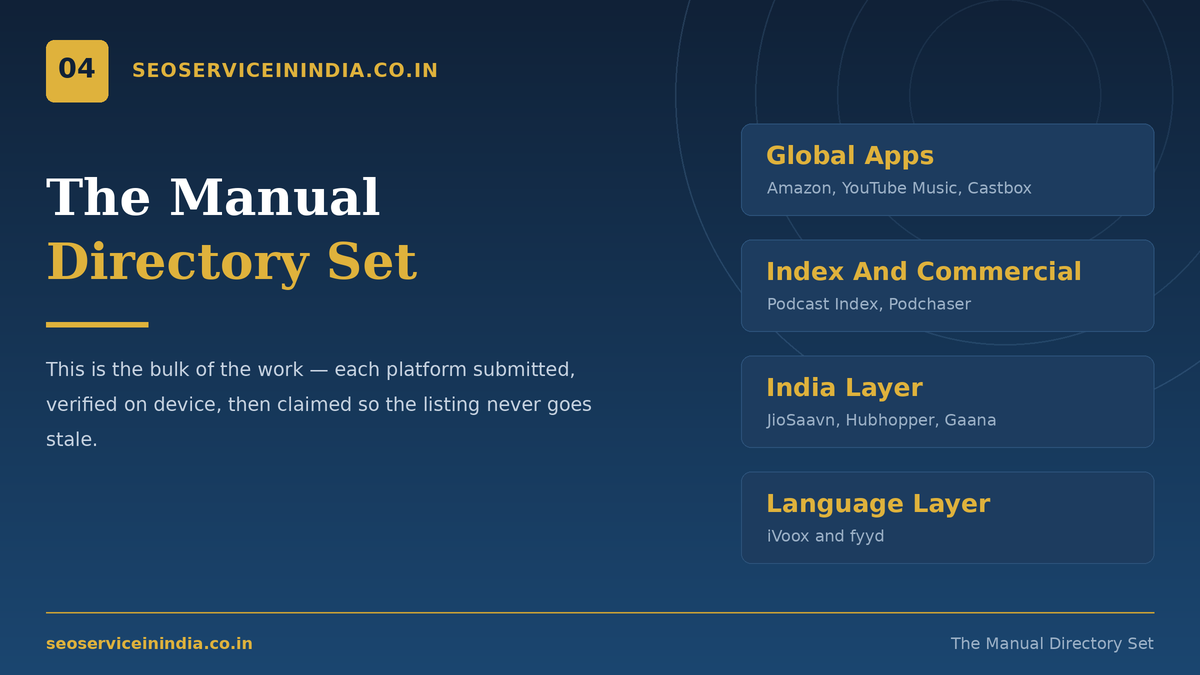
This is the bulk of the work: Amazon Music and Audible, YouTube Music, Podcast Index, Pocket Casts, Player FM, Podcast Addict, Castbox, Overcast, Castro, TuneIn, iHeartRadio, Deezer, Podchaser and Podfollow, plus the regional layer that genuinely converts — JioSaavn, Hubhopper and Gaana for India and the South Asian diaspora, iVoox for Spanish-speaking audiences, fyyd for German-speaking ones. Each one is submitted, verified on-device and then claimed, because an unclaimed listing goes stale the moment your show details change and you never see the analytics.
Search & Review Layer
Review monitoring turned into a programme, not a feed
ZenCast gives you something most hosts do not: rating and review tracking across more than 150 regional directories, on the Professional plan and above. Most users glance at it once a month and forget it. We run it as a working input.
We use it three ways. First, regional intelligence — reviews appearing in a market you were not targeting is the cleanest signal you have that an audience exists there, and it usually justifies a localisation or language-declaration change. Second, conversion: your strongest recent reviews become the quotes on your episode pages, your media kit and your show description, because a listener deciding whether to press play reads reviews, not charts. Third, defence: a one-star review describing an audio fault or a broken episode is a bug report, and catching it within days rather than quarters is the difference between a fix and a pattern.
What we will not do is tell you reviews will lift your chart position. Apple has stated on the record that its charts run on new subscriptions, playback activity and completion rate, and that ratings and reviews are not counted. Any agency scripting a "please rate and review us" call-to-action as a ranking tactic is selling you a myth. Reviews are trust and conversion. We treat them as exactly that.
Your own site as the search asset
Here is the part that separates a submission service from an SEO service, and it is why an SEO firm rather than a distribution reseller should be doing this work.
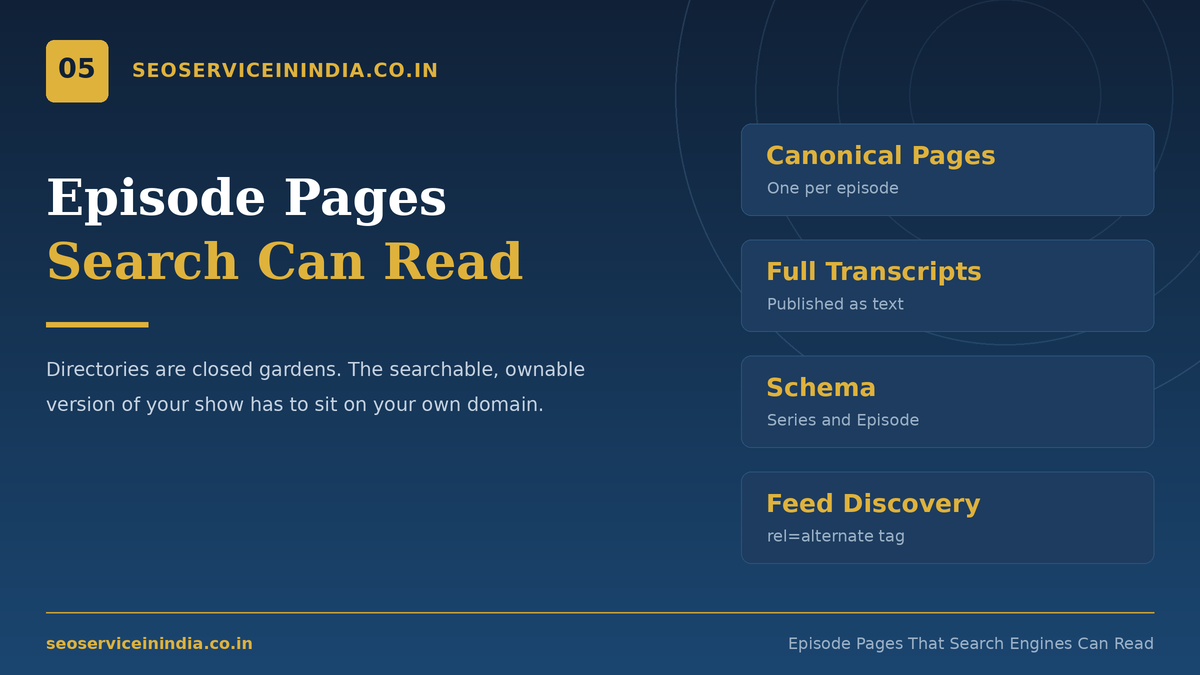
Your ZenCast website is convenient and it updates itself, but on the Hobby plan it lives on a ZenCast address, and even with a custom domain it is a template you do not fully control. Directories are closed gardens — Google and AI answer engines cannot read inside most of them. So the searchable, ownable version of your show has to sit on your own domain: one canonical page per episode, the full transcript published as text on that page, PodcastEpisode and PodcastSeries schema markup, a rel="alternate" feed discovery tag, real internal linking between related episodes, and speakers named as identifiable people rather than "the host".
ZenCast includes transcriptions on every plan, which gives us the raw material at no extra cost. We turn those transcripts into indexable pages that answer the questions people type, so your episodes start appearing in search results and in AI-generated answers — the two surfaces where podcast discovery has grown fastest and where no directory listing helps you at all.
Workflow
01 02 03 04 05 06 07
Our process, step by step
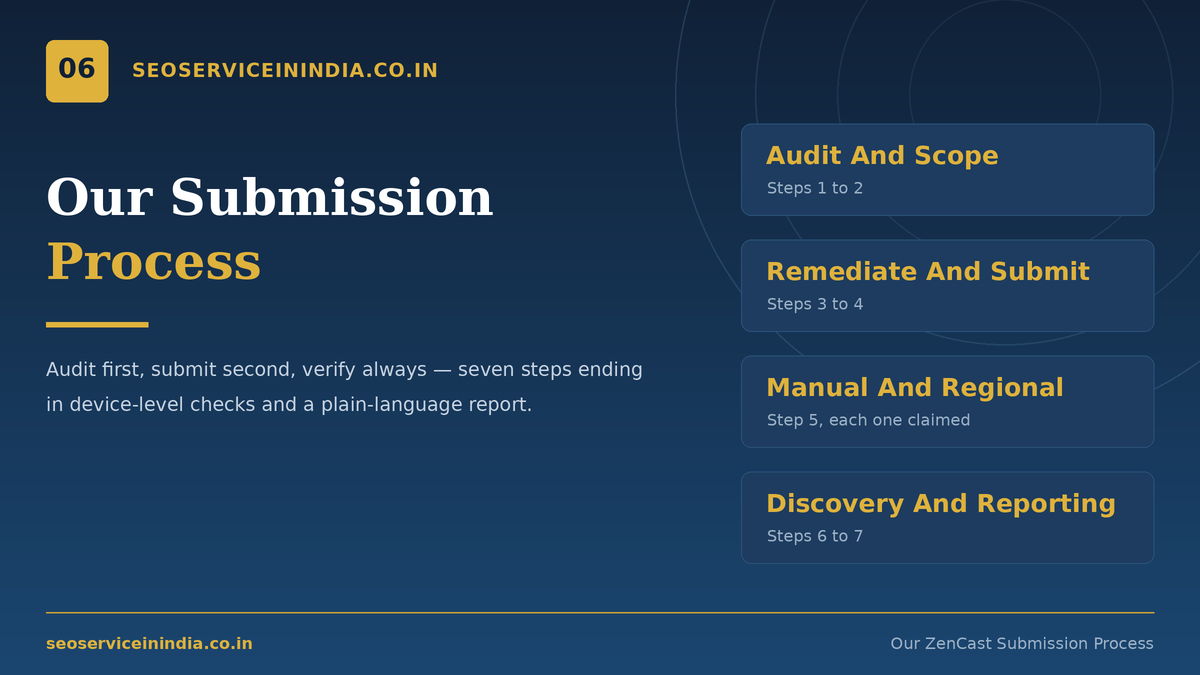
Free feed and listing audit. We validate your ZenCast feed, check which directories already carry your show, flag stale or duplicate listings, and confirm whether your current plan supports what you want to achieve. You get the findings whether or not you hire us.
Scope and plan sizing. Listing job, migration job, or plan upgrade — decided by evidence, not by default.
Feed remediation. Artwork, categories, owner email visibility, GUID stability, crawler access, blocking tags. Fixed before submission, not after rejection.
Primary submission. Apple Podcasts and Spotify, through to verified live listings.
Manual and regional submissions. The global set plus the markets your audience is actually in, each one claimed.
Search and discovery build. Canonical episode pages, transcripts, schema, internal linking, answer-engine readiness.
Verification and reporting. Device-level checks on every listing, review monitoring configured, and a plain-language monthly report: where you are listed, what changed, what the reviews say, and what search is doing.
Global Markets
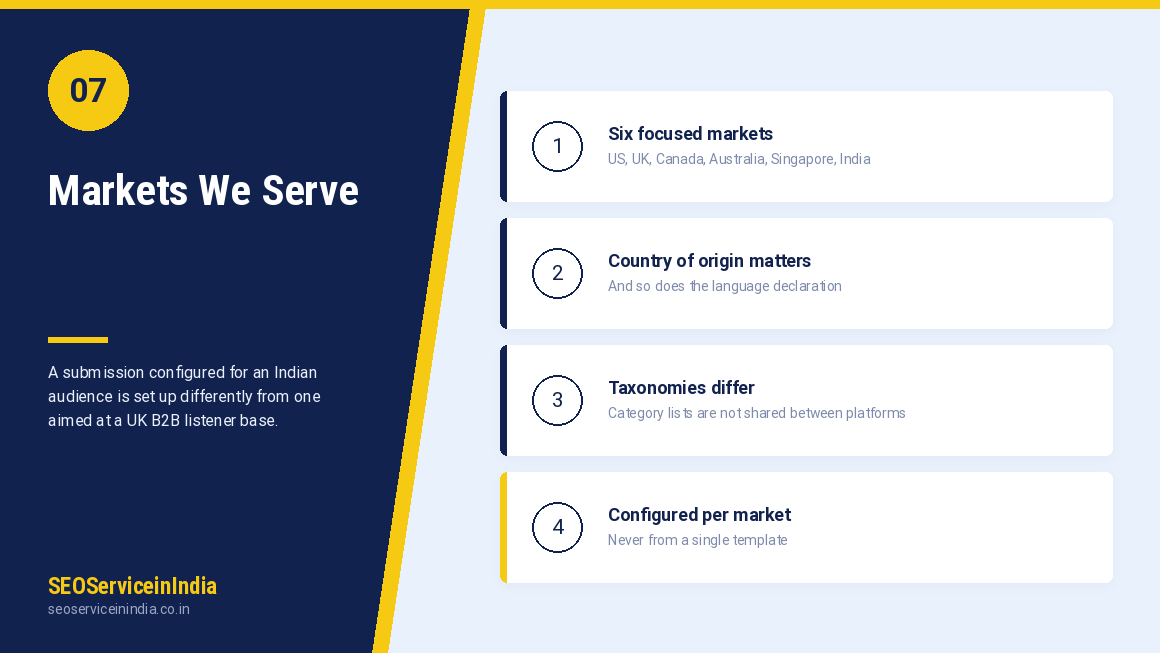
Market notes: where your listeners are
United States and Canada. The deepest directory ecosystem and the market where Apple, Spotify, YouTube Music and Amazon Music together account for most listening. Also the market where buyers, sponsors and guest bookers check your Podchaser record, so the commercial layer gets attention alongside the listening apps.
United Kingdom. Apple-heavy with strong app diversity. Category choice and clean episode metadata do more here than volume of listings.
Australia and New Zealand. ZenCast's home market — built in Melbourne — so Australian teams often find local support timezone-friendly. Distribution priorities mirror the US set with stronger iHeart and TuneIn presence.
Singapore. Small, multilingual and easy to get wrong. Language declaration matters more than anything else: a show in English aimed at a Singaporean audience should say so, and a Mandarin, Malay or Tamil element needs declaring rather than defaulting.
India. Android-majority, regional-language-rich, and badly served by an Apple-and-Spotify-only distribution plan. JioSaavn, Hubhopper, Gaana, Amazon Music India and Podcast Addict carry real audience here, and diaspora targeting in the US, UK, Canada, Australia and Singapore works best when the language and category fields are honest.
Why Choose Us
Why podcasters choose SEOServiceinIndia
Experience. We have submitted, claimed, repaired and migrated feeds across every major host and directory — including the dead ones still listed in the listicles. We know which forms fail silently, which verification emails go to the feed address instead of your inbox, and which platforms need a human on the other end.
Expertise. We are an SEO firm first. That means the submission work is done in service of something measurable: findability. Transcripts, schema, canonical pages and internal architecture are core practice for us, not an upsell.
Authoritativeness. Named specialists work your account, the work is documented, and every listing we claim is verified on a real device before we call it done.
Trust. We tell you what is free. ZenCast's one-click submission, its concierge migration, its bandwidth and its trial cost you nothing extra, and we say so on this page rather than letting you assume otherwise. We do not buy reviews, fabricate listings, create fake profiles as backlinks, or promise chart positions that no vendor controls.
Packages
Packages
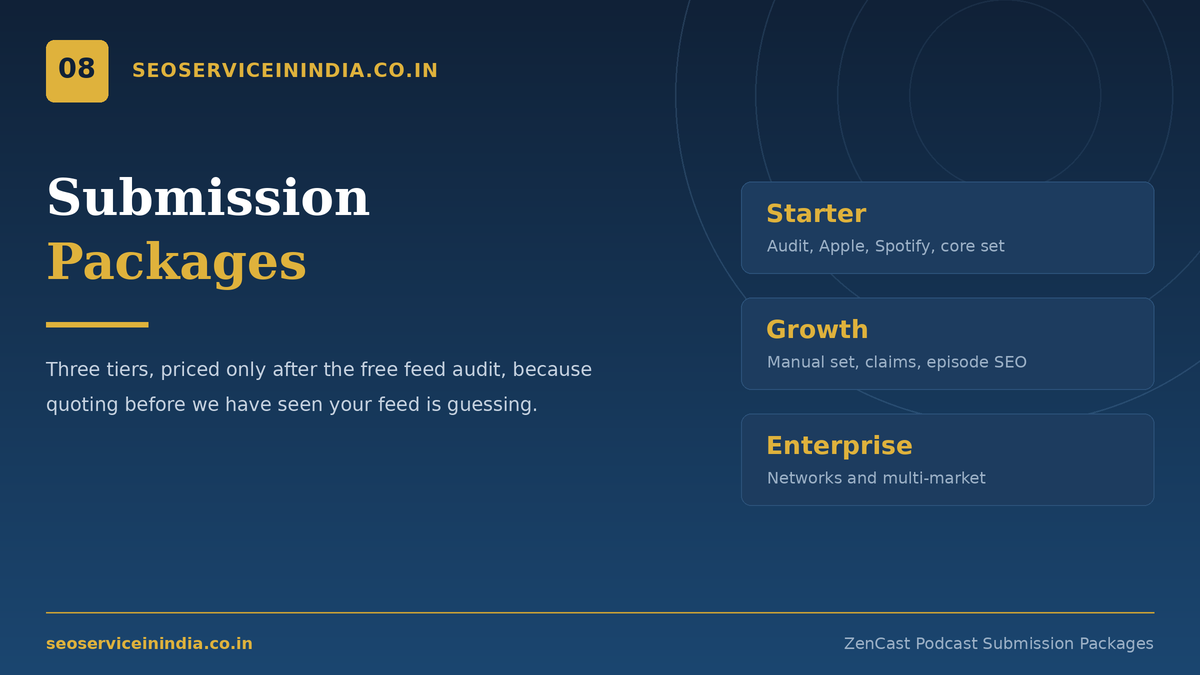
Three tiers, priced only after the free feed audit — because quoting before we have seen your feed is guessing.
Starter
Feed audit and remediation, Apple Podcasts and Spotify submission and verification, core directory set, listing verification report.
Growth
Everything in Starter, plus the full manual and regional directory set with ownership claims, review monitoring configured and reported, canonical episode pages with transcripts and schema for your published back catalogue, monthly reporting.
Enterprise
Everything in Growth, across multiple shows or a network, plus plan-level consultancy, private and public feed architecture, multi-market localisation, migration management and custom reporting for procurement or stakeholder sign-off.
No. ZenCast's own documentation describes a one-click submission process covering Apple Podcasts, iTunes and Spotify. The other platforms shown on its site can carry your feed, but each one needs a separate submission, account or claim. Two of the logos still displayed, Stitcher and Google Podcasts, no longer exist.
No, ZenCast is a hosting and publishing platform. Your audio and RSS feed live there and your show is published outwards from it. There is no ZenCast listing to appear in and no ZenCast chart to rank in.
They are two different companies. ZenCast is a podcast host built in Melbourne. Zencastr is a browser-based remote recording platform launched in 2014 by a different team. Searches for one very often land on the other.
Hobby covers hosting and the two automated submissions. Professional adds the custom domain, website customisation, review tracker, scheduler and private podcasts, which is the practical floor if search visibility or review monitoring matters. Plus is a flat rate for unlimited shows, which usually works out cheaper than running three shows on Professional, since Hobby and Professional bill per podcast.
Almost always a feed or verification issue rather than a publishing failure: artwork below the minimum size, a hidden owner email so the verification code never arrives, a blocked crawler, a leftover blocking tag, or a submission still sitting in the review queue. The audit identifies which, and each has a different fix.
No. The one-click submission, concierge migration, bandwidth and transcriptions come with your plan, and we say so plainly. Our fee covers the manual submissions, the ownership claims, the feed remediation and the on-site search work that no host performs.
The audit takes two to three business days. Feed fixes are usually same-week. Apple's review queue and the manual claim set typically resolve inside two to three weeks. Episode page and transcript SEO is continuous, and the first meaningful search movement usually shows in six to twelve weeks.
Free Feed Audit
Get your free ZenCast feed audit
Send us your ZenCast RSS feed URL and we will tell you exactly where your show is listed, where it is missing, what in your feed is blocking ingestion, and whether your current plan supports what you are trying to do. No cost, no obligation, and you keep the findings either way.
Talk to our podcast distribution team today — and get your show in front of the listeners who are already searching for it.
