
Hosting and distribution — unlimited storage, episodes and downloads, one-click distribution to 20+ listening platforms, IAB-certified analytics, a podcast website, a social media manager and clip tools. Plans run Launch, Boost and Supersonic, roughly $13, $29 and $69 per month on annual billing.
Ausha · Submission & PSO
Ausha Podcast Submission Services
Most podcast platforms give you a listing and leave you guessing. Ausha does something almost no other platform in this category does: it gives podcast search a scoreboard. Keyword search volume. A difficulty score. Your actual position on Apple Podcasts and Spotify, keyword by keyword, tracked over time, with competitor rankings sitting in the same view.
That changes what a submission service is worth. Anyone can paste an RSS feed into a form. Our Ausha podcast submission services cover the feed and directory work properly, then use the measurement layer Ausha hands you to run podcast discovery as a real optimization loop — research, publish, measure, adjust — the same way we run search campaigns for websites.
This page explains exactly what Ausha is (and isn't), where shows quietly go missing inside it, what we do about it, and what it costs. If you only want the short version: the listings themselves are free, and we'll tell you so. What you're paying us for is the work around them.
Three Products, Not One
01
02
03
What Ausha actually is — three products, not one
Ausha is a French podcast hosting and marketing platform, founded in 2018 and used by more than 24,000 active shows, including publishers like BBC Studios and AFP. It holds ISO/IEC 27001:2022 certification, which matters more than podcasters expect when a brand's legal or procurement team has to approve the vendor.
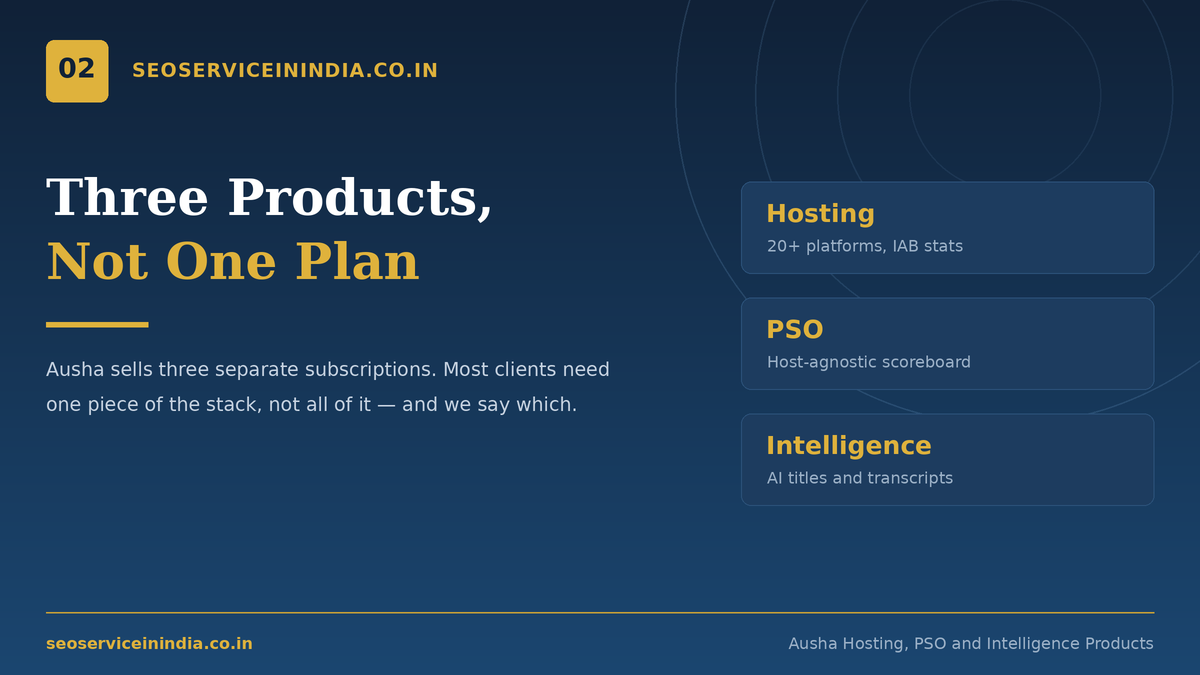
The part that confuses almost everyone: Ausha sells three separate subscriptions, not one bundle.
PSO (Podcast Search Optimization) — the keyword research and rank-tracking suite, sold as its own product line with Starter and Grow tiers. Crucially, it is host-agnostic. You can buy the scoreboard without moving your show to Ausha.
Ausha Intelligence — the AI module for transcription, search-optimized titles, descriptions, tags and promo copy. Also sold separately.
So there is no single "Ausha plan". There is a stack, and the honest answer for a lot of clients is that they need one piece of it, not all three. If your current host is fine and your problem is discoverability, the PSO Control Panel alone may be the right purchase and a migration would be wasted money and risk. We say that at the audit stage, before any invoice exists.
Distribution Gaps
01
02
03
04
05
06
Where podcasts quietly go missing on Ausha
"One-click distribution" is accurate, and it is also where people stop reading. These are the gaps we find most often.
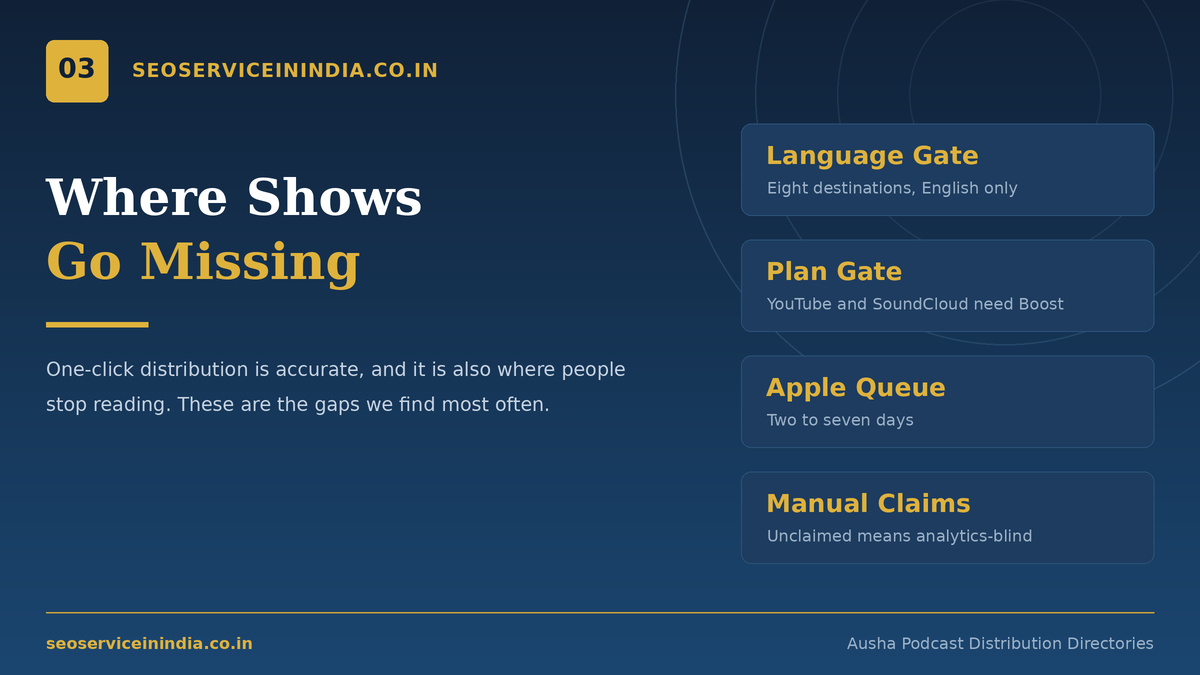
The English-language gate. Distribution to Podchaser, Listen Notes, Podcast Index, iHeartRadio, PlayerFM, JioSaavn, Gaana and Pandora is offered only for English-language shows. If you publish in Hindi, Tamil, Bengali, Mandarin, Malay, French or anything else, those eight destinations do not open from the dashboard — including JioSaavn and Gaana, which are exactly where an Indian-language audience lives. That work becomes manual submission, per platform, with per-platform verification. It is the single most common reason a non-English show on Ausha is under-distributed and doesn't know it.
The plan gate on YouTube and SoundCloud. Those two destinations require Boost level or higher. Plan selection is a distribution decision, not a storage decision, and shows on the entry plan routinely discover the gap months later.
Publish-before-distribute. Distribution can't be configured until the show has complete general information — title, description, correctly sized artwork — and at least one publicly published episode. A scheduled or draft episode won't unlock it. Launch checklists get built backwards all the time because of this.
The Apple queue. Ausha has streamlined Apple submission considerably, but Apple remains the platform with the strictest ingest rules and the longest wait — historically 2 to 7 days versus minutes-to-hours for Spotify. Artwork outside 1400×1400 to 3000×3000, a missing owner email, a non-compliant episode enclosure or a leftover itunes:block tag will hold you there indefinitely with no useful error message.
Stale and duplicate listings. Shows migrated into Ausha without GUID preservation and 301 redirects end up as two records in downstream directories — the old one still collecting the downloads, the new one collecting nothing.
Manual-claim destinations. Several platforms will list you but hand ownership, analytics and self-editing only to whoever claims the record. Unclaimed means analytics-blind and unable to fix your own metadata.
Seven-Step Workflow
01
02
03
04
05
06
07
Our Ausha submission and distribution workflow
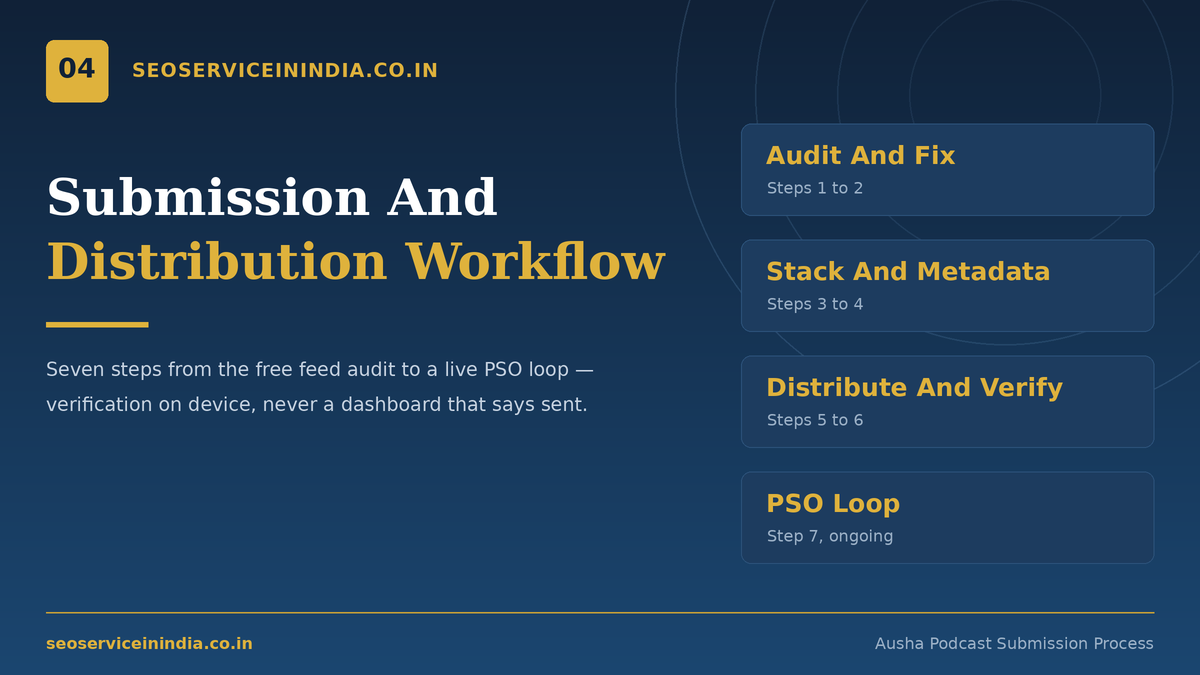
1. Free feed and visibility audit. We fetch your feed the way a crawler does, from outside your network, and check every tag that gates ingestion: owner email exposure, GUID stability, enclosure URLs and redirect chains, artwork dimensions and file type, categories, language declaration, episode count, itunes:block. We also check whether your show is already listed somewhere you didn't submit it — most established shows are.
2. Remediation before submission. Broken feeds get fixed first. Submitting a faulty feed to fifteen directories produces fifteen rejections and, worse, fifteen bad cached records.
3. Stack decision. Hosting, PSO, Intelligence, or some subset. Written recommendation with reasoning, including the case for staying on your current host.
4. Metadata build. Show title and subtitle, description with the first two lines written as the ones that actually get read, category and subcategory selection, tags, language and locale declaration, episode title conventions.
5. Distribution execution. Every eligible destination activated from the dashboard, plus manual submission for the ones your language or plan excludes, plus claim-and-verify on every platform that supports ownership.
6. Verification on device. We don't report a submission as complete because a dashboard says "sent". We confirm the listing renders, the artwork is right, the episodes play and the links resolve — on iOS and Android.
7. PSO loop, ongoing. Covered next. This is where the work stops being setup and starts being marketing.
Podcast Search Optimization
01
02
03
04
05
PSO: the part most agencies skip
Roughly half of listeners discover new shows inside a listening app, and a large majority of those type into the search bar. That means your episode titles and description are a search surface, not decoration.
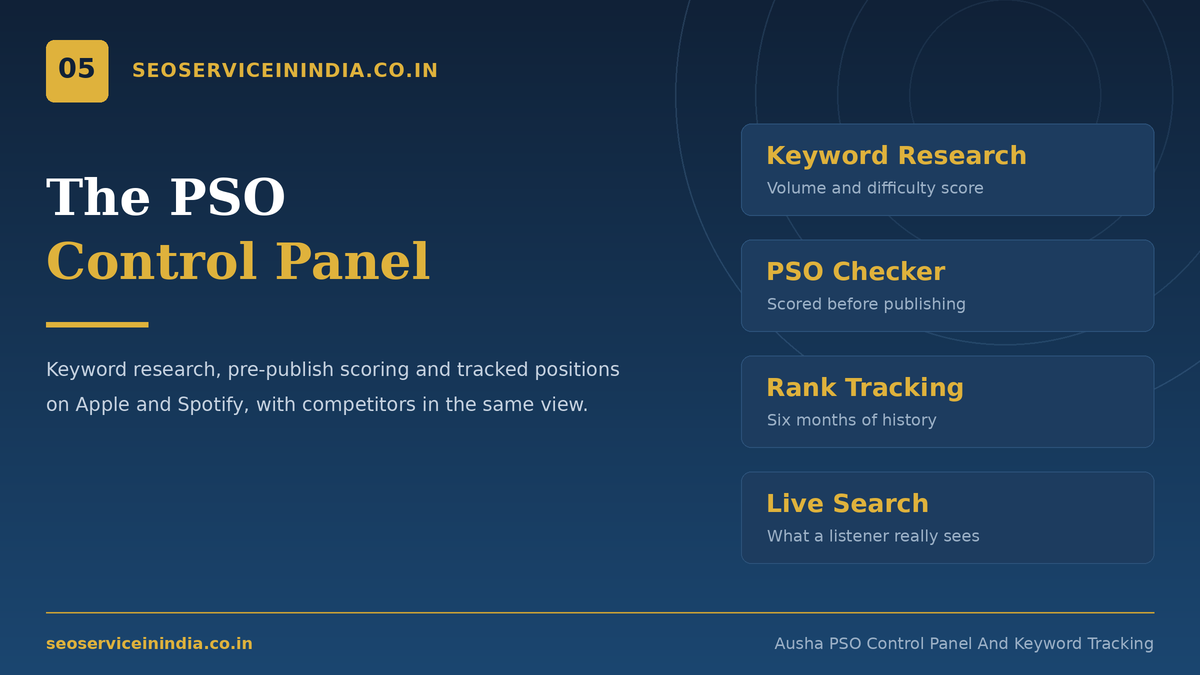
Ausha's PSO Control Panel is the only mainstream toolkit built for this, and in 2026 it got materially stronger with competitor rankings moved directly into keyword tracking. Here's how we use each part.
Keyword research. Search volume plus a difficulty score, with AI scanning your existing metadata and transcripts to surface keyword opportunities you already half-rank for. We map these into a show-level set and an episode-level set, because they behave differently.
PSO Checker. Paste a draft title, description and tags; get an optimization score and a step-by-step list. We run every episode through this before publication, not after.
Keyword tracking and rankings. Positions on Apple Podcasts and Spotify across your tracked keyword set, with history. Keyword allowances depend on tier — the entry PSO plan covers one show and a substantial keyword list with six months of history — so we size the set to what's genuinely commercial rather than tracking vanity terms.
Competitors and Category Benchmark. Which shows occupy your keywords, and what the top performers in your category are doing differently.
Live Search. A simulation of what a listener actually sees when they type your target term. This is the sanity check that keeps reporting honest.
One necessary caveat, and we'd rather you hear it from us: in-app search results are personalized and regionalized. A tracked rank is a strong directional signal, not a guaranteed universal position, and nobody — us included — can contractually promise you position one. What we can do is move the inputs, measure the movement, and show you the history.
Beyond the Listening App
Search and AI answer visibility beyond the app
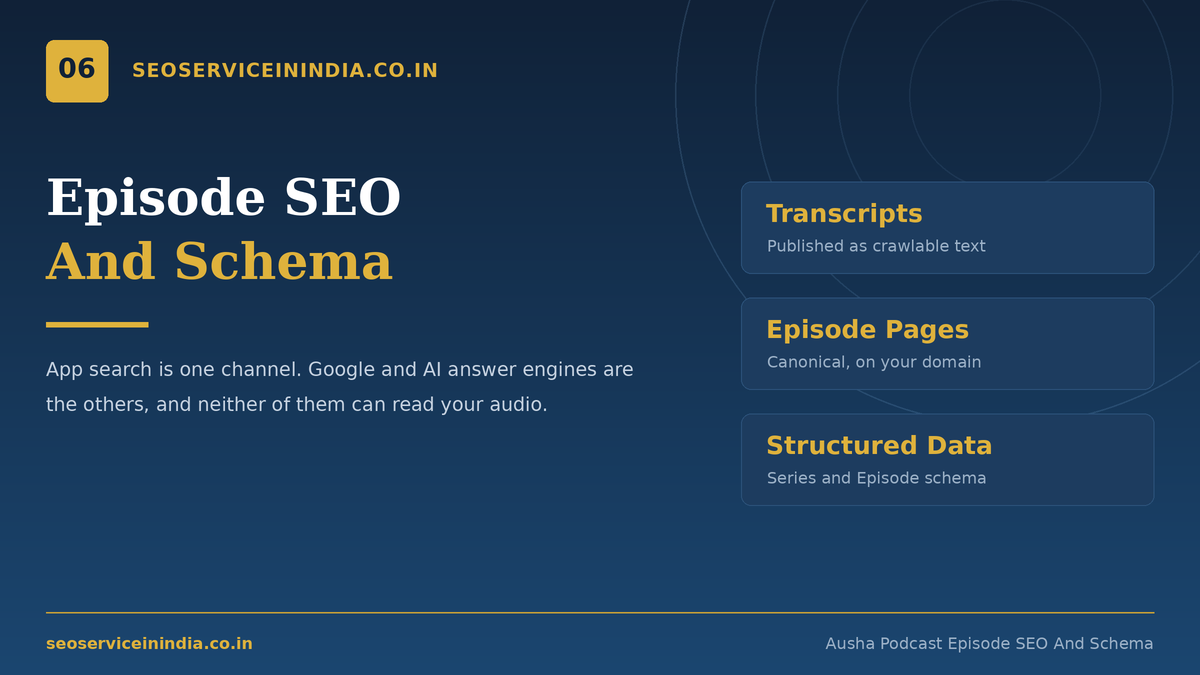
App search is one discovery channel. The others are Google and, increasingly, AI answer engines — and neither of them can read your audio.
We build the layer that makes your show legible outside the podcast apps: full transcripts published as crawlable text, a canonical episode page on your own domain for every episode with real show notes rather than a bare player, PodcastSeries and PodcastEpisode structured data, rel="alternate" pointing at your feed, and internal linking so episode pages actually accumulate authority instead of sitting orphaned. Ausha's built-in podcast website is a useful starting point; for brands with an existing site, the stronger play is almost always hosting episode pages on your own domain.
The compounding benefit: a well-structured transcript is the thing an answer engine can quote, and a quotable episode is how a niche show gets cited.
Paid amplification, scoped honestly
In April 2026 Ausha launched Visibility Ads in beta — paid podcast campaigns on Spotify and YouTube, run from the Ausha workspace, powered by a partnership with Base for Creators, starting around $100 and open even to shows hosted elsewhere.
It's a genuinely useful accelerator for a launch, a new season or a repositioning. It is not a substitute for the organic work, and we won't sell it as one. Our role is campaign structure, creative and measurement, so you can tell whether the spend produced followers or just impressions. We don't take a markup on your ad budget.
Related note, because reviews still repeat it: the brand sponsorship marketplace some Ausha comparisons list as a monetisation perk is winding down as of 1 November 2026. If sponsorship revenue is your reason for choosing a platform, that specific selling point no longer applies and we'll plan your monetisation route separately.
Migration, in or out
Migrations are where back catalogues die. Ours follow the same non-negotiables every time: episode GUIDs preserved exactly so downstream apps recognise existing episodes instead of creating duplicates; a feed-level 301 from the old host; the new feed URL pushed by hand to every platform that does not follow redirects; analytics baselined before and after so you can see whether numbers moved or measurement did; and a rollback plan.
If you run a private or members-only feed, we keep a two-feed architecture: a public marketing feed submitted everywhere, and a private feed submitted nowhere.

Global Delivery
Markets we work across
United States and Canada — the deepest directory ecosystem and the market where category competition on keywords is fiercest, so PSO sets need to be narrower and more specific.
United Kingdom — strong branded-podcast demand; the ISO 27001 and EU-hosting story tends to matter to corporate procurement here.
Australia — a mature, concentrated listener base where category benchmarking beats broad keyword chasing.
Singapore — multilingual audiences make correct language declaration and per-locale metadata decisive; English-language shows also unlock the eight gated destinations.
India — the largest single opportunity and the one most affected by the English-language gate. Hindi and regional-language shows need manual submission to JioSaavn, Gaana and the rest, plus Android-first assumptions in every link and CTA decision. Diaspora targeting is handled deliberately, not left to chance.
Why SEOServiceinIndia
Experience. We run this work daily across platform after platform — hosts, directories, aggregators and the closed platforms that people still try to submit to. We know which fields matter, which "submission" buttons are actually requests, and which failures are the platform's fault rather than your feed's.
Expertise. Our team works in search all day. Applying keyword research, difficulty assessment, metadata discipline and rank tracking to podcast search isn't a stretch for us — it's the same discipline with a different index, which is precisely why Ausha's PSO product suits how we already work.
Authoritativeness. We publish what we do and why, we name the platform limitations openly, and we don't claim relationships we don't have. We are not an Ausha reseller and we have no incentive to push you onto a plan you don't need.
Trust. Every listing we place is free to place, and we say so on this page. We don't create fake podcast profiles for links, we don't buy reviews or followers, and we don't promise chart positions or guaranteed rankings. You own every account we touch — logins stay in your name, and if you leave, nothing breaks.
Fit & Packages
Starter
Growth
Enterprise
Who this isn't for
We'll decline the work, or tell you to wait, if: your feed is private or fully paywalled, in which case most directories won't accept it by design; you have one unfinished episode and no publishing schedule, since directories and search both reward consistency and you'd be paying us to wait; you want a guaranteed number-one ranking or chart position, which nobody can honestly sell; or you need audio production, editing or scripting, which isn't what we do — though we'll happily work alongside your producer.
Packages
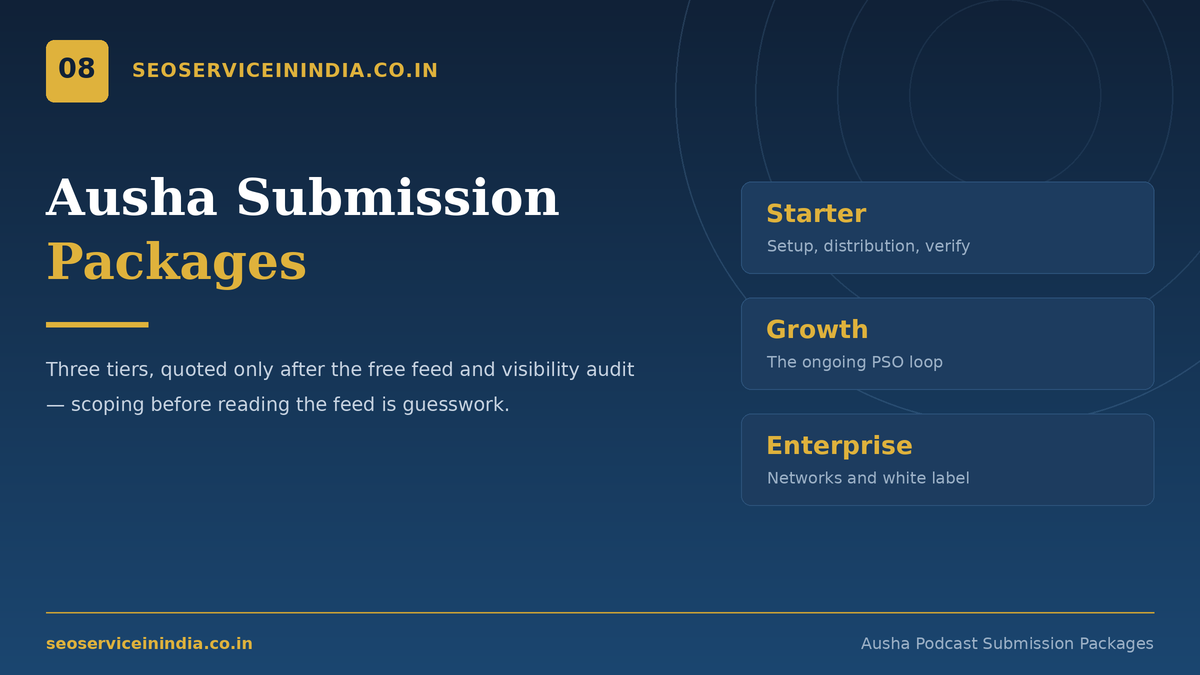
Submission Starter — feed audit and remediation, Ausha account and show setup, metadata build, distribution to every eligible destination plus manual submission where your language or plan requires it, claim-and-verify, device verification and a handover document.
Growth — everything in Starter plus the ongoing PSO loop: keyword set build, per-episode PSO checking before publication, monthly rank and competitor reporting, category benchmarking, transcripts and canonical episode pages with structured data.
Enterprise — multi-show and network setups, migrations, white-label delivery for agencies, multilingual distribution programmes, custom reporting, and Visibility Ads campaign management where it fits the plan.
Pricing is quoted only after the free feed and visibility audit, because scoping a podcast submission project before reading the feed is guesswork, and guesswork is how people end up paying for a migration they never needed.
Ausha is a paid hosting platform, but distributing to the listening directories carries no extra charge on any plan. There is also a free trial. What you pay us for is the feed remediation, metadata, manual submissions, claiming and the ongoing optimization — not for access to listings.
No, and this is the most useful thing to know about Ausha. The PSO Control Panel is sold as a standalone product compatible with any hosting platform. If your host is working fine, we'll often recommend buying PSO alone and leaving your hosting exactly where it is.
Not from the dashboard. Eight destinations — Podchaser, Listen Notes, Podcast Index, iHeartRadio, PlayerFM, JioSaavn, Gaana and Pandora — are offered for English-language shows only. For non-English shows we submit those manually and handle each platform's verification separately.
Spotify typically takes minutes to hours. Apple has historically taken two to seven days because of its review process. Neither timeline can be accelerated by anyone, including us — what we can do is make sure nothing in your feed sends you to the back of the queue.
No, and treat anyone who does with suspicion. In-app search results are personalized and regional. We optimize the inputs we can control, track the outcome honestly, and report movement with history so you can see what the work produced.
Very likely, and that's normal — several directories crawl public feeds automatically. The job then isn't submission, it's finding those records, claiming them, correcting the metadata and removing duplicates left behind by an earlier host change.
It depends on your destinations, not your file sizes. YouTube and SoundCloud distribution requires Boost or higher; API and Zapier access sits on Supersonic. We recommend the cheapest plan that reaches the platforms your audience genuinely uses.
Yes. We deliver unbranded audits, submission logs and PSO reports that agencies pass to their own clients, and we're happy to stay invisible to the end client.
Free Feed & Visibility Audit
Get a free Ausha feed and visibility audit
Send us your RSS feed URL. We'll come back with what's broken, which destinations you're missing, whether you actually need to migrate, and a keyword opportunity snapshot — before you commit to anything.
