
General dentistry
$2 – $8
Per click, typically the cheapest inventory in the account.
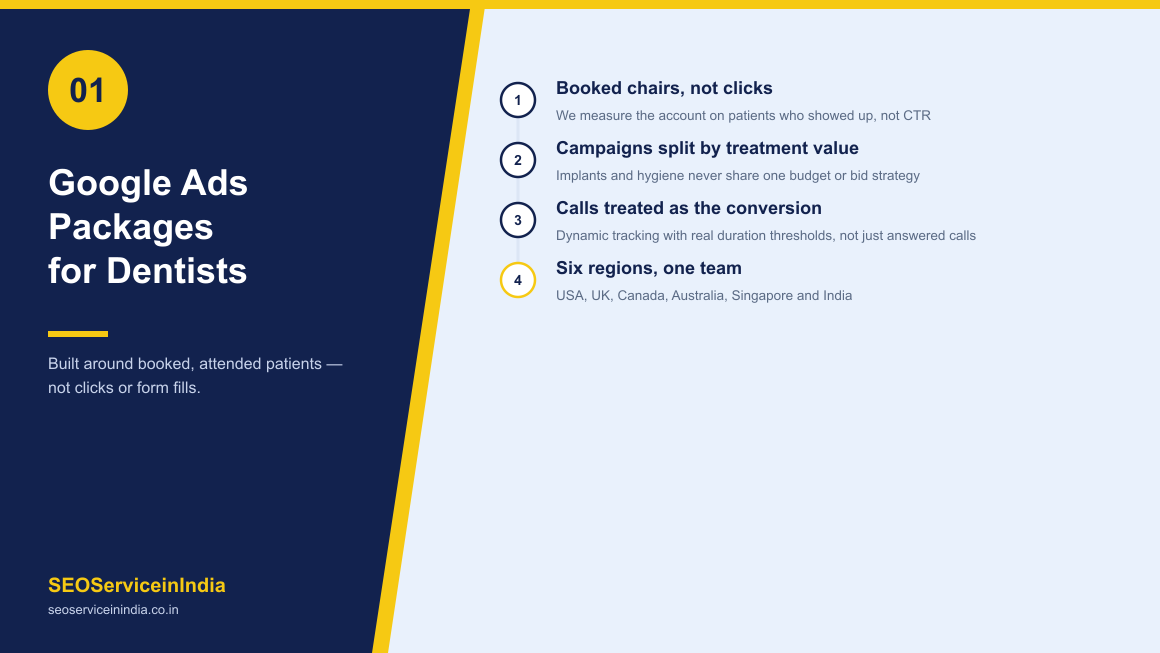
Most dental practices don't have a traffic problem. They have a booked-chair problem. Ads run, clicks arrive, the monthly report shows a healthy click-through rate — and the appointment book still has gaps on Tuesday afternoon. Our Google Ads packages for dentists are built to close that gap, because we measure the account on the only number that pays your overheads: patients who booked, showed up and sat in the chair.
SEOServiceinIndia manages paid search for dental practices, group clinics and dental service organisations across the USA, UK, Canada, Australia, Singapore and India. Every account is built around procedure-level economics, phone-call quality and conversion data pulled back from your practice management system — not vanity metrics.
Dentistry sits at the top of the paid search auction. Industry benchmark data places Dentists & Dental Services among the highest average cost-per-click categories on Google Ads at roughly $7.85, alongside legal services and home improvement. Recent 2026 benchmarks put dental CPC near $8.00 with a conversion rate around 10.67% and cost per lead close to $73.
Source: WordStream, The Ad SpendThat average hides an enormous spread:
$2 – $8
Per click, typically the cheapest inventory in the account.
$5 – $15
Urgent intent, mobile-heavy, and priced accordingly.
$6 – $20
Image-led demand with a longer research window.
$12 – $35
The most expensive query in the account, and the most valuable.
A difference of well over ten times between the cheapest and most expensive query in the same account. Source: Geekpoweredstudios
This is exactly why a single "dental campaign" fails. If implants, hygiene, emergencies and Invisalign share one budget and one bid strategy, the cheap clicks win the auction, the expensive high-value clicks get starved, and the practice concludes that Google Ads "doesn't work for implants." It does. It was simply never given its own campaign, its own budget and its own acceptable cost per patient.
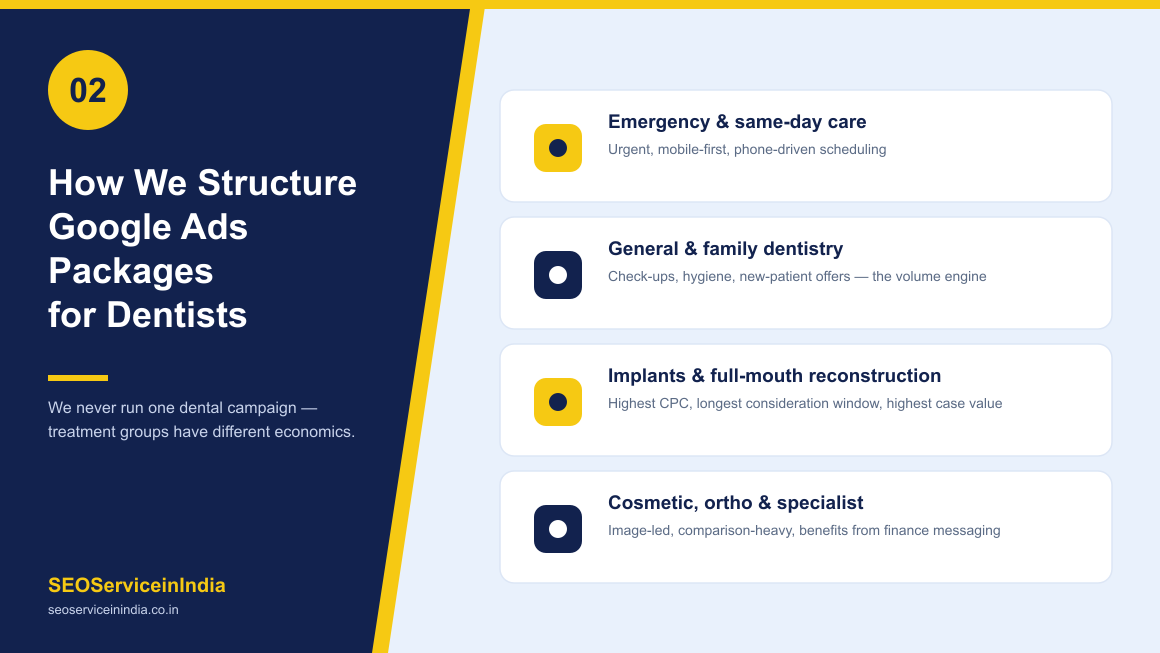
We never run one dental campaign. We build separate campaigns for the service groups that have genuinely different value and behaviour:
Urgent, mobile-first, phone-driven, needs 24/7 or extended-hours scheduling.
Check-ups, hygiene, new-patient offers; the volume engine.
Highest CPC, longest consideration window, highest case value.
Image-led, strong on Demand Gen and remarketing support.
Comparison-heavy, price-sensitive, benefits from finance messaging.
Narrow volume, high margin.
Each group gets its own budget guardrail and its own target cost per booked patient. An implant consultation worth $6,000 in treatment plan value can justify a $300 acquisition cost. A hygiene appointment cannot. Bidding to a blended average across both is the single most common reason dental accounts underperform.
Sending implant traffic to a homepage is how budget disappears. Every package includes procedure-specific landing page recommendations — or full builds on the higher tiers — with the treatment named in the headline, transparent pricing or finance ranges, before-and-after evidence, clinician credentials, insurance and payment plans accepted, and a booking action visible without scrolling.
Patients will drive twenty minutes for a cleaning and two hours for a specialist implant surgeon. We set radius targeting per campaign rather than per account, exclude postcodes that historically produce no-shows, and layer bid adjustments toward the areas your existing patient base already comes from.
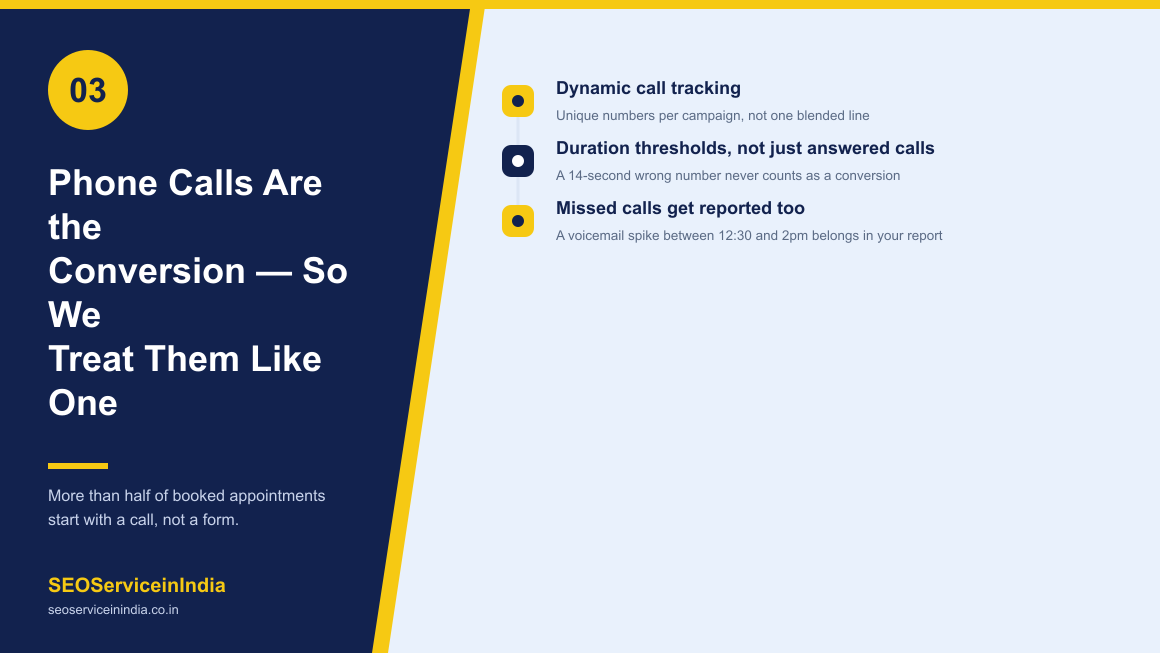
For most practices, more than half of all booked appointments start with a phone call, not a form. That makes call handling part of the ad account, not a separate department.
Every package includes dynamic call tracking with unique numbers per campaign, call-only campaigns for emergency and mobile-heavy searches, and call-duration thresholds so that a fourteen-second wrong number is never counted as a conversion. We typically set a 60–90 second threshold depending on your front-desk script, then tune it against real recordings.
We also report what most agencies quietly ignore: missed and abandoned calls. If 20% of paid calls hit voicemail between 12:30 and 2:00pm, no amount of bid optimisation fixes the account. That finding belongs in your monthly report, and it goes in ours.
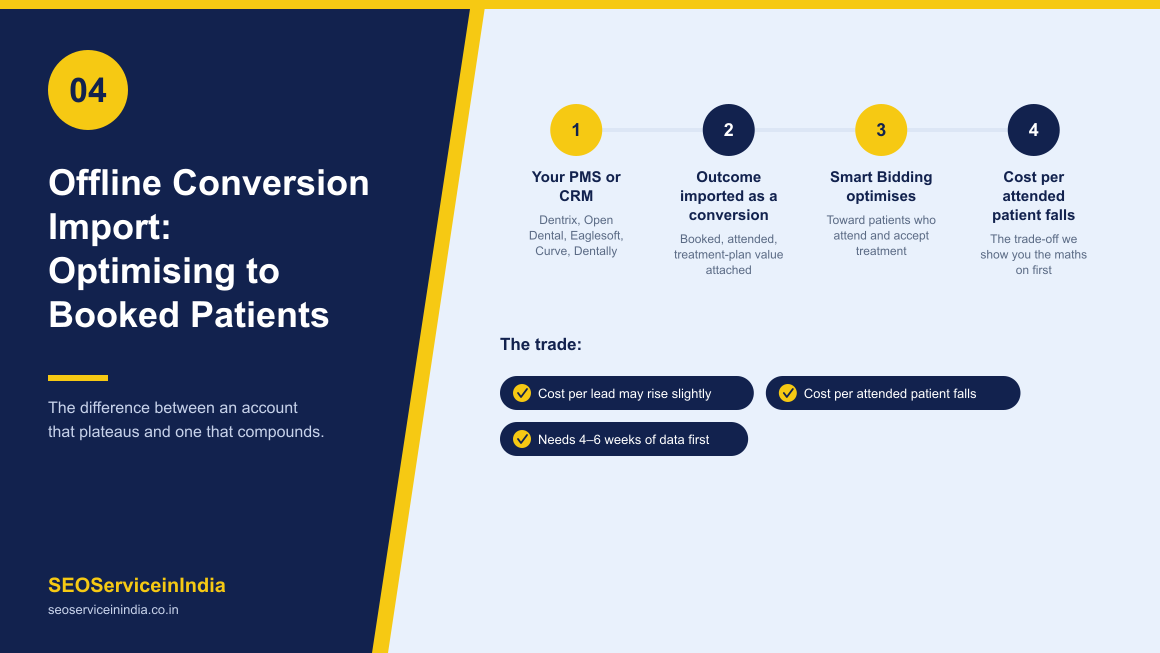
This is the difference between a dental account that plateaus and one that compounds.
By default, Google's Smart Bidding optimises toward whatever you tell it a conversion is — usually a form submission or a call. It has no idea which of those leads booked, which showed up, and which turned into a $7,000 treatment plan. So it happily buys more of whatever is cheapest.
We connect your practice management or CRM system — Dentrix, Open Dental, Eaglesoft, Curve, Dentally, Cliniko, Praktika or your booking platform — and import the outcome back into Google Ads as an offline conversion with a value attached. Once four to six weeks of outcome data is flowing, the bidding algorithm starts buying patients who attend and accept treatment, and stops buying the ones who never answer the follow-up call.
Practices that make this switch usually see cost per lead rise slightly and cost per attended patient fall considerably. That trade is always worth taking, and we will show you the maths before we make the change.
Local Services Ads sit above standard search ads and charge per lead rather than per click. For dentists in eligible markets they are often the cheapest source of new-patient calls — but the programme has changed significantly and any agency still describing it the old way is out of date.
On 20 October 2025, Google consolidated Google Guaranteed, Google Screened and License Verified by Google into a single Google Verified badge, and the associated money-back guarantee was discontinued. Since then, Google has begun transitioning Local Services Ads out of their separate dashboard and into Google Ads, where they run as a specialised Performance Max campaign type built for pay-per-lead goals, with verification status and the Google Verified badge carrying over automatically. The rollout is phased: the first wave began in August 2026 for selected US home and storefront service advertisers, service-area businesses and accounts with custom bidding follow in late 2026, and non-US accounts plus the remaining categories transition during 2027.
Source: Google Local Service Ads in 2026: How They Work & What's Changing +2Dental sits inside Google's Health category alongside optometry and primary care, so most practices fall into the later waves rather than the first.
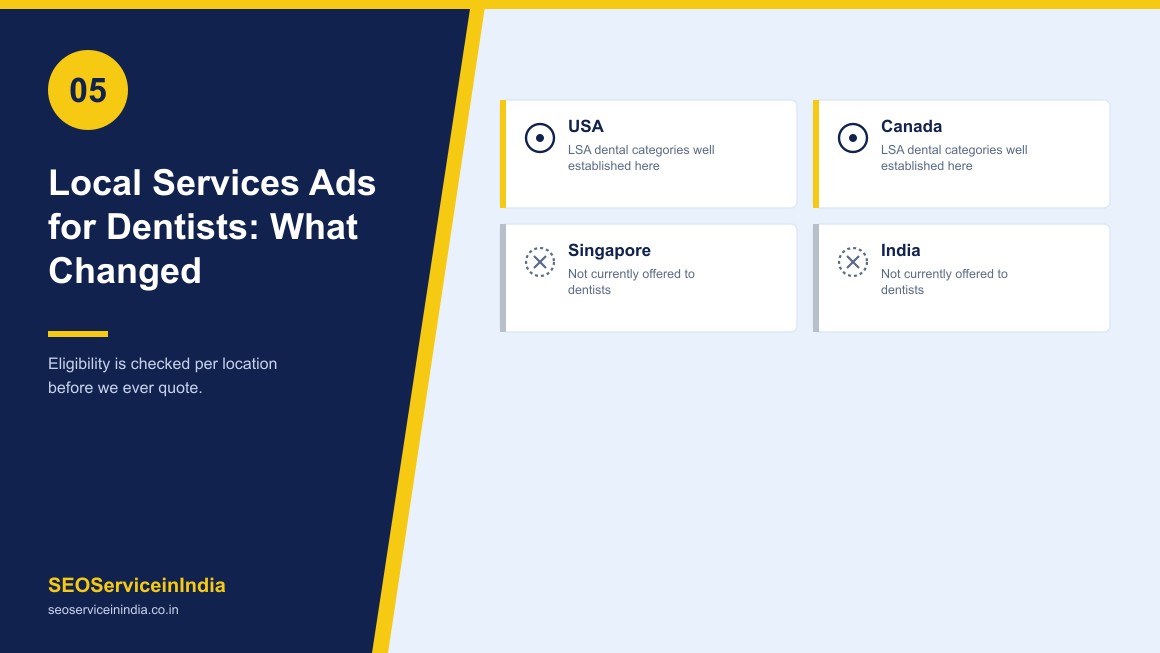
LSA dental categories are well established in the USA and Canada, coverage varies elsewhere, and the format is not offered to dentists in every market — India and Singapore included. We confirm availability for your specific city rather than selling you a channel you cannot use.
They are not available for health care verticals, so for dental accounts we plan around calls and messages rather than in-ad booking. Source: Enrichlabs
Where LSAs are available, we run them alongside Search rather than instead of it. LSAs tend to win on cost per contact; Search wins on high-ticket implant and cosmetic cases where the patient researches before calling.
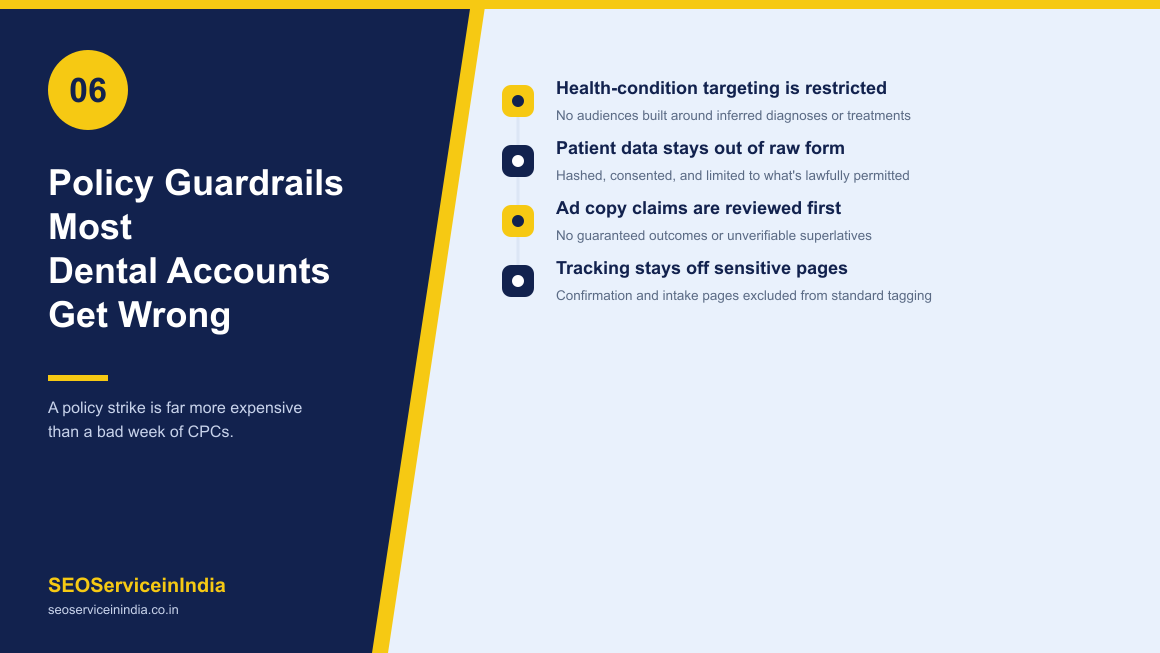
Healthcare advertising carries restrictions that catch out generalist agencies, and a policy strike is far more expensive than a bad week of CPCs.
Google's personalized advertising policy prohibits building audiences around inferred medical conditions or treatments. That means no remarketing list called "visited the gum disease page," no targeting based on a suspected diagnosis, and careful audience naming throughout the account. We build compliant remarketing around site engagement and service interest rather than condition inference.
No patient names, phone numbers or clinical notes are uploaded. Where enhanced conversions or customer match are used, data is hashed, consented and limited to what the practice is lawfully permitted to share under HIPAA, UK GDPR, PIPEDA, the Australian Privacy Act, Singapore's PDPA or India's DPDP Act as applicable.
Guaranteed outcomes, "painless" absolutes, unverifiable superlatives and misleading price anchors are the fastest route to disapproval. We write copy that converts within the rules rather than gambling that a claim slips through.
Confirmation pages tied to a specific treatment, patient portals and intake forms are excluded from standard tagging. We implement server-side tagging and Consent Mode where the market or the practice requires it.
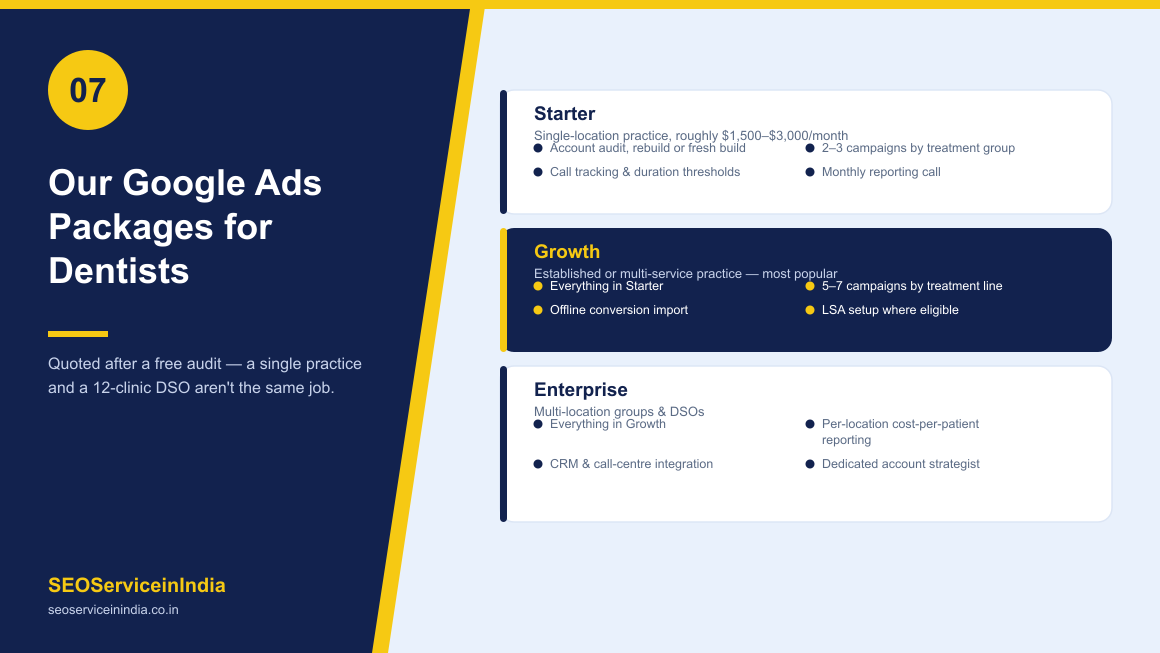
Every engagement starts with a free account and market audit. Final pricing is quoted after that audit, because a single-location suburban practice and a twelve-clinic DSO are not the same job. The tiers below describe scope, not a fixed invoice.
For practices spending roughly $1,500–$3,000 per month on ads and needing a clean, well-tracked foundation.
For practices spending roughly $3,000–$10,000 per month and running several treatment lines.
For groups, franchise networks and dental service organisations across multiple cities or countries.
We manage dental Google Ads accounts for practices in the United States, United Kingdom, Canada, Australia, Singapore and India, plus clients across the UAE and wider Europe. Each market gets its own treatment: insurance-led messaging and LSA eligibility in the US and Canada, NHS-versus-private positioning in the UK, private health fund messaging in Australia, corporate and expatriate patient targeting in Singapore, and price-transparency plus EMI messaging in India where the paid dental auction is far cheaper but the lead-quality problem is far larger.
Three things decide whether a dental account is safe in an agency's hands: regulated-category experience, honesty about what paid search can and cannot fix, and reporting you can actually audit.
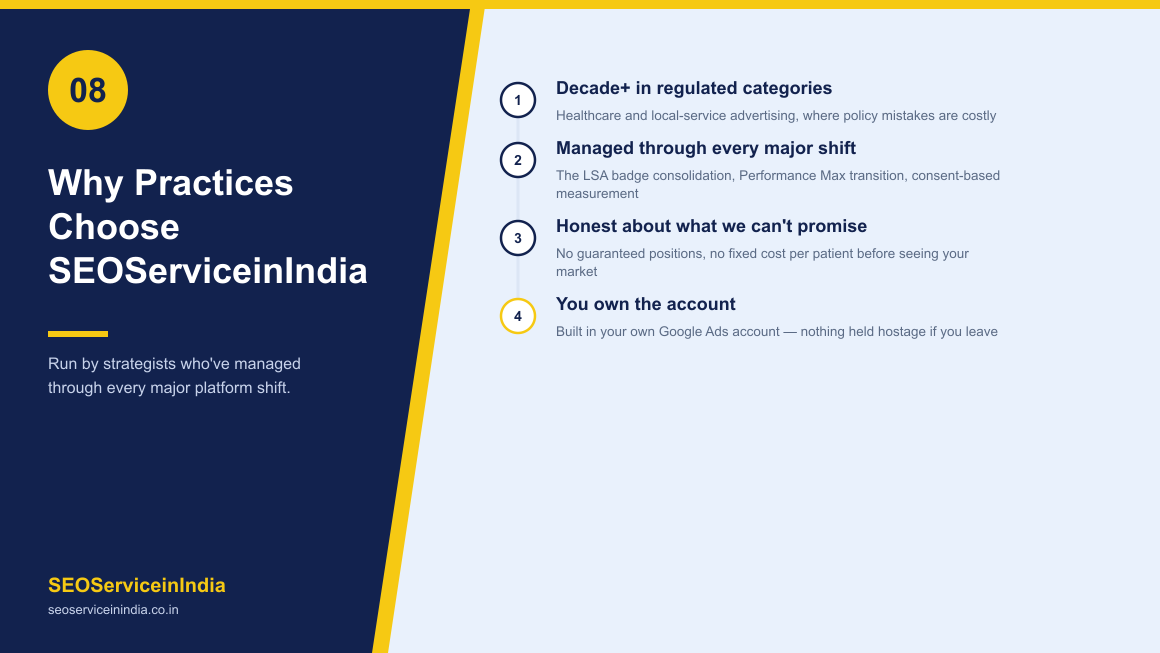
We have run paid media for healthcare and local service advertisers for more than a decade, across regulated categories where policy mistakes are costly. Our dental work is handled by strategists who have managed accounts through the LSA badge consolidation, the Performance Max transition and the shift to consent-based measurement — not by a generalist rotating through fifteen unrelated verticals.
We do not guarantee positions, we do not quote a fixed cost per patient before seeing your market, and we will tell you when your budget is too low for your city rather than take the retainer anyway. Several practices we speak to are better served fixing front-desk call handling for a month before adding a dollar of spend, and we say so.
Reporting is plain. You see what was spent, what came back, and what we changed. Accounts are built in your own Google Ads account under your ownership, so nothing is held hostage if you leave.
Most practices spend between $1,500 and $5,000 per month, with competitive metro areas often needing $3,000 or more to stay visible across high-value service keywords. Smaller markets can perform well at the lower end. In India, effective budgets are typically far lower in dollar terms. We size the budget against your local CPC, your target patient count and your chair capacity — not a standard number.
Source: KeyGrowCost per lead benchmarks for dental Google Ads currently sit around $73–$84, while cost per booked patient runs roughly $70–$150 for general dentistry and $200–$400 for implants and specialty procedures. Those are averages; your figures depend on city, competition and how well your front desk converts calls.
Source: GeekpoweredstudiosSearch campaigns usually produce calls within the first week. Meaningful optimisation needs four to six weeks of conversion data, and offline conversion import needs a full patient cycle — typically six to ten weeks — before bidding shifts toward booked, attended patients. We set expectations at kickoff and report against them.
Where LSAs are available for dental categories in your country, usually yes — they often produce the lowest cost per contact. But eligibility varies by market and they are not offered to dentists everywhere. We verify availability for your location during the audit rather than assuming.
Yes. Most accounts start on the existing site with conversion tracking and call tracking added, plus targeted landing page improvements. Full procedure landing pages are included from the Growth tier upward where the current site is holding conversion rate back.
Yes. We run white-label Google Ads management for agencies serving dental clients, with reporting delivered under your brand.
Send us your current account access or simply your website and target treatments. We will return a written audit covering wasted spend, missing negatives, tracking gaps, landing page issues and a realistic budget-to-patient projection for your city — before you commit to anything.
Talk to our dental PPC team today and find out what a booked patient should actually cost you.

Speak with our SEO Company Experts
Give us a Ring, e-Mail, WhatsApp, or Skype.