
Listening without a screen
Apple, Spotify and YouTube compete for screen attention. TuneIn competes for the moments when there is no screen — and that changes both who hears you and how they behave.
Most podcast discovery advice assumes your listener is holding a phone. TuneIn assumes they aren't. It is the audio layer inside cars, kitchen speakers, smart TVs, gaming consoles and dashboards — the place people listen while driving to work, cooking dinner or working out, without ever opening an app store.
TuneIn serves over 75 million active listeners every month, carrying more than 100,000 radio stations and over 5 million podcasts across more than 200 platforms and connected devices, including over 50 in-car audio systems, in more than 100 countries. If your show isn't in that catalogue, it doesn't exist for a large share of the listening that happens away from a handset.
Our TuneIn podcast submission services get your show into that directory correctly, keep the record accurate afterwards, and build the one visibility mechanism TuneIn actually rewards. Start with a free feed audit.
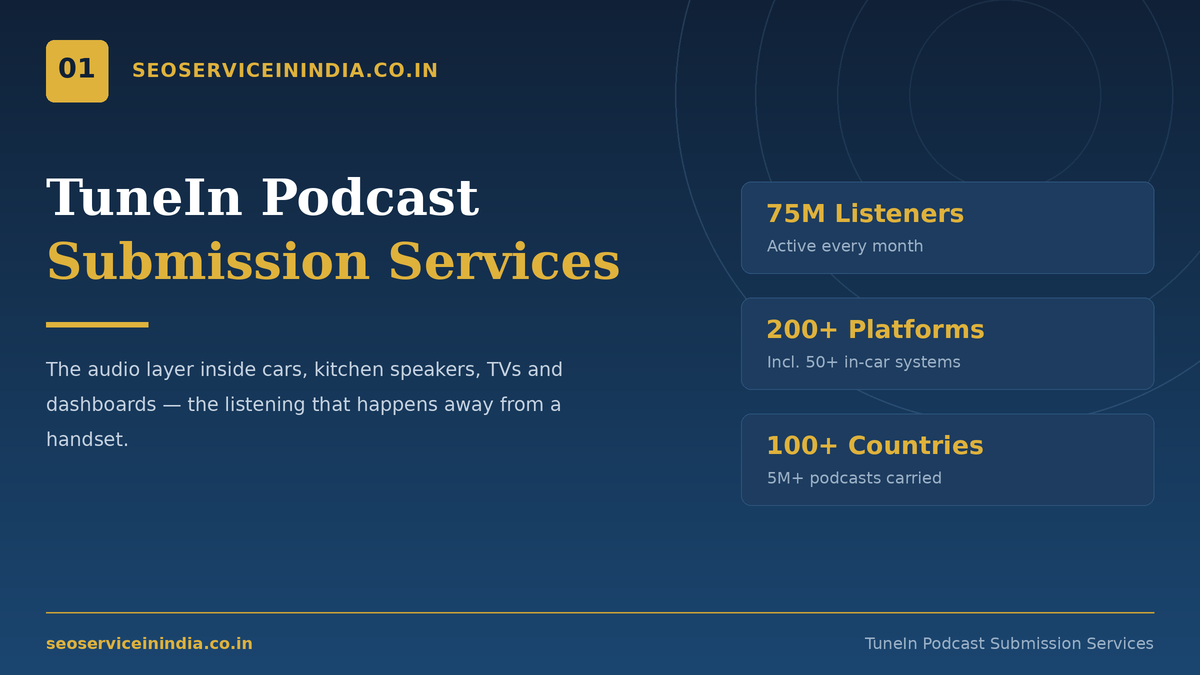
Apple, Spotify and YouTube compete for screen attention. TuneIn competes for the moments when there is no screen — and that changes both who hears you and how they behave.
Connected-device listening sessions are longer. A commuter doesn't skip after ninety seconds; they let an episode run for the length of the drive. A smart-speaker listener rarely browses a category grid; they say a name out loud and expect audio to start. A dashboard listener chooses from a short list of large tiles, not a scrollable feed of thousands.
That has three consequences for how your show must be prepared. Your title has to be pronounceable and unambiguous when spoken. Your artwork has to survive being rendered small and glossy on a dashboard. And your description has to carry your category and subject in plain language, because the systems matching a spoken request to a program are reading text, not interpreting vibes.
This is also why a TuneIn listing behaves like an infrastructure asset rather than a marketing asset. You place it once, correctly, and it propagates to platforms you would never negotiate with individually.
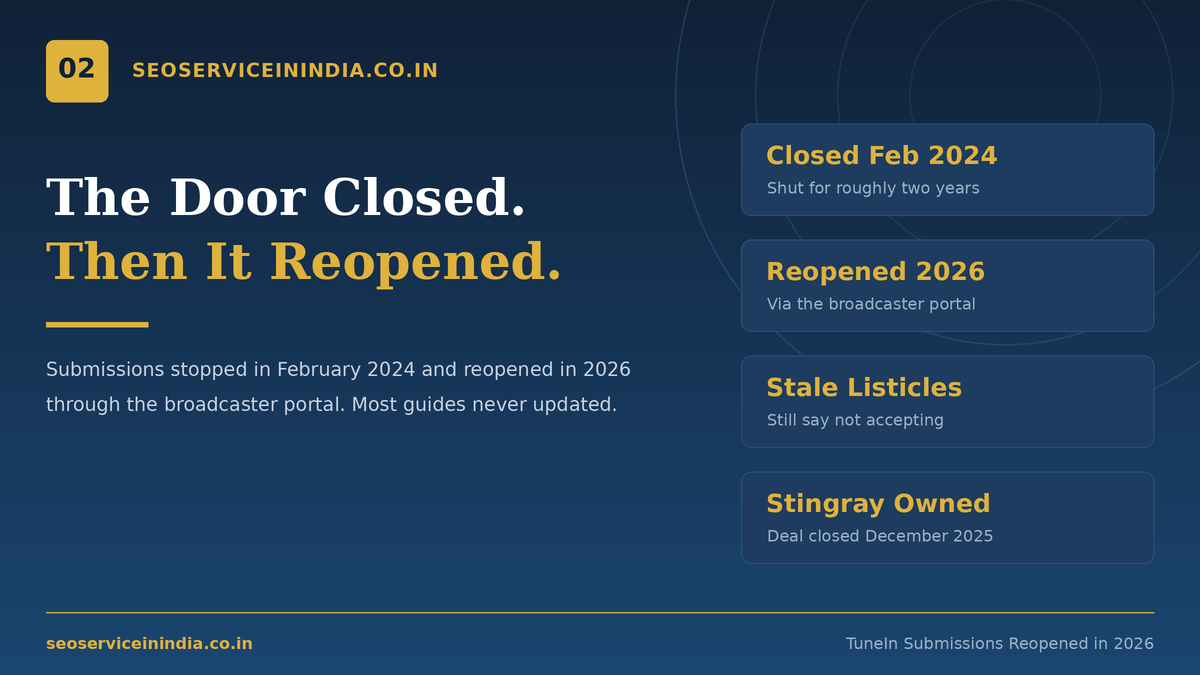
Here is the fact that makes this page necessary: TuneIn stopped accepting new podcast submissions in February 2024, and kept that door shut for roughly two years. In 2026 it reopened through the broadcaster portal.
The problem is that the internet didn't notice. Host knowledge bases, agency blog posts and "top 50 podcast submission sites" listicles written during the closure still tell podcasters that TuneIn is not accepting submissions. Some of them link to portal pages that changed. Others send you to a generic support inbox that no longer handles listing requests.
So two groups of podcasters are currently missing out. The first tried during the closure, got rejected or ignored, and wrote TuneIn off permanently. The second read the stale guidance and never tried at all.
There is a third group as well: shows that were listed before February 2024, never touched the record again, and have since migrated hosts, rebranded or changed artwork. Their listing is live and wrong.
Our first job is to work out which of those three you are. That takes a feed audit, not a sales call.
In November 2025, Stingray agreed to acquire TuneIn in a deal worth up to $175 million, and the transaction closed in December 2025. The TuneIn brand continues to operate as it did.
Why should a podcaster care about a corporate transaction? Because TuneIn is now part of a group whose business is audio distribution and advertising at scale, with device and automotive partnerships on both sides of the deal. The strategic direction points toward more monetisable, better-structured inventory — which means the quality and completeness of your catalogue record is more likely to matter over time, not less.
Practically, it also means stability. A directory that has just been bought for its distribution footprint is not a directory that is about to be switched off. That's a reasonable thing to know before you invest work into a listing.
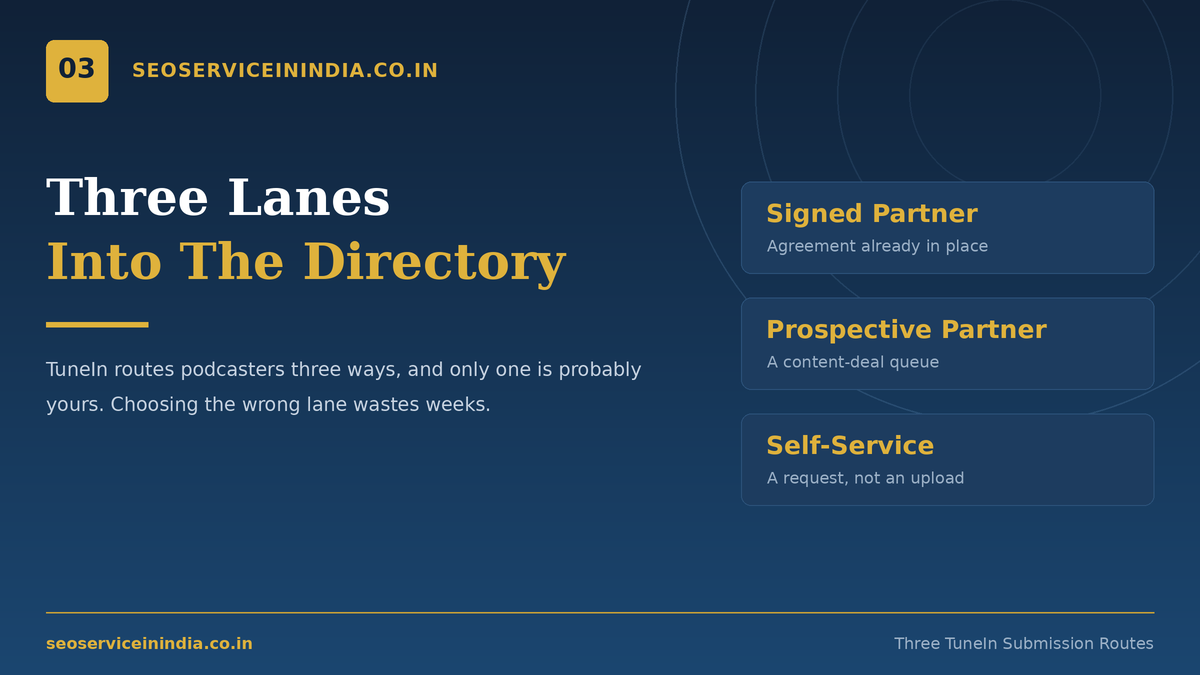
TuneIn's own documentation routes podcasters down three different paths: one form for organisations that have already signed a partner agreement, a second for prospective partners actively working with TuneIn's content team, and a self-service portal for everyone else.
The wording on that self-service route is worth reading carefully. You are submitting a request to be added to the directory. It is not an upload, and it is not guaranteed. A request with a broken feed, placeholder artwork or an incoherent category selection is a request that quietly fails.
The submission itself runs through the broadcaster portal: you verify an email address with a login passcode, open the add-podcast flow, paste your RSS feed URL, and complete the remaining required fields — podcast title, category and language — before submitting for review.
Choosing the wrong lane wastes weeks. A single independent show filing as a prospective partner joins a queue meant for content deals. A twelve-show network filing twelve separate self-service requests creates twelve unlinked records instead of one coherent publisher footprint. Part of what you're buying here is someone who has done this often enough to pick the right door first time.
This is the failure mode that catches experienced podcasters, and it is documented by the hosts themselves.
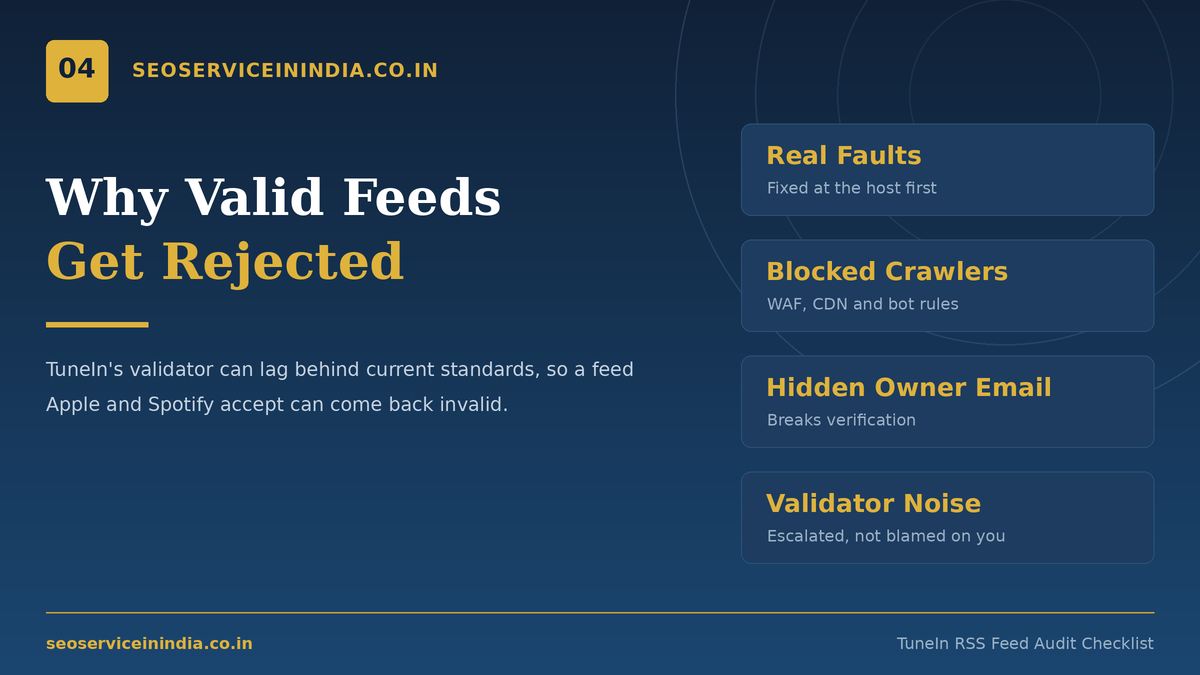
TuneIn's internal feed validation can lag behind current podcasting standards. A feed that is entirely valid — and accepted without complaint by Apple and Spotify — can be returned with an "RSS feed is not valid" error simply because it carries newer tags that TuneIn's validator doesn't yet recognise. Acast tells its own users to expect this and to escalate to TuneIn support when it happens.
If you don't know that, the error message lies to you. You go back to your host, hunt for a fault that isn't there, re-encode files, regenerate GUIDs and sometimes break something that was working. We have seen shows lose episode history chasing a phantom validation error.
Our feed audit separates real faults from validator noise. Real faults we fix:
Validator noise we handle differently: documented, escalated and pursued with TuneIn support, with your host's confirmation attached — rather than pretending a platform bug is your fault.
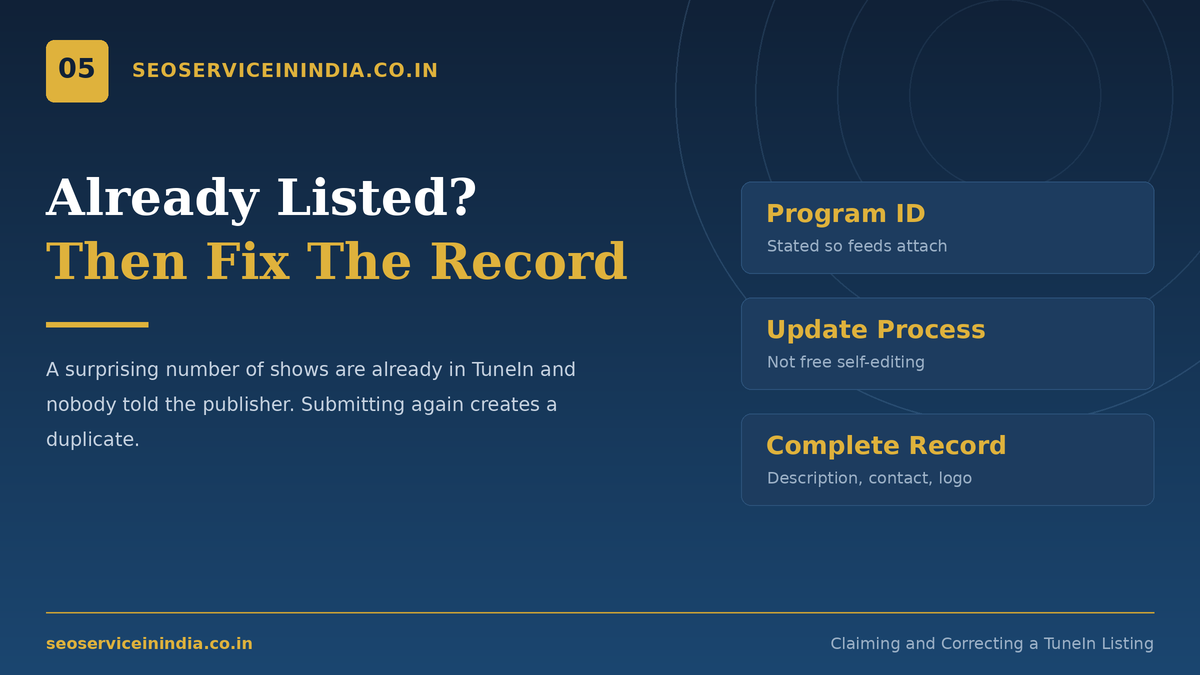
A surprising number of shows are already in TuneIn and don't know it. Feeds get picked up through host relationships, partner distribution and historical submissions, and nobody tells the publisher.
Two things follow. First, submitting again creates a duplicate — two records, split listening, and listeners landing on whichever version the platform happens to surface. Second, if you never claimed or corrected the original, it may be showing artwork from three rebrands ago against a feed URL you stopped using.
Listings on TuneIn are organised around a program, each with its own program ID. When a feed needs to be attached to an existing program rather than creating a new one, that ID has to be stated explicitly in the submission — otherwise you get the duplicate. Corrections to a live listing go through TuneIn's podcast update process rather than being self-edited freely, which is exactly the kind of admin that sits in an agency's hands rather than a producer's.
TuneIn also states plainly what a complete record looks like: shows carrying a proper description, contact details, a schedule lineup and a logo tend to attract more listeners than those with gaps. That is not a subtle SEO theory. It's the platform telling you which fields it rewards.
So the deliverable here is a clean, single, current, complete record — found, claimed, corrected and maintained.
Every directory page you read promises "featured placement". On most platforms, that promise is fiction. On TuneIn, you don't have to guess — the platform answers the question itself.
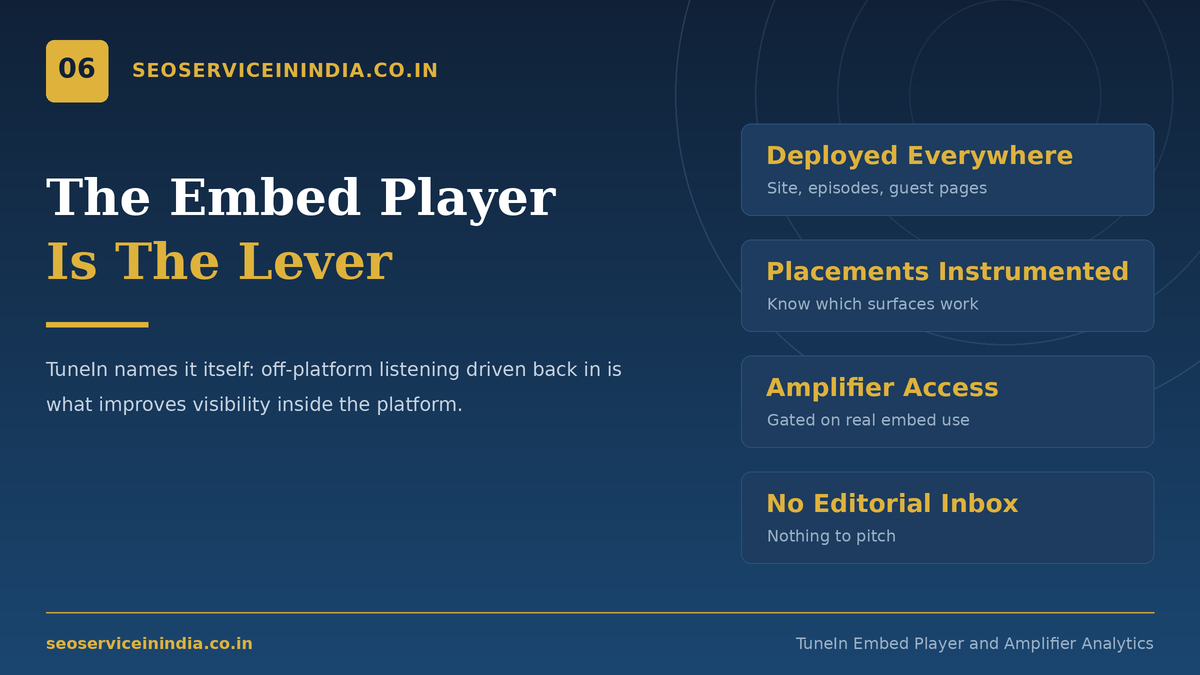
Asked how a podcast gets featured, TuneIn's own guidance names one factor above all others: the Embed Player. Placing a TuneIn player on sites outside TuneIn.com drives external listeners straight into your TuneIn content, and that increased listening improves your content's visibility and popularity within TuneIn.
Read that again, because it reframes the whole job. There is no editorial inbox to charm and no curation team to pitch. The mechanism is off-platform listening driven back onto the platform. Which means the work is technical and promotional, not relational:
The same lever unlocks measurement. TuneIn's Amplifier program grants broadcasters access to listener analytics — but only after you have created an embed player, put it on your site, opened a broadcaster account through the self-serve portal, selected your report content and cadence, and TuneIn has confirmed the embedded player is genuinely in use.
That is unusually honest platform design, and it's the heart of this service. On TuneIn, the embed player is simultaneously your distribution surface, your visibility mechanism and your key to data. Skip it and you have a listing that sits there earning nothing and reporting nothing.
Because TuneIn lives on speakers and dashboards, a meaningful share of requests for your show are spoken aloud rather than typed. That demands metadata choices most podcast SEO ignores.
We test your show name for voice ambiguity — homophones, awkward abbreviations, numerals that get read two different ways, and names that collide with a radio station or a song title already in the catalogue. Where a collision exists, we work on the fields we can control: a distinctive author/publisher value, a description that leads with the subject, and category placement that puts you where the intent actually is.
We also prepare your record for tile-based interfaces: square artwork that stays legible at dashboard size, a title that doesn't truncate into nonsense, and a first line of description that does real work because it's often all a listener sees.
Full RSS feed audit against TuneIn's ingestion and validation requirements
Existing-listing search across TuneIn and connected surfaces, with duplicate detection
Correct submission lane selection and complete portal submission
Program ID handling so feeds attach to the right existing program
Artwork preparation and compliance check
Category, language and description optimisation, including voice-request testing
Broadcaster account setup and the podcast update process for corrections
Embed player generation and deployment plan across your owned and partner surfaces
Amplifier analytics application and reporting cadence setup
Listing verification on device — web, mobile and, where accessible, speaker and in-car surfaces
Wider directory syndication so TuneIn isn't a single point of dependence
Written handover documenting every field, ID and login used
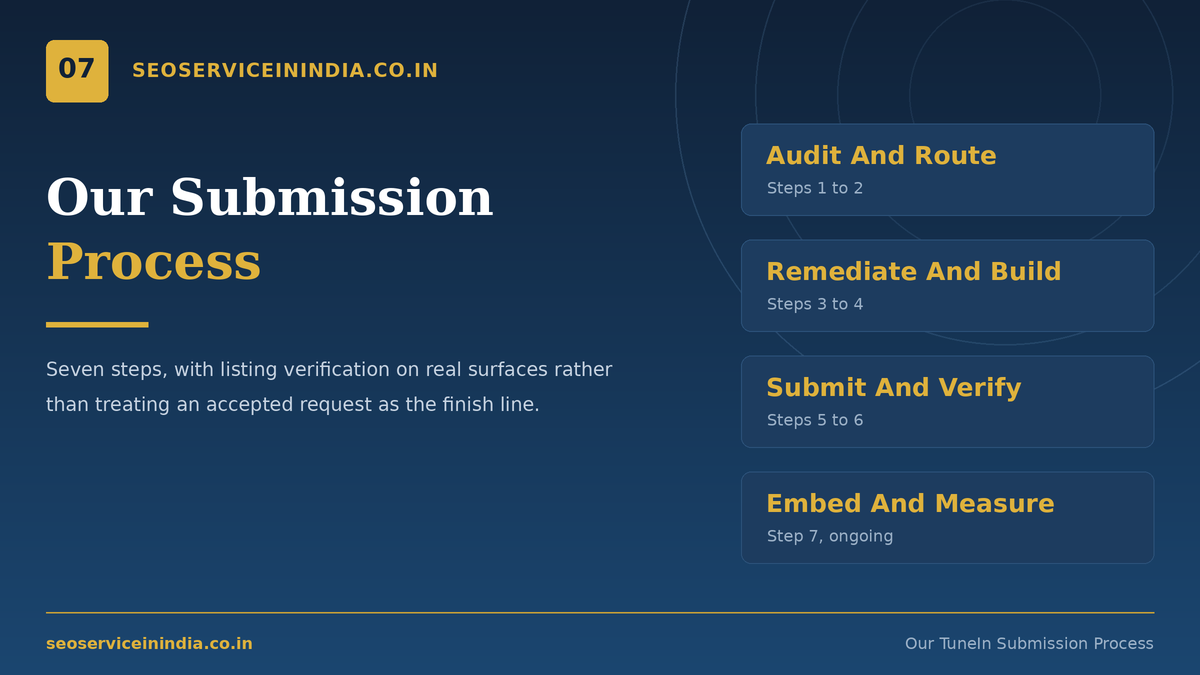
We read your feed the way the directory does and tell you what will pass, what will fail, and whether you're already listed.
Submit new, claim existing, or correct a stale record. We choose the submission lane and say what it will and won't achieve.
Crawler access, owner email, GUIDs, enclosures, artwork, tags and encoding fixed at the host before anything is submitted.
Title, category, language, author and description written for spoken requests and tile interfaces.
Portal submission filed, validation errors triaged against host confirmation, escalated where the fault sits with the validator.
We confirm the live record on real surfaces and check episodes are arriving — not just that the request was accepted.
Player deployed, placements instrumented, Amplifier reporting requested, monthly reporting begins.
The deepest connected-device market and where TuneIn's automotive and speaker integrations are most heavily used. If your show monetises through sponsorship in the US, in-car listening is audience you can't reach through app-first distribution alone.
A radio-literate audience that treats streamed audio and broadcast as one habit. TuneIn's radio-plus-podcast catalogue means your show sits beside the stations your listener already trusts — which favours clear positioning against those stations' subject areas.
Now the home market of TuneIn's owner. Bilingual audiences make honest language declaration and, where relevant, separate French-language records worth planning properly rather than leaving to a default.
Long commutes and strong smart-speaker adoption make TuneIn a sensible complement to Apple and Spotify. Regional targeting is worth being deliberate about in your description.
Small volume, high device density and a multilingual audience. Language declaration and precise category placement matter more here than sheer reach.
Smart-speaker installed base and factory-fitted in-car audio have grown fast in metros and Tier-1 cities. For Hindi and regional-language shows, correct language declaration is the difference between reaching that audience and being invisible to it — and TuneIn's global footprint also puts you in front of the South Asian diaspora in the US, UK, Canada, Australia and Singapore.
A directory record is one surface. We also build the surfaces you own outright, because that's where search and AI answer engines look:
Canonical episode pages on your own domain, one per episode, with real text on them
Published transcripts, which are the most reliable way to become findable for things said inside episodes
PodcastSeries and PodcastEpisode structured data, so machines read your show as a show
rel="alternate" feed auto-discovery so your RSS is machine-findable from your site
Consistent show naming across every platform, so entity signals converge instead of fragmenting
This layer is what keeps your visibility from being fully dependent on any single platform's decisions.
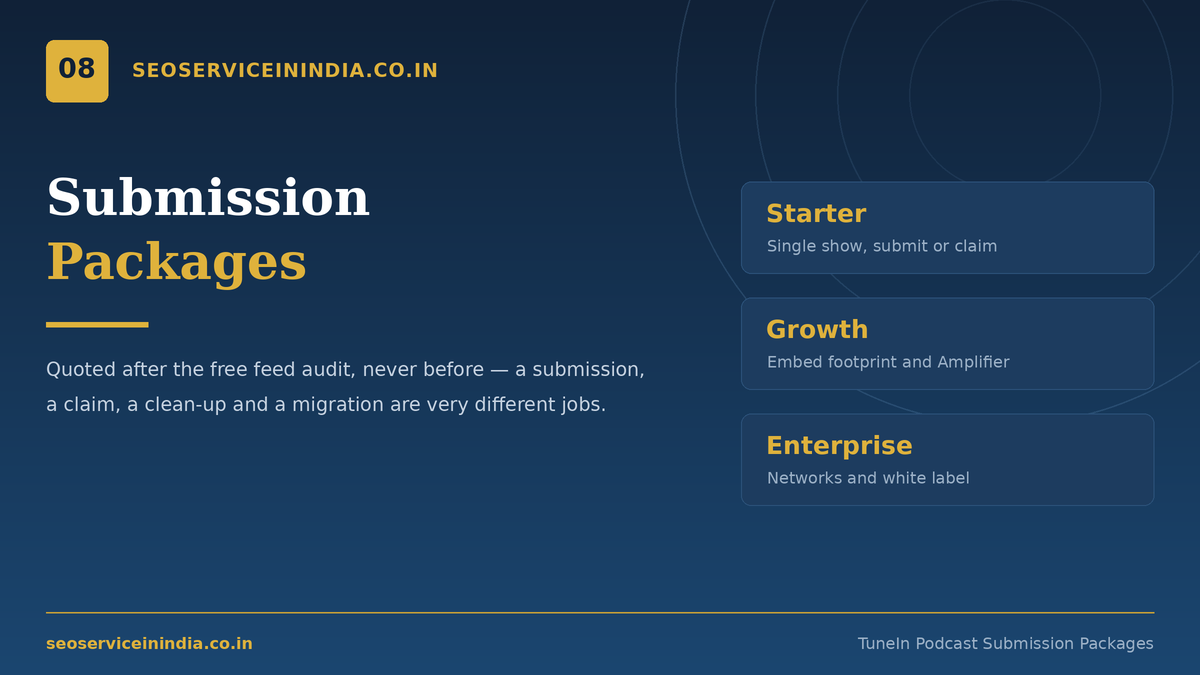
Feed audit, remediation, submission or claim, metadata build, listing verification, handover documentation.
plus embed player deployment across your site and episode pages, Amplifier analytics setup, wider directory syndication, and monthly listing-health and listening reporting.
Bulk submission and claim programmes, publisher-level record structure, template feed governance, transcript and episode-page production at volume, and white-label reporting for agency partners.
Pricing is quoted after the free feed audit, never before. We won't price work until we know whether you need a submission, a claim, a clean-up or a migration — those are very different jobs.
The TuneIn listing is free. You are not paying us for access, and nobody can sell you access.
You are paying for the feed audit that stops a rejection, knowing which of three submission lanes to file through, telling a real feed fault apart from a validator bug, finding and merging the duplicate record nobody told you about, and building the embed footprint that is the only visibility and analytics lever the platform actually offers. If you have the time and appetite to do all of that in-house, do it — we'd rather tell you that than sell you a form submission.
We have submitted, claimed and repaired podcast records across Apple Podcasts, Spotify, Amazon Music, YouTube Music, Pocket Casts, Castbox, Player FM, Podcast Addict, Deezer, iHeartRadio, JioSaavn, Podcast Index and TuneIn. We know which platforms auto-ingest, which need a manual claim, and which send verification to an address buried inside your feed.
Our recommendations come from platform documentation and host documentation, checked against what the live record actually shows — which is why this page tells you about the validator lag and the Amplifier gate instead of listing generic benefits.
We work with agencies, networks and brand publishers across the USA, UK, Canada, Australia, Singapore and India, including white-label delivery for partner agencies.
We say when a listing is free. We say when a platform has closed a door. We don't create fake profiles, fake reviews or fake credits, and we don't promise chart positions or featured slots that no vendor controls.
Yes. TuneIn closed podcast submissions in February 2024 and has since reopened them through its broadcaster portal. A lot of host help pages and agency blog posts still say otherwise, which is why many podcasters believe the door is shut when it isn't.
Timelines vary because each request is reviewed rather than auto-published. A clean feed with complete, accurate fields moves fastest; requests filed through the wrong lane, or with feed faults, are where the long delays come from. We give you a realistic expectation after the audit rather than a number we can't control.
Usually because TuneIn's feed validation can lag behind current podcasting standards, so newer tags that Apple and Spotify accept without complaint may trip its validator. Hosts document this openly. The fix is to confirm the feed is genuinely valid, then escalate to TuneIn support with that evidence — not to start breaking things in your feed.
No. TuneIn lists your existing RSS feed from whatever host you use. If your current host blocks crawlers, hides the owner email or generates unstable GUIDs, we fix those settings — migration is only recommended when the host itself makes correct distribution impossible.
Possibly. Feeds reach the catalogue through host relationships and partner distribution as well as direct submission. That's why we search before we submit: filing a fresh request for a show that's already listed creates a duplicate record that splits your listening.
Through TuneIn's Amplifier program, which requires you to deploy a TuneIn embed player on your site, open a broadcaster account via the self-serve portal, choose your report content and cadence, and have TuneIn confirm the embedded player is actually in use. Skipping the embed means no data.
No, and neither can anyone else. TuneIn states that the biggest factor in visibility is the embed player driving external listening back into its platform. We build that mechanism properly and report on it — we don't sell a placement that isn't for sale.
The directory listing is free. Our fee covers the feed audit, submission and claim work, metadata optimisation, embed deployment, analytics setup and ongoing listing maintenance around it.
Send us your RSS feed URL. We'll tell you whether your show is already in TuneIn, whether your feed will pass submission, what's holding it back, and which of the three routes applies to you — in writing, before any quote.
No obligation. No guessing. Just a clear read on where your show actually stands.

Speak with our SEO Company Experts
Give us a Ring, e-Mail, WhatsApp, or Skype.