
Lean-back listeners. People browsing internet radio want to press play and keep listening without choosing each episode. An evergreen back catalog suits this well: interviews, teaching series, sermons, storytelling, language lessons, or music-led shows.
Shoutcast · Podcast Station Setup
Shoutcast Podcast Submission Services
Your podcast lives in an RSS feed. Shoutcast lists live audio streams. That one difference is why most attempts to "submit a podcast to Shoutcast" go nowhere. It is also why our Shoutcast podcast submission services start by building what the Shoutcast directory actually lists: a stable, always-on radio station made from your episodes.
SEOServiceinIndia plans the station and configures the stream. We set clean metadata, switch on public listing, confirm that your station appears, and keep it there. We work with podcasters, brands, churches, schools, and community broadcasters across the USA, UK, Canada, Australia, Singapore, and India.
Start with a free Shoutcast readiness audit. We check your episodes, music rights, and technical setup before you spend anything.
Know the Platform
01 02 03 04 05
What Shoutcast Is in 2026, and What It Isn't
Shoutcast was created in 1998 by Nullsoft, the team behind the Winamp media player. It passed through AOL and then the Belgian radio company Radionomy, and it has been part of Azerion since 2022. It remains an active service with three parts:
- streaming server software that broadcasters can run themselves
- hosted streaming plans
- a public directory where stations publish their name, genre, and current listener count
Listeners browse that directory by genre, pick a station, and press play.
What Shoutcast is not is a podcast directory. There is no field for an RSS feed URL, no episode pages, and no "follow" button. Apple Podcasts and Spotify ingest your feed and list your show. Shoutcast lists a broadcast stream and shows whoever is tuned in right now.
Many "top podcast submission sites" lists still include Shoutcast without explaining this. Podcasters arrive with an RSS link, find no form, and give up. Some confusion also comes from Shoutcast's past: the old Winamp desktop player had its own podcast directory. That was a feature of the Winamp app, not a route to today's Shoutcast listeners.
One more clarification. The word "shoutcaster" is also used for esports commentators, which has nothing to do with this service.
The practical conclusion is simple. To appear on Shoutcast, your podcast has to become a station. That is the job we do.
Why Podcasters Still Want a Shoutcast Listing
A Shoutcast listing reaches listeners that on-demand podcast apps don't.
Discovery outside crowded charts. Podcast charts are dominated by large networks. The Shoutcast directory is organized by genre, and many niche genres have only a handful of active stations. A well-labeled station can be easier to find there than a show buried in a crowded podcast category.
Reach through third-party players. Directory data is read by many internet radio players and apps. One accurate listing can surface in places you would never submit to individually.
A live channel you control. Launch days, live recordings, Q&A sessions, and events can go out live. Automation then keeps the station playing between them.
Branded and community audio. Businesses, faith groups, colleges, and diaspora communities use a station as an always-on audio home that doesn't depend on a single app's algorithm.
Feed vs. Stream: The Difference That Decides Everything
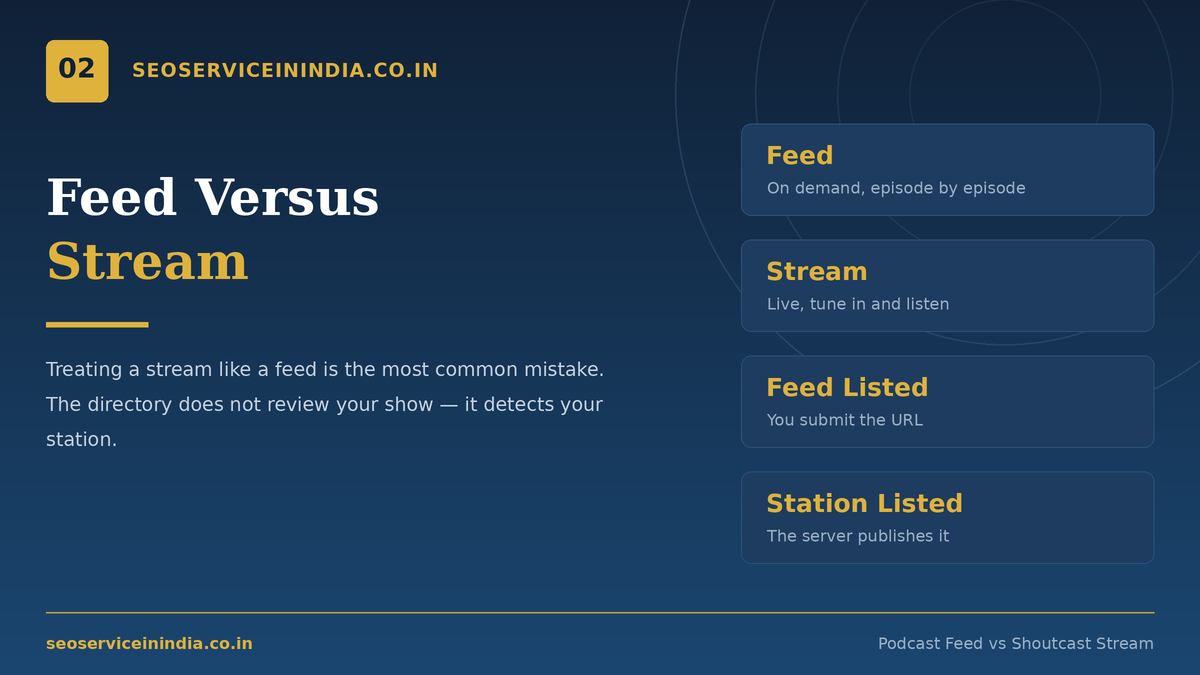
| Podcast RSS feed | Shoutcast stream | |
|---|---|---|
| How people listen | On demand, episode by episode | Live, tune in and listen |
| What gets listed | Your show and its episodes | Your station |
| How you get listed | Submit the feed URL to each directory | The server publishes to the directory when public listing is enabled |
| What drives visibility | Follows, completions, metadata | Live listeners, genre, uptime, metadata |
| What you measure | Downloads and plays | Concurrent listeners and listening hours |
Treating a stream like a feed is the most common mistake. The directory doesn't review your show; it detects your station. Everything about getting listed therefore comes down to engineering and presentation, not form filling.
Is a Shoutcast Listing Right for Your Show?
We would rather tell you now than after you have paid.
Strong fit:
- talk-led shows with 20 or more evergreen episodes
- music-led shows using original or properly licensed music
- faith, education, wellness, and language programs
- regional-language shows serving diaspora audiences
- brands that want a branded audio channel
- shows that already record live or want to
Weak fit:
- daily news shows whose episodes go stale within days
- shows with fewer than about ten episodes, where a loop repeats too quickly
- episodes full of commercial music you cannot license for streaming
- sponsor-driven shows that depend purely on download counts, since stream listening is measured differently
If your show is a weak fit, your free audit will say so and point you to the platforms that suit you better.
Service Scope
01
02
03
04
What Our Shoutcast Podcast Submission Services Include
Station Strategy and Programming
A station isn't a playlist on shuffle. We design a programming clock that covers:
- how often new episodes air
- which evergreen episodes rotate, and how often
- where short station IDs and your call to action sit
- how topics are grouped by time of day
If you run live sessions, we build them into the schedule so automation pauses and resumes cleanly.
Stream Setup and Configuration
We confirm the right route for you: an official Shoutcast account, self-hosted Shoutcast server software, or a compatible host that supports directory listing. We then configure:
- a codec and bitrate suited to spoken-word audio
- secure (HTTPS) streaming, so browser players don't block playback
- a stable stream URL that won't change later
- automated playback (AutoDJ) so the station stays live when you aren't
Metadata and Directory Presentation
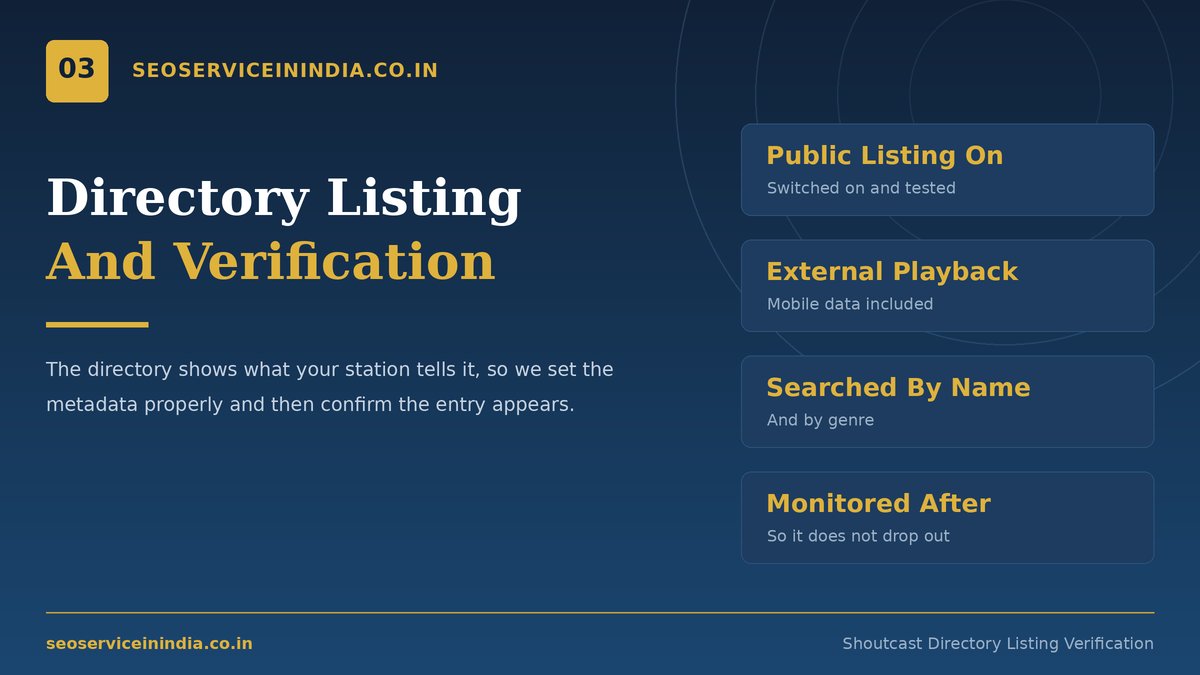
The directory shows what your station tells it. We set:
- a clear, brandable station name
- the genre that matches most of your programming
- a plain-English description
- station artwork
- a consistent now-playing format, such as "Show Name – Episode Title"
We never use keyword-stuffed station names or promotional text in the now-playing field. It looks spammy to listeners and can hurt approval and retention.
Public Listing, Verification, and Monitoring
We switch on public listing and test playback from outside networks and on mobile data. We then search the directory by name and genre to confirm that the listing appears and displays correctly. After launch, we check uptime and metadata on a regular schedule so the station doesn't quietly drop out.
Beyond the Directory
Listen-Live Page and Website Integration
A directory listing works best when it leads somewhere. We add a secure embedded player to a dedicated "Listen Live" page on your website. That page gets proper headings, internal links, and structured data. We also link it from your show notes and social profiles so every channel points to the same stream.
Companion RSS Distribution
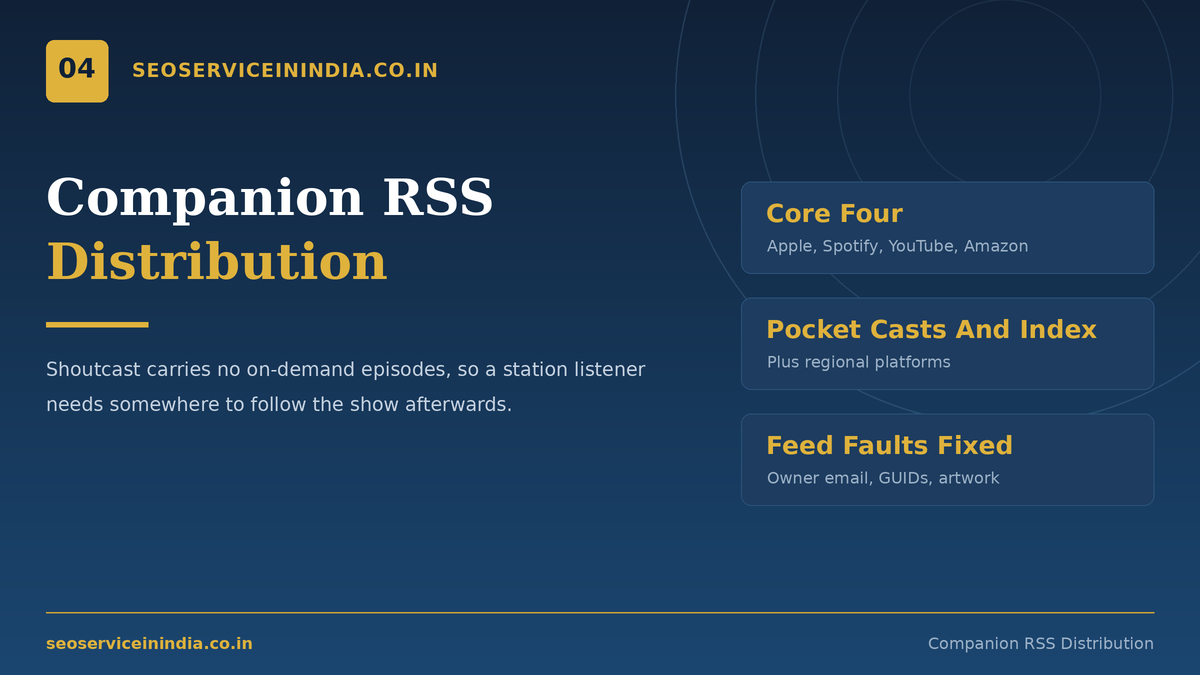
Shoutcast doesn't carry on-demand episodes. When a station listener enjoys an episode, they need somewhere to follow your show. So we also submit and verify your feed on:
- Apple Podcasts, Spotify, YouTube, and Amazon Music
- Pocket Casts and Podcast Index
- the regional platforms relevant to your market
We also fix the feed faults that block listings, including hidden owner emails, unstable episode IDs (GUIDs), and non-square artwork.
Rights Check
Rights and Royalties: The Check Most Providers Skip
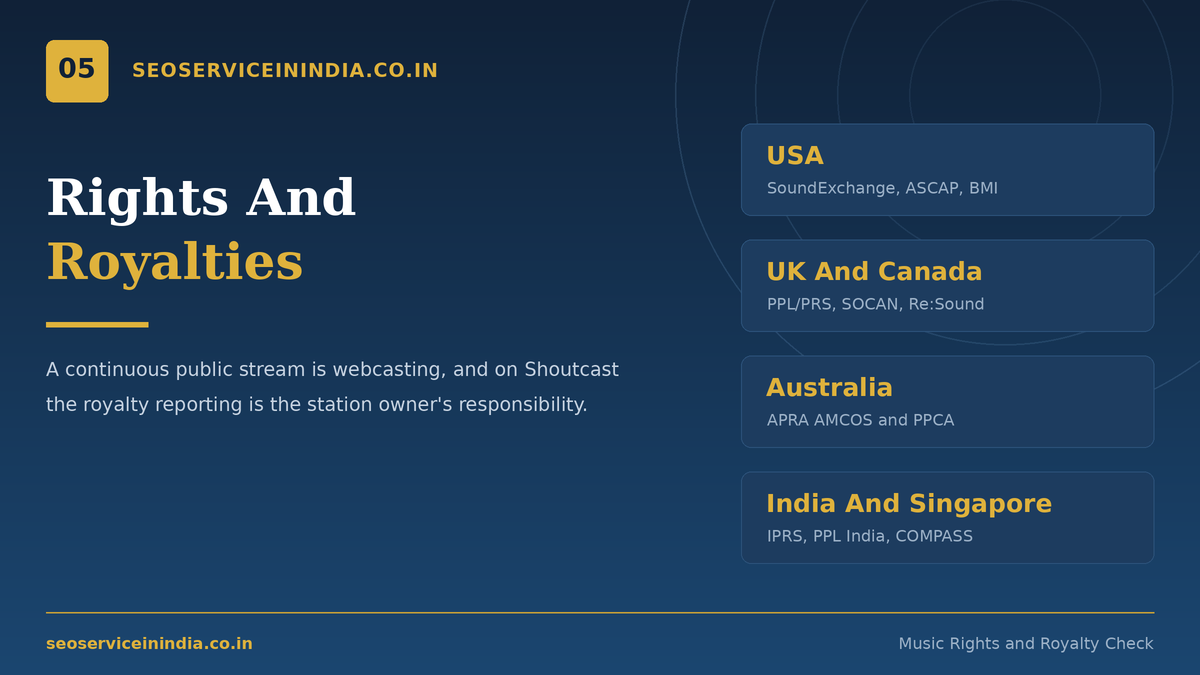
Turning episodes into a continuous public stream is a form of webcasting. If your episodes contain commercial music, internet radio licensing rules may apply. On Shoutcast, royalty reporting and payment are the station owner's responsibility, not the platform's.
The organizations commonly involved include:
- USA: SoundExchange, plus ASCAP, BMI, SESAC, or GMR
- UK: PPL and PRS for Music
- Canada: SOCAN and Re:Sound
- Australia: APRA AMCOS and PPCA
- Singapore: COMPASS
- India: IPRS and PPL India
We aren't a law firm, and we don't give legal advice. We do flag every episode that contains third-party music before it goes into rotation, so you can clear it, cut it, or leave that episode out. Talk-only shows with original or properly licensed music are the simplest to stream.
Technical Fit
Official Shoutcast vs. "Shoutcast-Compatible" Hosts
Many hosting companies use the word "Shoutcast" in their brand, and some position themselves as alternatives to Shoutcast itself. That is legitimate, but it creates confusion. The official Shoutcast directory is what listeners browse, so the question is whether your plan actually publishes to it.
Before you pay for anything, we confirm which route your setup supports:
- an official Shoutcast account, which offers free and paid tiers
- self-hosted Shoutcast server software with directory publishing enabled
- a compatible host that supports official directory listing
Icecast stations use their own directories, not Shoutcast's, and we will tell you if that is the better fit.
Why Stations Don't Appear, or Quietly Disappear
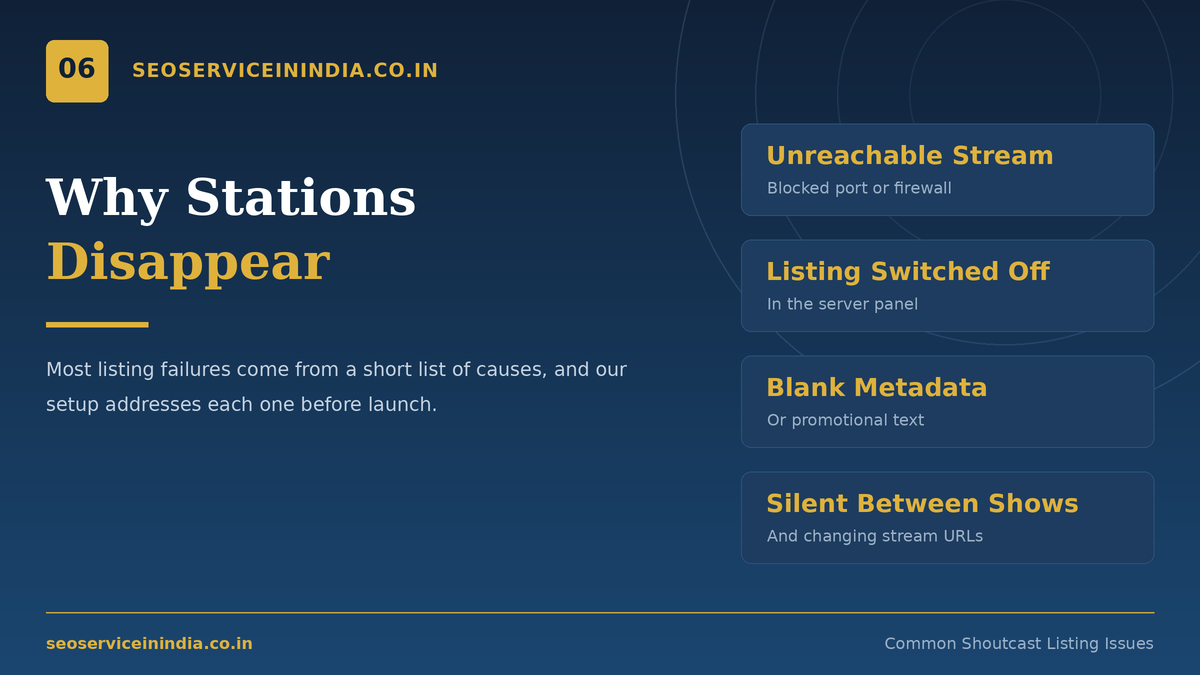
Most listing failures come from a short list of causes:
- The stream can't be reached from outside your network. This is usually a blocked port, a firewall rule, or a home connection.
- Public listing is switched off in the server or hosting panel.
- Now-playing metadata is blank, garbled, or promotional.
- The genre doesn't match the content, so listeners leave quickly.
- The station goes silent between live sessions.
- The stream URL keeps changing, which breaks links and trust.
- An insecure stream sits inside a secure website player, so browsers block playback.
Our setup addresses each of these before launch, and our monitoring catches them if they return.
Audit to Monitoring
1 2 3 4 5 6 7
Our Process
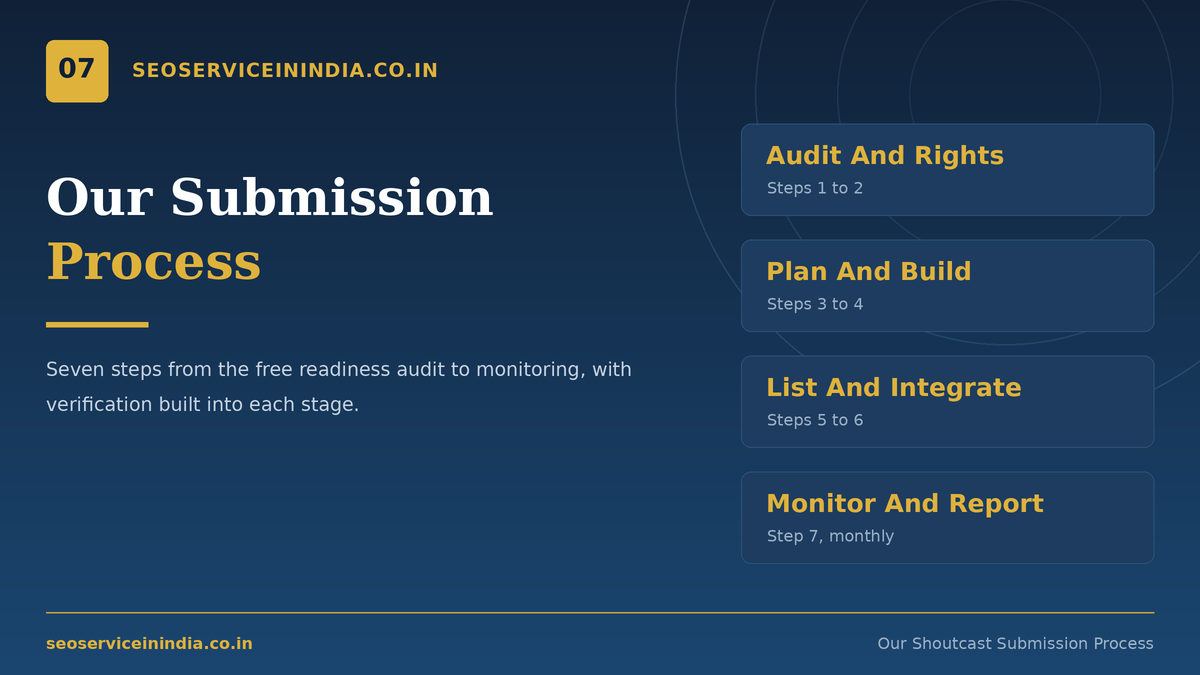
Free readiness audit. We review your catalog, audio quality, current hosting, and goals.
Rights and fit check. We flag music-heavy episodes and confirm Shoutcast suits your show.
Station plan. We agree the programming clock, station identity, genre, and live windows.
Build and configure. We set up the stream, secure playback, automation, and metadata.
Enable listing and verify. We switch on public listing, test externally, and confirm the directory entry.
Integrate and distribute. We launch the listen-live page and complete companion RSS submissions.
Monitor and report. We track uptime, listeners, and metadata health, and report monthly on Growth and Enterprise plans.
Six Core Markets
Serving Podcasters Across Six Markets
A 24/7 station has no fixed prime time. Your best slot in one country is 3 a.m. somewhere else, so we schedule programming around where your listeners actually are.
USA: We map music-licensing exposure early and schedule across four mainland time zones.
UK: We schedule for commuting and working hours and check PPL/PRS exposure on music segments.
Canada: We plan for bilingual audiences where relevant and check SOCAN and Re:Sound exposure.
Australia: We schedule for time zones that sit far from US-centric programming and check APRA AMCOS and PPCA exposure.
Singapore: We serve multilingual audiences with a clear language declaration in the station description.
India: We specialize in regional-language and devotional stations, and in diaspora audiences listening from the other five markets.
SEOServiceinIndia
Why Work With SEOServiceinIndia
Experience. We have mapped the submission rules of dozens of podcast platforms, live and retired. We know where a listing is automatic, where it needs a manual claim, and where no submission route exists at all.
Expertise. Shoutcast listing sits where audio engineering meets search visibility. We handle both: stream configuration and metadata on one side, listen-live pages, structured data, and companion RSS work on the other.
Accountability. Every engagement follows a documented process with verification at each stage, so you can see what was done and why.
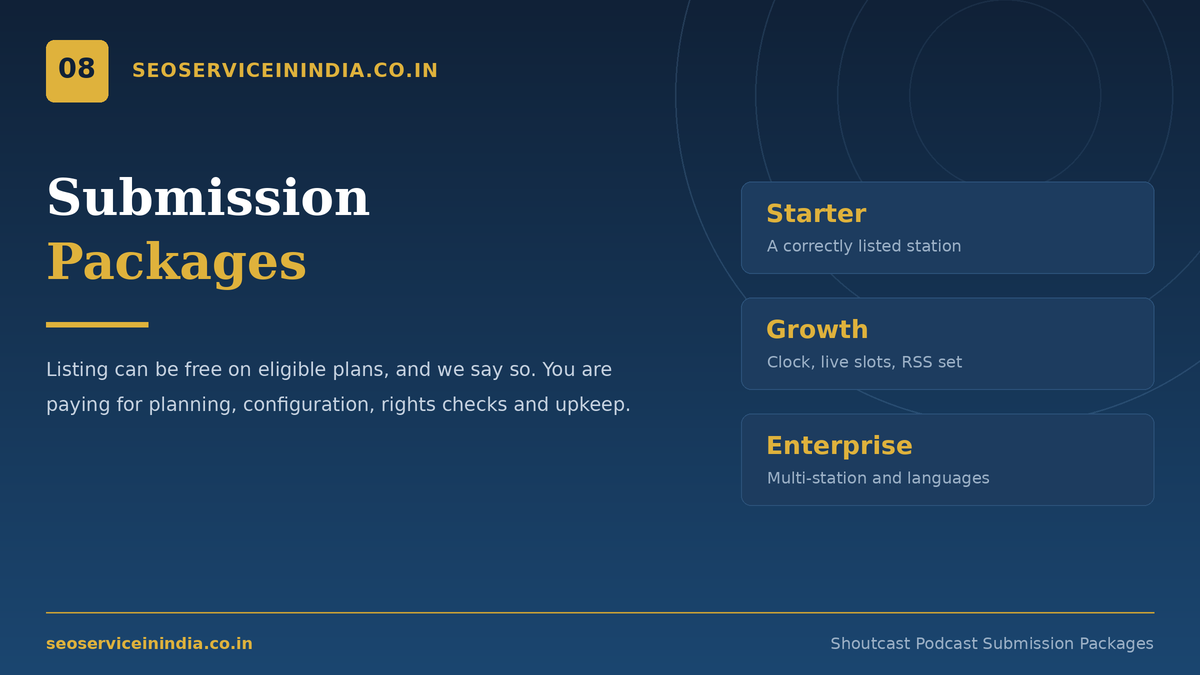
Trust. Getting listed in the Shoutcast directory can be free on eligible plans, and we say so openly. You are paying for the work around the listing: planning, configuration, rights checks, verification, and upkeep. We also never inflate listener counts. The directory reflects real listening, and artificial listeners are dishonest and risky.
Flexible Engagement
Starter
Growth
Enterprise
Shoutcast Podcast Submission Packages
For established shows that want a correctly listed station:
- readiness audit and rights flag report
- stream configuration with secure playback and automation
- station name, genre, description, and now-playing metadata
- public listing, external testing, and directory verification
- listen-live embed for your website
Everything in Starter, plus:
- a custom programming clock with station IDs and call-to-action spots
- live-session scheduling
- a listen-live page with structured data and internal links
- companion RSS submission to major directories
- monthly monitoring and reporting
For networks, brands, and multi-station groups:
- multiple stations or language channels
- market-by-market scheduling
- ongoing catalog rotation updates
- full companion distribution, including regional platforms
- priority monitoring and quarterly strategy reviews
Pricing is quoted after your free audit, because catalog size, rights exposure, and hosting route change the work involved.
What We Measure
Stream success is measured differently from downloads. We report on:
- concurrent and peak listeners
- total listening hours
- average session length
- your station's visibility within its genre
- clicks from the directory to your listen-live page
- growth in feed followers on the podcast platforms station listeners move to
Together, these show whether the station is building a real audience rather than just existing.
No. Shoutcast lists live audio streams, not RSS feeds. To appear there, your episodes need to be broadcast as a station with public directory listing switched on. That is what our service builds.
Once the stream is publicly reachable, correctly labeled, and set to public, listings typically appear within minutes to a couple of days. Unstable streams take longer and can drop out.
No, but always-on stations are easier to find and keep listed. Automation plays your catalog between live sessions so the station never goes silent.
It depends on your content. Talk-only episodes with original or properly licensed music are simplest. Episodes containing commercial music may need internet radio licenses in your market. We flag these during the audit.
No. Shoutcast adds a live listening channel. Your RSS feed still needs to be listed on podcast platforms, which is why our Growth and Enterprise packages include companion distribution.
No one honestly can. Directory visibility reflects real listeners and station quality. We improve the inputs (uptime, metadata, programming, and promotion) and never use artificial listeners.
Yes. We schedule live windows so your broadcast takes over the stream and automation resumes when you finish.
Yes. Our core markets are the USA, UK, Canada, Australia, Singapore, and India, but the setup works worldwide. We check licensing exposure for your country during the audit.
Free Readiness Audit
Put Your Podcast on the Dial
Your back catalog can keep working around the clock and reach listeners who never open a podcast app. Book your free Shoutcast readiness audit with SEOServiceinIndia, and we'll tell you honestly whether a station fits your show and exactly what it takes to get listed.
Request your free audit today.
