Home/iOS App SEO Packages | Rank Higher on the App Store
iOS App SEO Packages | Rank Higher on the App Store
iOS App SEO Packages
iOS App SEO Packages That Turn App Store Searches Into Installs
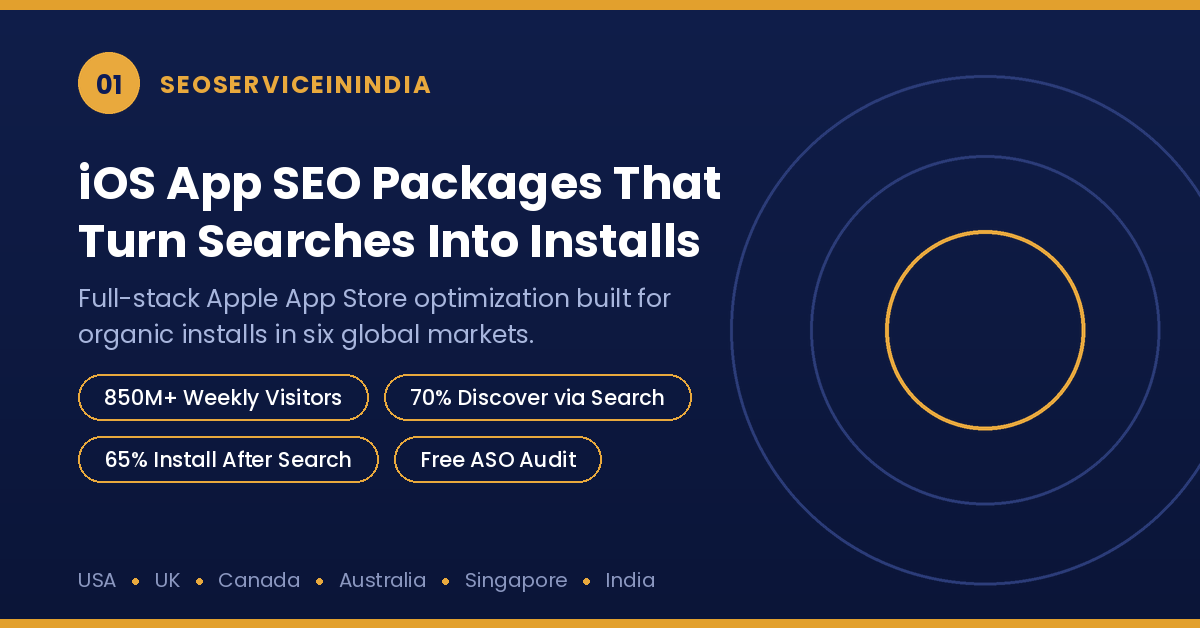
Over 850 million people visit the Apple App Store every week, 70% of them use search to discover apps, and almost 65% of all downloads happen directly after a search. That is the entire case for iOS App SEO in three numbers: the demand already exists, it is concentrated in the search bar, and the apps that win it pay nothing per install.
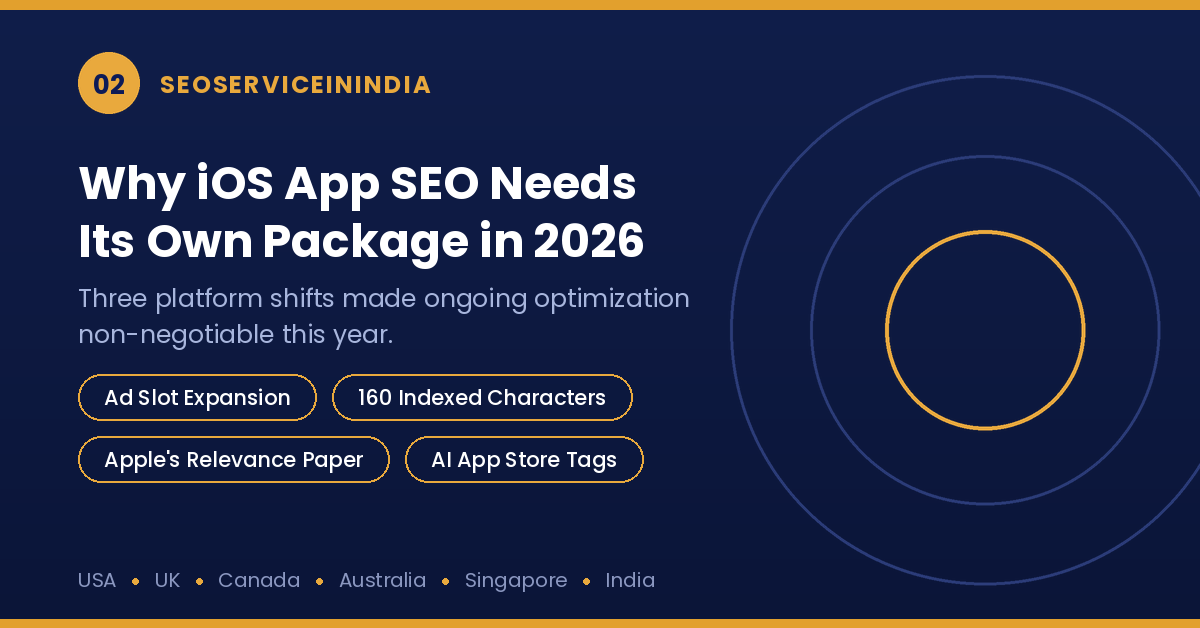
Here is what changed in 2026, and why a packaged, ongoing approach now beats one-off optimization. In March 2026, Apple expanded sponsored placements throughout App Store search results — where a single ad once sat above organic listings, multiple paid slots now push organic results further down the page. The free half of App Store search got smaller. Every organic position you hold is worth more, and every metadata, creative, and retention decision behind that position is more decisive than it was a year ago.
iOS is not Google Play with a different logo. The two stores index different fields, weigh different signals, and punish different mistakes — which is why a generic "ASO service" quietly underperforms on Apple.
On iOS, your keyword strategy is an allocation problem. Apple indexes a 30-character title, a 30-character subtitle, and a hidden 100-character keyword field — and does not index your description for search. Every character is contested space, duplicated words are wasted space, and the difference between ranking and invisibility is often how intelligently those 160 characters are allocated across your real search opportunities. On Google Play, keyword work is a content-writing problem across 4,000 indexed characters. Agencies that treat both stores the same are solving the wrong problem on at least one of them.
Three 2026-specific shifts make this the year to move from ad-hoc tweaks to a managed program:
The paid squeeze
Apple's March 2026 expansion of search ads means organic results compete with more sponsored slots on the same screen. Apps holding position 1–3 organically still capture high-intent taps; apps at position 6–10 increasingly don't get seen without paying.
Apple published how ranking works
Apple's March 2026 research paper on App Store search relevance confirmed the algorithm weighs two named signal families: textual relevance (how well your metadata semantically matches the query) and behavioral relevance (what users actually do with your result — taps, installs, and post-install retention). You can no longer win on keywords alone or on downloads alone; the packages below work both levers deliberately.
AI now reads your listing
With iOS 26, Apple introduced AI-generated App Store tags — a model analyzes your metadata, description, and even screenshots to categorize and surface your app in new discovery layers. Sloppy metadata doesn't just rank worse; it gets your app tagged into the wrong discovery buckets entirely.
Ranking Signals
What Decides Your iOS App Ranking — And What We Do About It
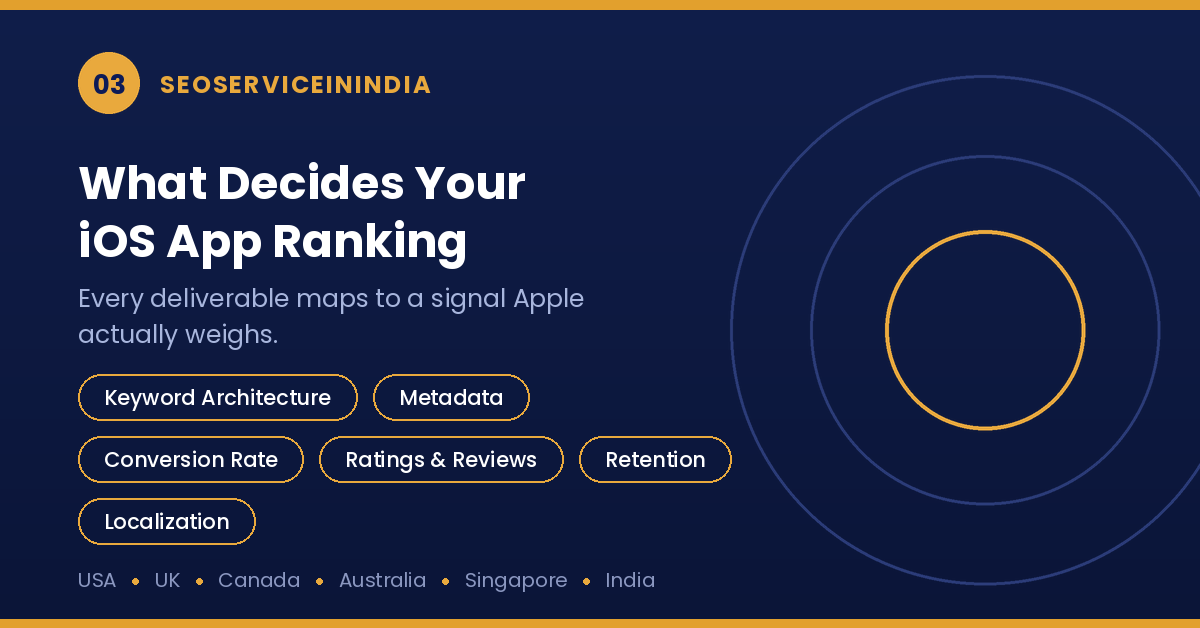
Every deliverable in our packages maps to a signal Apple actually uses. Here is the honest version of that map.
Keyword & Metadata Architecture
We build your keyword universe from App Store search data across your target countries — real search popularity, difficulty, and competitor coverage — then allocate terms across title, subtitle, and the 100-character keyword field with zero duplication and no wasted characters. Metadata refreshes ship roughly every 4–6 weeks with app releases, because Apple reindexes new metadata within hours of a release and ranking impact typically shows within 4–8 weeks. Title changes are handled conservatively — they carry the most risk and the longest recovery time if they go wrong, and we will tell you when not to touch yours.
Conversion Rate Optimization on the Product Page
Apple uses your tap-to-install conversion rate from search as a ranking input, which makes your icon, screenshots, and preview video ranking assets, not just design assets. We run structured creative tests through Apple's product page optimization framework, promote winners, and iterate — because a listing that converts 20% better doesn't just install more users from the same traffic, it earns more traffic.
Ratings, Reviews & Retention Signals
Apps sustained above a 4.0 rating convert and rank measurably better. We build ethical, policy-compliant review acquisition into your app's flow (prompt timing after value moments, never after crashes), manage review responses as a conversion asset, and report retention honestly — because Apple's behavioral relevance signal means an app that spikes installs and bleeds users gets repriced by the algorithm. Where retention is the bottleneck, we say so instead of shipping another metadata refresh that can't fix it.
Localization for Every Market You Sell In
Each App Store storefront is its own index. A US-only metadata set leaves rankings on the table in the UK, Canada, Australia, Singapore, and India — and cross-localization tactics let a single storefront index additional language sets. We localize metadata per storefront with native search behavior, not machine translation.
Organic Lever
Custom Product Pages: The 2026 Organic Lever Most Agencies Ignore
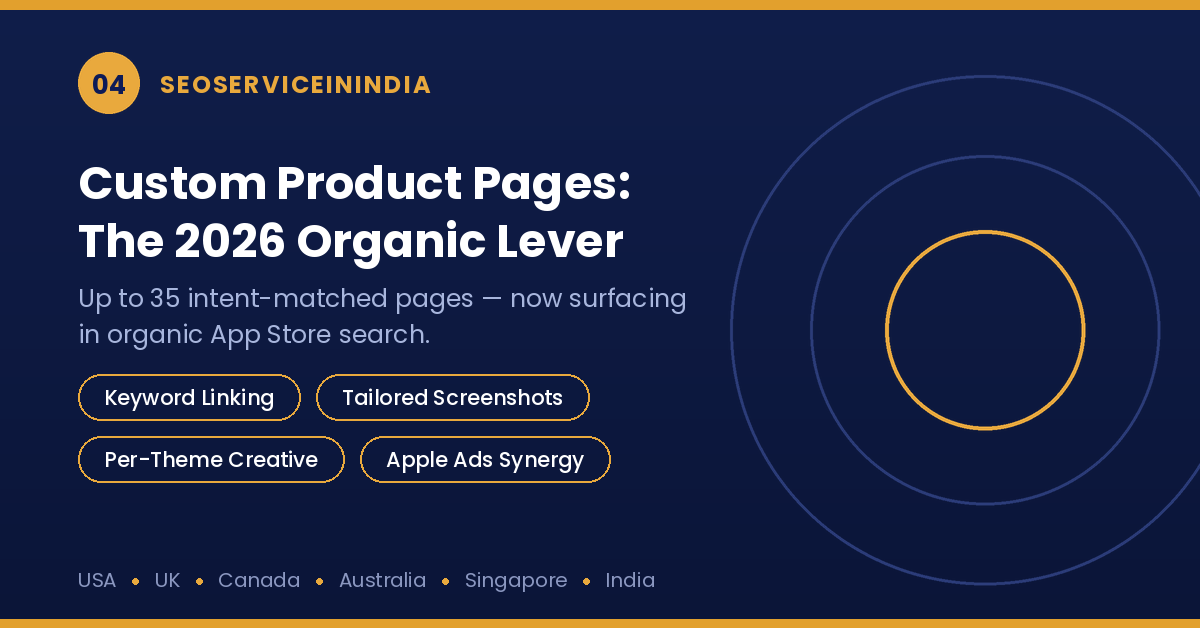
Custom product pages (CPPs) started life as an Apple Ads feature — up to 35 alternate versions of your product page, each with its own screenshots, preview video, and promotional text. The 2026 development that matters for SEO: CPPs can now surface in organic search results through keyword linking, which turns them into intent-matched organic landing pages inside the App Store itself.
Practically, that means a fitness app can show strength-training screenshots to someone searching "gym workout planner" and yoga-led creative to someone searching "morning yoga" — organically, from the same app. Our Growth and Enterprise packages include CPP strategy: mapping your highest-value keyword themes to dedicated pages, building the creative briefs, configuring the keyword associations in App Store Connect, and measuring conversion per page. If you also run Apple Ads (rebranded from Apple Search Ads in April 2025), the same CPPs do double duty as ad destinations — one asset, two channels.
Eight Workstreams
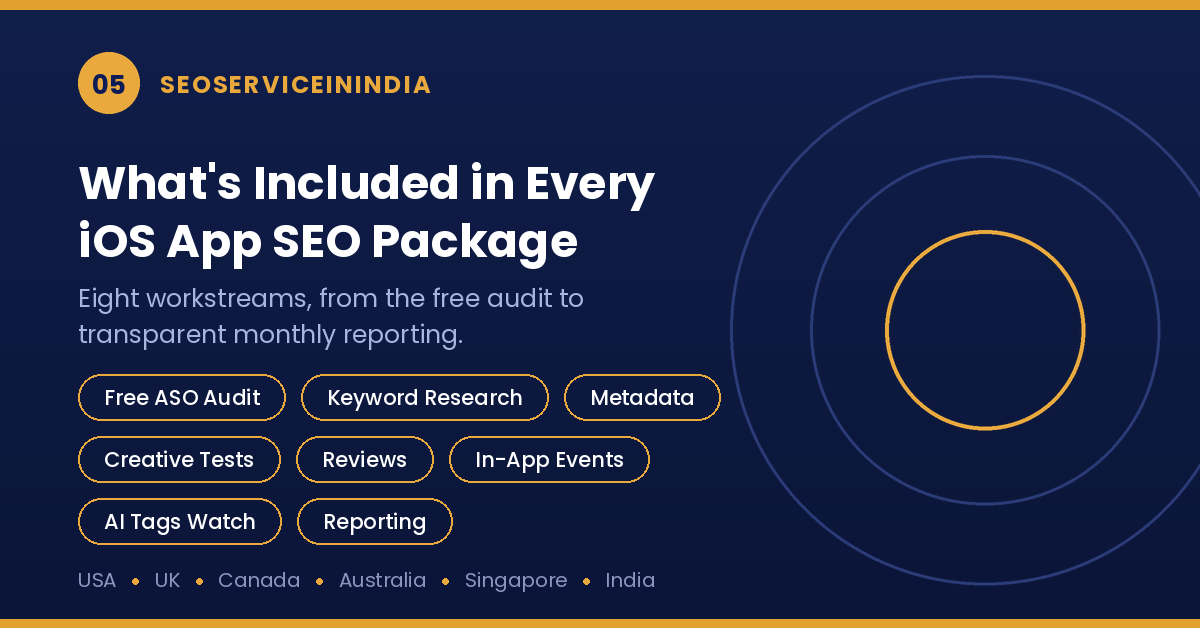
What's Included in Every iOS App SEO Package
Eight workstreams, run as a continuous program rather than a one-off listing edit — from the free audit before you pay anything to transparent reporting against money spent.
01
Free iOS ASO Audit Before You Pay Anything
Current keyword rankings, metadata waste analysis, conversion benchmarks against your category, and the three highest-impact fixes, in writing.
02
Country-Level Keyword Research
For every storefront you target, refreshed monthly.
03
Title, Subtitle & Keyword Field Optimization
Shipped with your release cycle.
04
Screenshot & Icon Test Roadmap
Using Apple's native product page optimization tests.
05
Ratings & Review Management
With response handling and prompt-timing consultation.
06
In-App Events & Seasonal Metadata
To capture featuring and event-card visibility.
07
App Store Tags Monitoring
Verifying how Apple's AI layer is categorizing your app and correcting the inputs when it's wrong.
08
Transparent Monthly Reporting
Keyword movement, impressions, product page views, conversion rate, organic installs, and what we're doing next — against money spent, not vanity charts.
Workflow
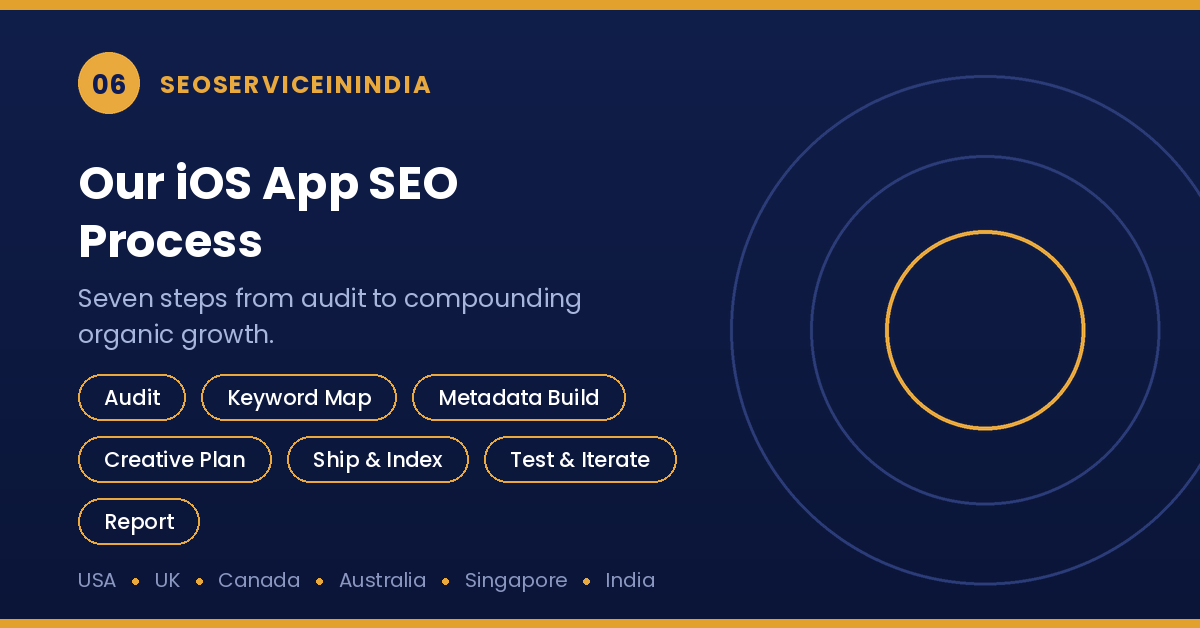
Our iOS App SEO Process
Seven steps from audit to compounding organic growth — because ASO is a compounding program, not a one-time fix.
01
Audit & benchmark
Free audit of your current listing, rankings, conversion rates, and competitor set across target storefronts.
02
Keyword architecture
Full keyword universe mapped to search popularity and difficulty, then allocated across your indexed fields per country.
03
Metadata build
New title/subtitle/keyword field sets prepared per storefront, staged for your next release.
04
Creative & conversion plan
Screenshot narrative, icon variants, and preview video briefs built for testing — not guessing.
05
Ship & index
Metadata goes live with your release; we verify indexation and track early ranking movement.
06
Test & iterate
Product page tests run in 2–4 week cycles; CPP keyword associations configured for winning themes.
07
Report & compound
Monthly reporting with the next cycle's changes pre-agreed — because ASO is a compounding program, not a one-time fix.
Packages
iOS App SEO Packages & Pricing
Starter
For new launches and single-market apps: one storefront, core metadata optimization on a 6-week cycle, review response management, monthly reporting.
Growth
For apps ready to scale organically: up to four storefronts with localization, product page optimization tests, custom product page strategy for top keyword themes, in-app events calendar, bi-weekly optimization cycles.
Enterprise
For portfolios and competitive categories: unlimited storefronts, full CPP program, Apple Ads + ASO coordination so paid and organic keyword data feed each other, retention-signal analysis, dedicated account strategist, custom reporting.
Exact pricing is quoted after your free ASO audit — because an app with clean metadata and a conversion problem needs a different scope than an app with neither, and quoting before looking is how agencies overcharge one client to subsidize another.
Global Reach
Markets We Serve
United States
The deepest and most contested storefront; ad-slot expansion hits hardest here, making organic positions 1–3 the target.
United Kingdom & Canada
Strong purchasing power with lighter keyword competition than the US; Canada rewards English + French localization.
Australia
High-ARPU market often used as a soft-launch storefront; we optimize it as a revenue market, not just a test bed.
Singapore
Small but premium, multilingual search behavior, and a common APAC beachhead.
India
The App Store's fastest-growing storefront by visitors, with record annual visitor numbers and a premium-user skew that surprises developers who only know India as an Android market.
Plus diaspora targeting: Indian-language keyword sets ranking in US, UK, and Gulf storefronts.
E-E-A-T
Why SEOServiceinIndia for iOS App SEO
Experience
We run ASO as an ongoing program across categories — fintech, health, education, e-commerce, gaming — in six markets, and this page's recommendations come from that delivery work, not recycled listicles.
Expertise
Our metadata work is built on Apple's own published signals and documentation, updated as Apple ships changes — not on 2023 tactics.
Authoritativeness
Every claim we make in reporting is tied to App Store Connect data you can verify in your own account; you keep full ownership and admin access at all times.
Trustworthiness
No incentivized reviews, no install farms, no rank guarantees — those violate Apple's guidelines and get apps removed. We put that in writing, and we'll tell you when ASO isn't your bottleneck.
Honest Fit Check
Who These Packages Are Not For
Honesty saves both of us time. These packages are a weak fit if:
You want guaranteed #1 rankings (nobody controls Apple's algorithm, and anyone promising it is lying).
Your app has a retention or crash-rate problem so severe that no listing optimization can outrun the behavioral signal — fix the product first, we'll show you the data.
You need app development or redesign (we optimize listings, not codebases).
You're exclusively on Google Play — this page's sibling services cover that.
Metadata changes are typically reindexed within hours of a release, with ranking impact visible in 4–8 weeks. Conversion improvements from creative tests usually show in 2–4 weeks. Compounding gains — where rankings, conversion, and behavioral signals reinforce each other — build over 3–6 months.
No. Unlike Google Play, Apple does not index the description for keyword ranking. It still matters for conversion and for the AI tagging layer introduced with iOS 26, which is why we write it carefully — but your search rankings come from the title, subtitle, and keyword field.
More than ever. Apple Ads conversion depends on the same product page ASO improves, ad relevance is tied to metadata quality, and the March 2026 ad expansion means paying forever is the only alternative to ranking organically. Our Enterprise package coordinates both so paid keyword data sharpens organic targeting.
Yes — per-storefront metadata localization is included from the Growth tier, covering the USA, UK, Canada, Australia, Singapore, India, and any additional storefronts you sell in.
No, and you should walk away from anyone who does. Apple's algorithm weighs behavioral signals no vendor controls. What we guarantee is the work: documented changes, verifiable data, and reporting against money spent.
That hub covers strategy across all app marketplaces. This package is Apple-only depth: the 100-character keyword field, custom product pages, product page optimization tests, App Store tags, and per-storefront localization specific to iOS.
Free ASO Audit
Ready to See What Your App's Listing Is Leaving on the Table?
Get your free iOS ASO audit today — real data from your storefronts, three priority fixes, and a package recommendation in writing, with no obligation.
Fill in the enquiry form, call us, message us on WhatsApp, or email the team — whichever suits your time zone. We reply within one business day.