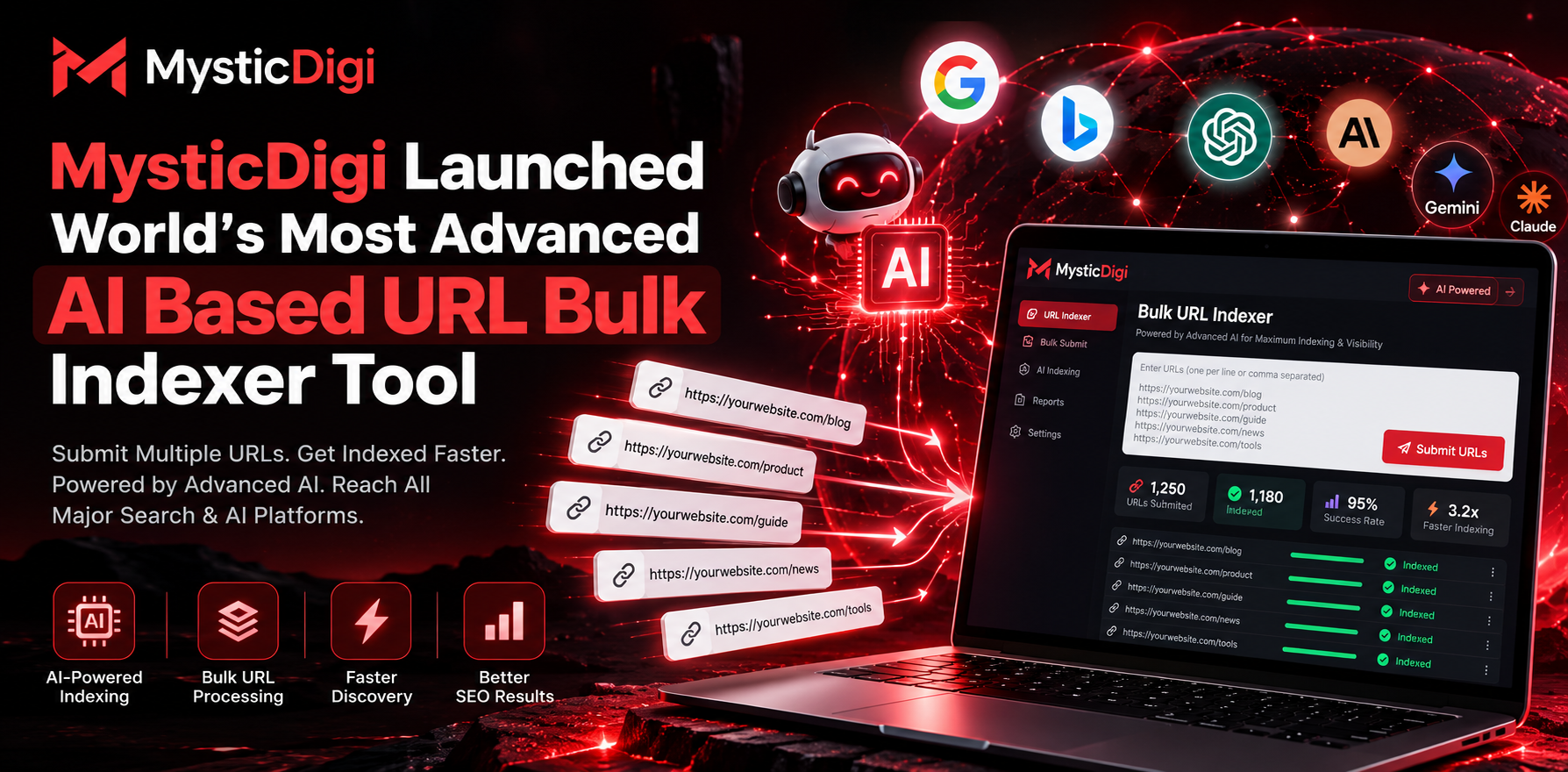
The gap between publishing a page and getting it discovered has quietly become the single biggest tax on modern SEO. In October 2026, MysticDigi officially launched its AI-powered Bulk URL Indexer Tool to close that gap, not just for traditional search engines like Google, Bing and Yahoo, but for the generative AI layer that now sits on top of the open web, including ChatGPT, Google AI Overviews, Perplexity, Gemini and Claude.
The tool is live, subscription-based, and built for the people who publish at volume: SEO agencies, guest bloggers, content marketers, digital PR teams, and in-house publishers who are tired of waiting weeks for Google to notice their work and even longer for AI systems to cite it.
You can access the tool here: https://bulkurlindexertool.com/
Over the last two years, indexing has moved from a background concern to a frontline problem. Three shifts converged, and most publishers were caught unprepared.
Google quietly tightened crawl budgets after the Helpful Content and Site Reputation Abuse updates. New sites can wait 4 to 12 weeks for pages to enter the index. Established sites still see large chunks of their fresh content sit in Discovered — currently not indexed for 30 days or longer. The Google Indexing API remains officially limited to JobPosting and BroadcastEvent schema, leaving regular blog posts, service pages, and guest contributions without a sanctioned fast lane.
Bing powers ChatGPT Search, Copilot, DuckDuckGo and Yahoo. A URL that is missing from Bing is effectively invisible to a large and growing share of AI traffic. Yet most SEO workflows still treat Bing submission as an afterthought handled manually, one URL at a time.
ChatGPT, Perplexity, Gemini, Claude and Google AI Overviews now generate billions of monthly answers, and a growing share of them cite external URLs. Being indexed in the traditional sense is no longer enough. If AI crawlers such as GPTBot, OAI-SearchBot, PerplexityBot, Google-Extended and ClaudeBot never reach a page, that page cannot be cited, recommended or surfaced inside an AI-generated answer, no matter how good its SEO scores look on paper.
MysticDigi built the Bulk URL Indexer Tool to solve all three problems from one dashboard.
MysticDigi has been running SEO campaigns for clients across India, Singapore, the UAE, the UK and the United States for years. Indexing frustrations were a daily complaint on internal calls: brand-new client blogs sitting un-indexed for a month, guest posts on reputable publications that never surfaced in Search Console, and perfectly optimized service pages that AI engines simply refused to acknowledge.
The team tried every workaround — IndexNow pings, log file nudges, internal link injections, social sharing bursts, third-party indexer scripts that quietly stopped working after each core update. Nothing scaled. Nothing accounted for AI crawlers. Nothing gave a single, verifiable view of where a URL actually stood across the search and AI ecosystem.
So MysticDigi built it in-house. After a long private beta with its own agency clients, the Bulk URL Indexer Tool is now open to the public on a subscription model at bulkurlindexertool.com.
The tool is not a repackaged submission script. It uses AI to decide how, when and where each URL should be pushed, and it covers both classical search engines and generative AI systems from a single interface.
Instead of hammering every URL through the same pipeline, the engine profiles each link — domain authority signals, content freshness, schema completeness, crawl history — and chooses the right combination of submission channels, retry intervals and priority levels. URLs that look thin or stuck get pre-flight guidance before they are submitted.
One upload pushes URLs to Google through sanctioned and verified pathways, to Bing and Yahoo through the IndexNow protocol, and to Yandex through its native submission API. No more juggling four different webmaster consoles.
Each submitted URL is also prepared and surfaced for the crawlers that feed large language models — GPTBot, OAI-SearchBot, PerplexityBot, Google-Extended, ClaudeBot, Amazonbot, Bytespider and the growing list of answer-engine agents — so the content stands a real chance of appearing inside ChatGPT answers, Perplexity citations, Google AI Overviews, Gemini responses and Claude recommendations.
Upload thousands of URLs at once via CSV, sitemap or direct paste. The queue handles rate limits, retries and verification without manual babysitting.
Every URL gets a real-time status, a verification check against each search engine, and a timestamped log that can be exported for client reports.
Pages that previously waited weeks typically enter the Google, Bing and Yahoo indexes within hours to a few days, depending on domain signals.
Content becomes discoverable to the models that power ChatGPT, Perplexity, Gemini, Claude and Google AI Overviews, increasing the probability of being cited and recommended.
No more switching between Google Search Console, Bing Webmaster Tools, Yandex Webmaster, IndexNow endpoints and ad-hoc AI-crawler accessibility checks.
A single operator can process the submission workload of an entire indexing department.
Exportable, timestamped logs end the age-old client question: did you actually submit this?
For SEO agencies, indexing has moved from a quiet operational task to a visible deliverable. Clients now ask for GEO reports, AI citation tracking and answer-engine visibility alongside traditional rankings. The Bulk URL Indexer Tool turns that from a scramble into a repeatable workflow — ingest URLs, submit to every classical and AI endpoint, verify, report.
Digital marketing teams get a measurable lever for content velocity. Campaign pages, product launches, landing pages for paid traffic and press release URLs can be pushed into the index on the same day they go live, so paid and organic efforts stop waiting for each other.
Guest bloggers invest significant effort pitching, writing and placing content on third-party publications they do not control. The single biggest frustration is watching those placements sit un-indexed, un-cited and under-performing because the host site has a slow crawl rate or a weak internal link structure.
With this tool, every published guest post can be submitted the moment it goes live, verified across Google, Bing and Yahoo, and surfaced to AI crawlers so it has a chance of being cited inside ChatGPT, Perplexity and Gemini answers. The outbound link to the author's or client's site gets discovered faster, which translates directly into faster referral authority.
Content marketing lives or dies by topical freshness. A thought-leadership piece written in response to a breaking industry development is worthless if search engines take three weeks to notice it. By then, the news cycle has moved on.
The Bulk URL Indexer Tool collapses that lag. New blog posts, long-form guides, video landing pages, podcast episode pages and newsletter archive pages can all be pushed into the discovery layer within hours. More importantly, they become eligible for citation inside AI-generated answers while the topic is still trending.
Appearing in a ChatGPT answer, a Perplexity citation or a Google AI Overview is no longer accidental. It requires that the AI crawlers specific to each system can reach the URL, parse it, and store it in the model's retrieval index. The Bulk URL Indexer Tool handles all three steps in the background: it validates crawler accessibility, submits the URL to the systems that influence AI retrieval, and verifies that the content has been picked up.
The practical outcome is that pages submitted through MysticDigi's tool are measurably more likely to be surfaced inside AI-generated answers and recommendations across the major chatbot ecosystems, which is now a traffic and authority channel in its own right.
The tool is live and open to new users at https://bulkurlindexertool.com/. Subscription plans are structured for solo bloggers, in-house marketing teams and large SEO agencies, so the entry point matches the publishing volume.
New users typically start by uploading a sitemap or a list of recently published URLs and watching the first batch move from Submitted to Verified across all engines within hours. From there, the dashboard becomes a routine part of the publishing workflow.
Free tools ping one or two endpoints and stop there. MysticDigi's tool submits across Google, Bing, Yahoo and Yandex, prepares URLs for AI crawlers like GPTBot and PerplexityBot, verifies indexing status, and gives exportable reports — a workflow free tools do not come close to matching.
The Google Indexing API is officially limited to JobPosting and BroadcastEvent URLs. It does not cover regular blog posts, service pages or guest posts, and it does not touch Bing, Yahoo or AI engines. The Bulk URL Indexer Tool covers all of them from one dashboard.
Yes. The tool is explicitly built to make URLs discoverable to AI crawlers, which is the prerequisite for being cited and recommended inside generative AI answers — something traditional indexers were never designed to do.
Those tools focus almost exclusively on Google and rely on legacy workarounds. MysticDigi's tool is AI-driven, covers all major search engines plus the AI layer, and is maintained by an active SEO agency that keeps the submission logic current with every algorithm shift.
Absolutely. The tool was built with guest bloggers and digital PR professionals in mind. You can submit any URL you want indexed, whether it lives on your own domain or on a publication you contributed to.
Submission volume is tied to the subscription plan. Plans scale from individual publishers to enterprise agencies, so the limit matches real-world publishing needs rather than throttling you after a handful of URLs the way most free tools do.
Most URLs are picked up by Google, Bing and Yahoo within hours to a few days. AI engine visibility typically follows within a similar window, far faster than waiting for organic crawl cycles.
You can create an account and start submitting URLs at https://bulkurlindexertool.com/.
 what is SEO ?
 what is off-page seo?
 what is on-page seo?
 Googles Generative AI – A Helpful Feature For Local Business Owners
 What Is a Canonical Tag..?
 What are Twitter Cards?
 What are DC Tags?
 What are Open Graph Tags?
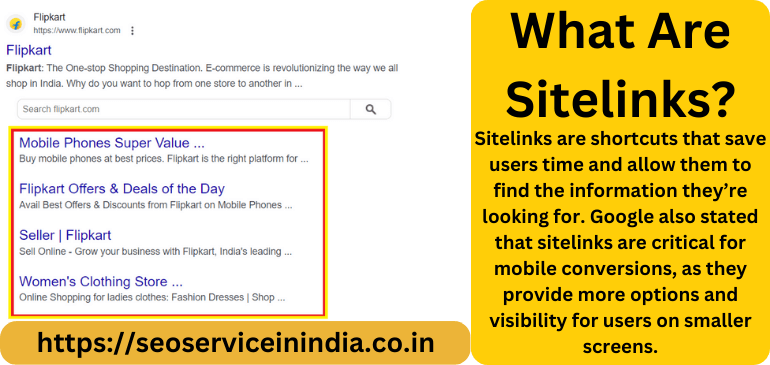 What are Sitelinks?
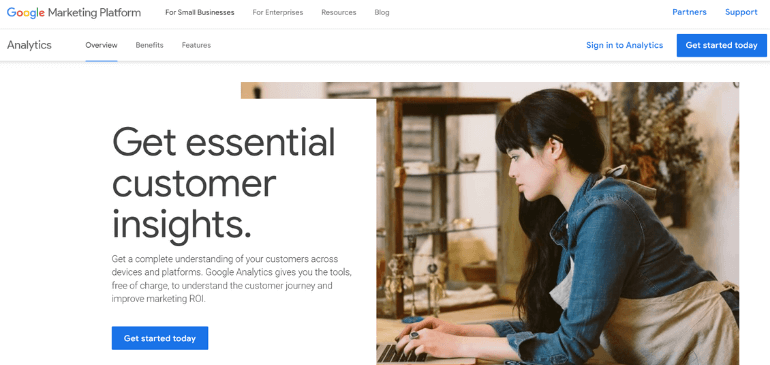 what is google analytics?
 What is Featured Snippet?
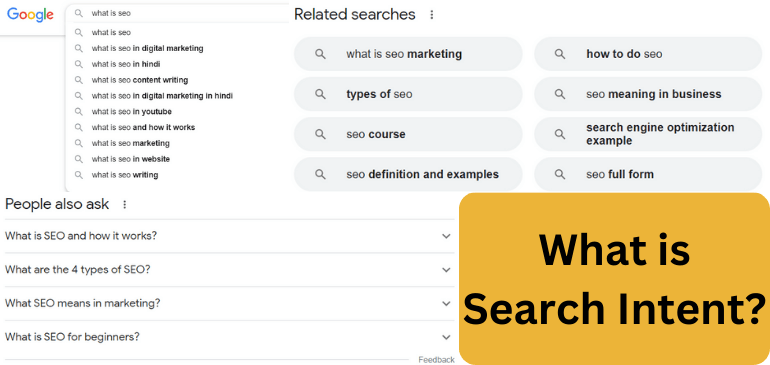 What is Search Intent?
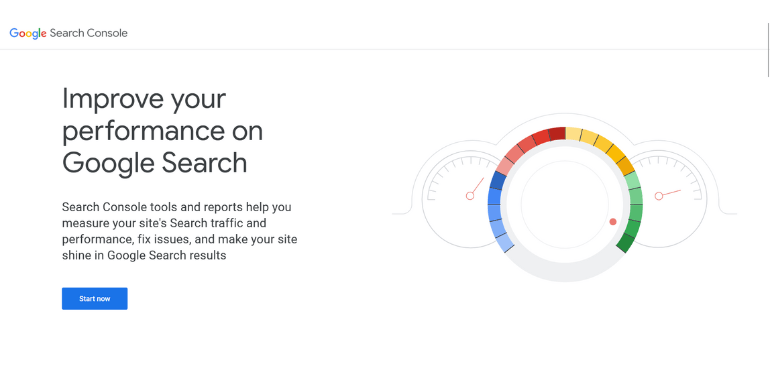 What is Google Search Console?
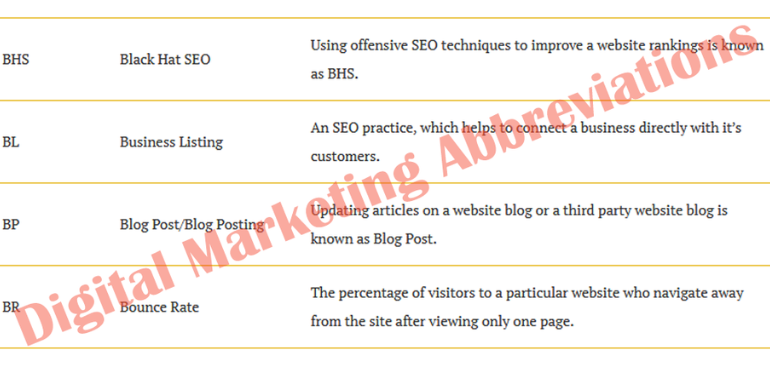 Complete List of Digital Marketing Abbreviations with Definition
 Advanced SEO Interview Questions for eCommerce Websites
 SEO Most Technical and Practical Interview Questions Ever Asked
 What is Web Spam and Types of Web Spams that Google Consider
 What is E-A-T?
 What is E-E-A-T?
 Cracking Open The Box: Demystifying The Components Of An Effective SEO Package
 Unlocking Success: Navigating the World of SEO Services
 Boosting Your Online Gaming Platform’s Success with iGaming SEO Services
 Personalize Your Search With New Features After Hidden Gem Google Algo Update
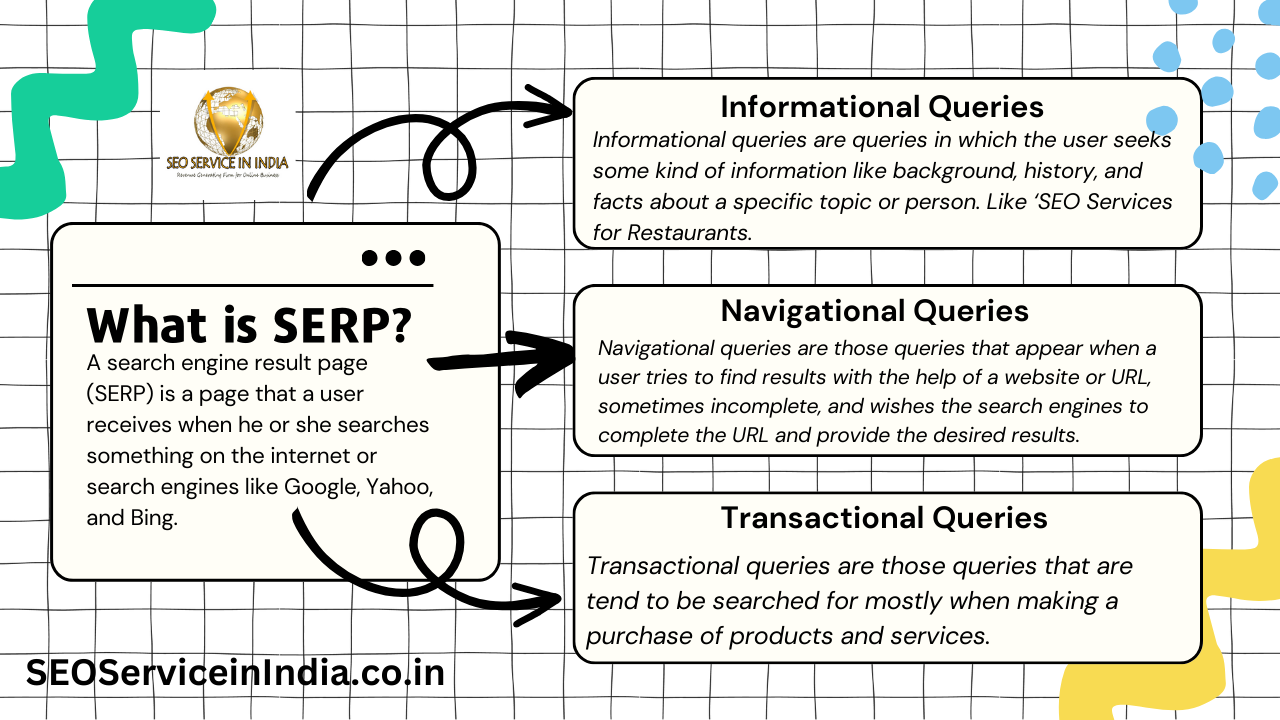 What is SERP? A Digital Search Technology
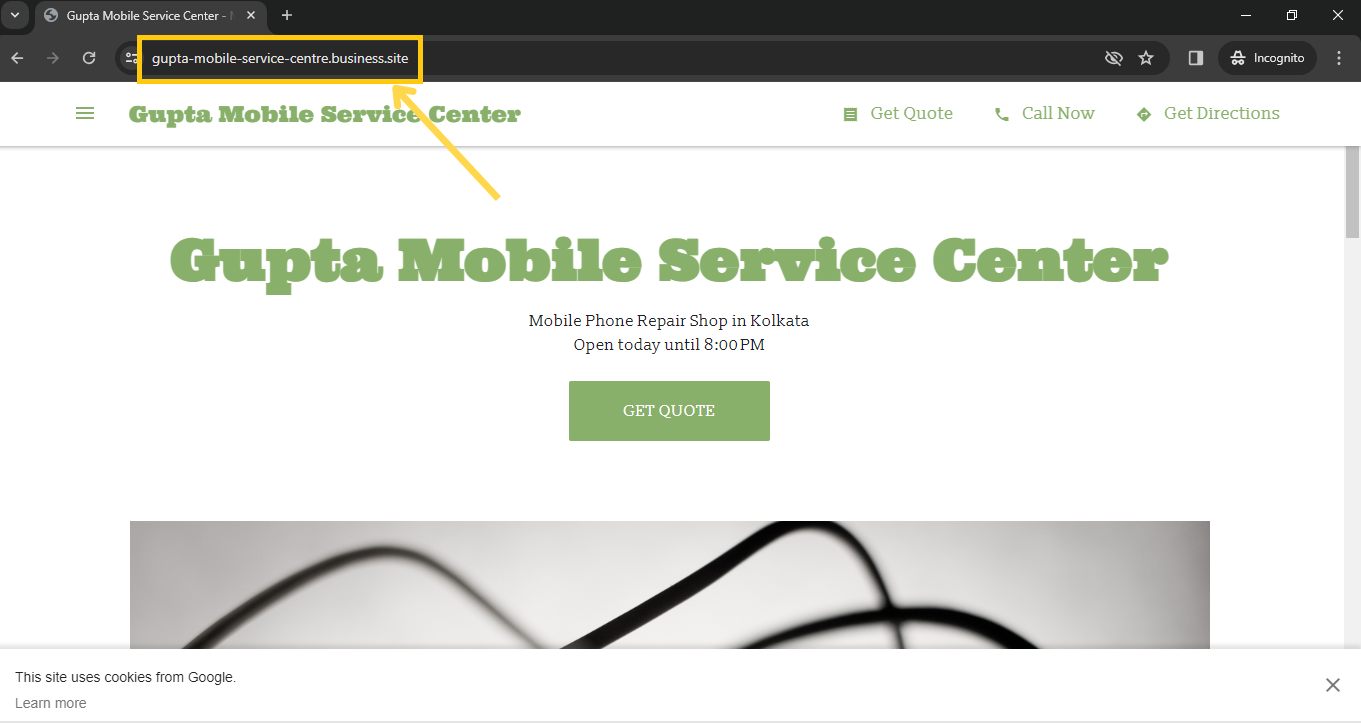 Google Shutting Down Websites Made on Business Profile
 What is Web Light Webpage Transcoding
 Google is discontinuing Web Light Webpage Transcoding.
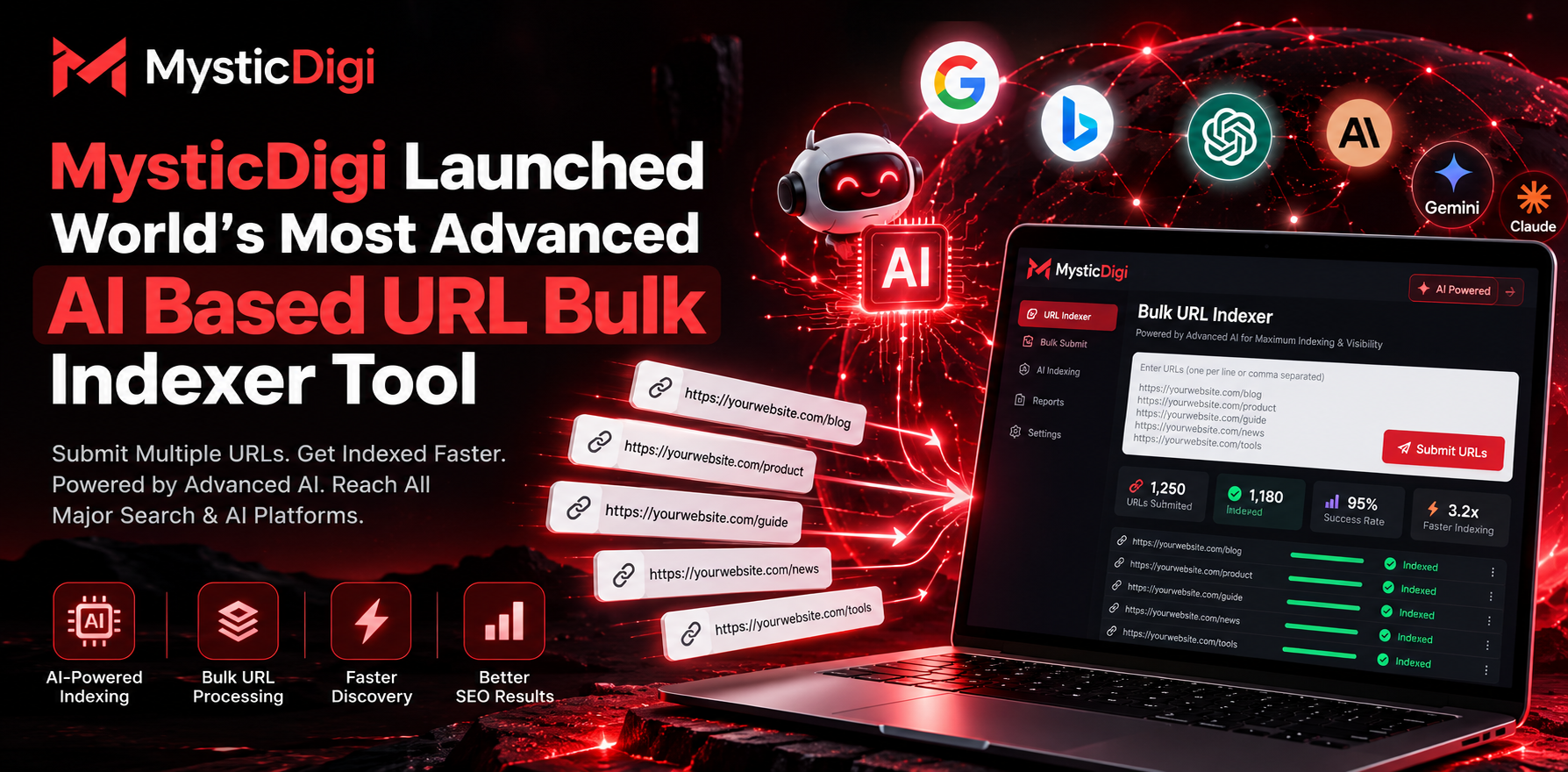 MysticDigi Launches AI-Powered Bulk URL Indexer Tool
 What is Large Photo Summary Card?
 What is twitter Player Card?
 What is Twitter App Card?
 What is Twitter summary Card?
 What are Google Ads?
 What is search Ads Campaign?
 What is Google Display Ads?
 What are Google Shopping Ads?
 What is Google Discovery Ad?
 What is PPC?
 how does PPC works?
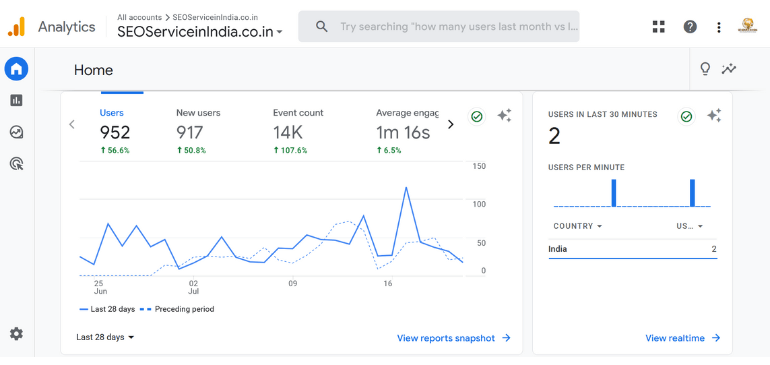 What is Google Analytics 4?
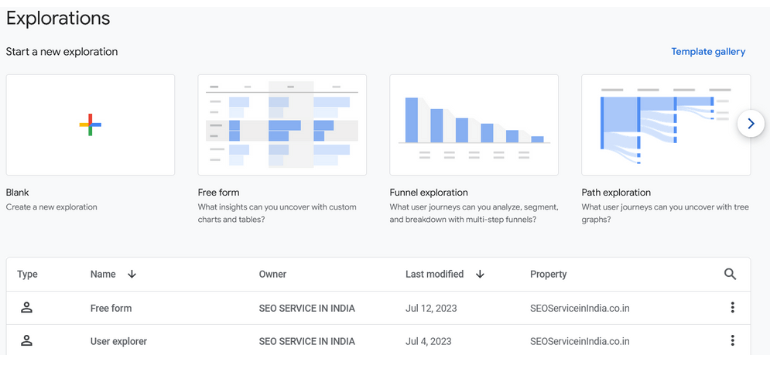 What is exploration Tab in google analytics 4
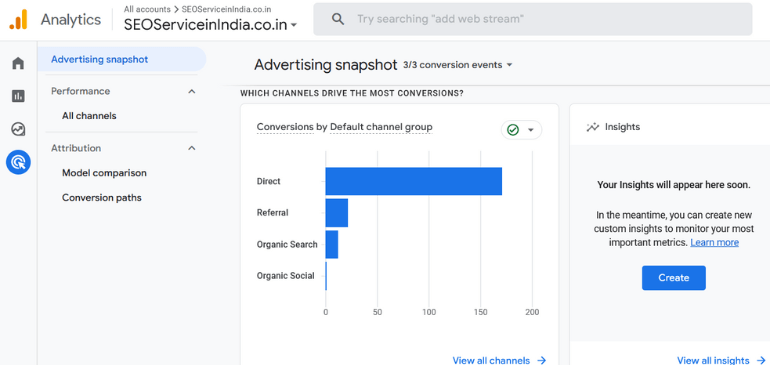 What is Advertising Tab in google analytics 4
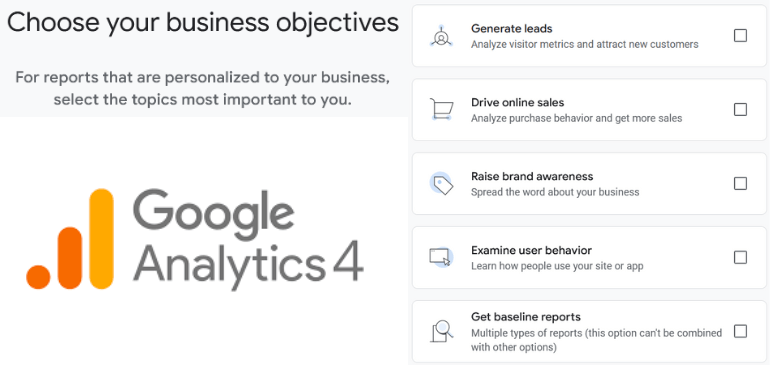 What is Business Objectives Tab in google analytics 4
 How To/ Simple Steps Change Age Group (Demographics) in Google Ads Campaigns
 How to Use ChatGPT Prompt Templates to Boost Your Content Creation
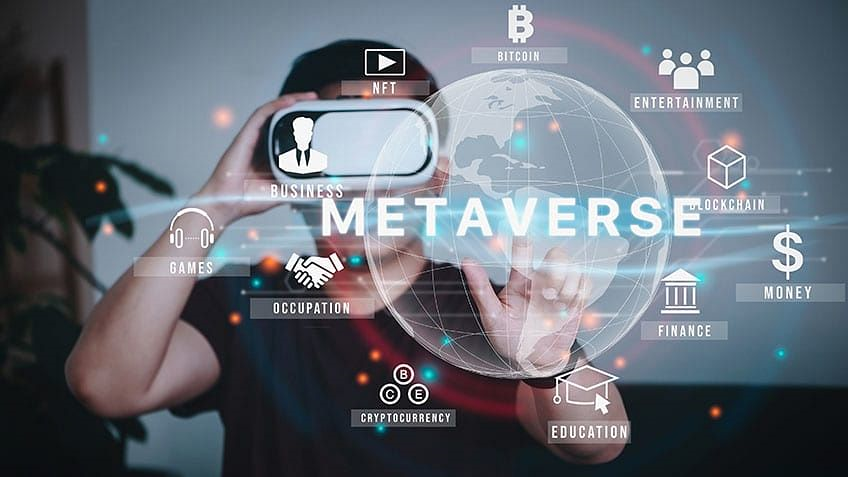 Metaverse Technology: The Future of The Internet
 Metaverse Technology: The End of Humanity
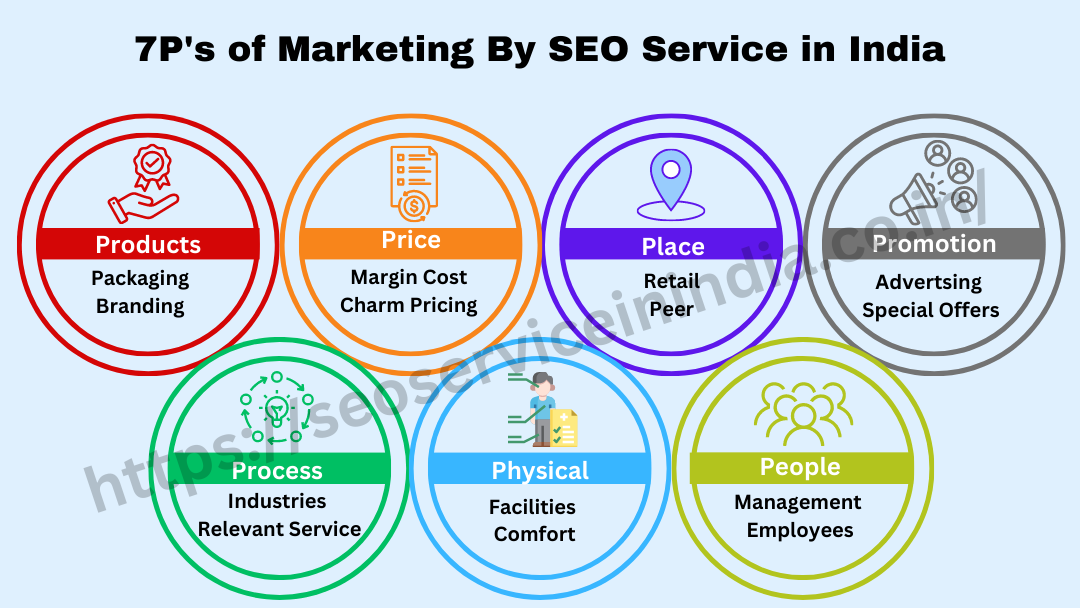 What are 7P’s of Marketing?
 what is Moz Brand Authority?
 SEOServiceinIndia Ranked As Top 10 SEO Company In Delhi For 2024
 ascending the app store ranks
 Optimizing Your App's Visibility
 YouTube's 2023 Major Updates

MysticDigi has officially launched its AI-powered Bulk URL Indexer Tool — built to push URLs across Google, Bing, Yahoo, Yandex and generative AI crawlers from a single dashboard.....

It's not every day that a company makes a leap in the SEO world, but when they do, it's a story worth telling. A bustling ....

Recently, Google announced that they are retiring their seven-year-old Web Light webpage transcoding service that....

Google is discontinuing its webpage transcoding service, which was used to speed up sites on sluggish mobile connections.....

Google is constantly innovating and developing new features and services for its users.....

There were three essentials of human life: food, clothing, and shelter, but with the developing world, now one more element has created its own space in the essentials list, i.e., the Internet. ....

Speak with our SEO Company Experts
Give us a Ring, e-Mail, WhatsApp, or Skype.